The FAQs are AI-generated, and Fortune India is not responsible for its content or any associated copyright issues.
Explained: Understanding Vedanta’s demerger math and its impact on shareholders
/ 2 min read
Under the post-demerger arrangement, Vedanta shareholders will receive one share in each of the four newly created companies for every share held in the parent entity
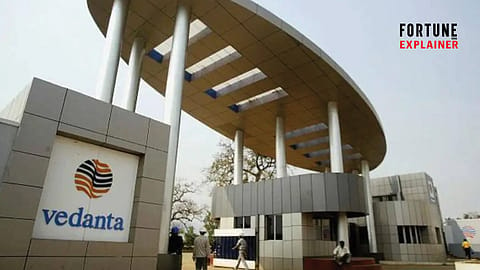
The company’s shares crossed the May 1 record date for the demerger, which coincided with Maharashtra Day, when markets were closed
Vedanta has completed its much-anticipated demerger, bringing the metal and mining major a step closer to listing its spun-off businesses. Investors are now awaiting the separate listings of these entities on the BSE and NSE.
The company has turned into five different and independent entities following the demerger, with four newly created entities. These entities are Vedanta Aluminium Metal (VAML), Vedanta Power (VPL), Vedanta Oil and Gas (VOGL), and Vedanta Iron and Steel (VISL).
However, the residual entity, Vedanta Ltd, will continue to hold key businesses, including its stake in Hindustan Zinc Ltd as well as its zinc international, copper, and ferro chrome operations.
The company’s shares crossed the May 1 record date for the demerger, which coincided with Maharashtra Day, when markets were closed.
How will shares be distributed after demerger?
Under the post-demerger arrangement, Vedanta shareholders will receive one share in each of the four newly created companies for every share held in the parent entity.
If you are a shareholder in Vedanta, you will receive one share each of VAML, VPL, VOGL, and VISL for every Vedanta share you hold while retaining your existing Vedanta share.
When will you get the shares?
The scheme became effective on May 1. The new shares are usually credited to your demat account within 30 to 45 days from the record date. Central Depository Services Ltd. (CDSL) will send you an email once the shares are credited.
What happens to your average cost?
The total investment value of a shareholder stays the same. It just gets split across five stocks. The average cost per share for each company will be adjusted based on a ratio that Vedanta will announce.
For example, if you bought 100 shares at ₹500 each (total ₹50,000) and the split is 50% to Vedanta and 12.5% to each new company, then:
Vedanta: ₹250 per share
Each new company: ₹62.50 per share
{{#most-powerful-women-snapshot-individual.slug}} {{/most-powerful-women-snapshot-individual.slug}} {{^most-powerful-women-snapshot-individual.slug}} {{/most-powerful-women-snapshot-individual.slug}} {{#showRanking}} {{current-rank}} {{/showRanking}} {{#photo.0.url}}
{{name}}
The total cost across all five holdings will still be ₹500 per share combined. Once Vedanta announces the final ratio, the demat accounts of the shareholders will get updated automatically.
Why has Vedanta decided to demerge into five companies?
The restructuring is intended to turn each business into a focused, standalone company, making it easier to attract investors interested in specific sectors, improve efficiency, and allow more targeted use of capital. It could also help reduce the long-standing conglomerate discount.
Explaining the reasoning, Agarwal said in a PTI interview in December 2025 that the demerger was preferred over asset sales or other restructuring options to fully unlock the growth potential of each business, especially at a time when demand, particularly in India, is strong and rising.
“Vedanta is like a big banyan tree. There is tremendous potential in each business, and each one of them has the potential to become a banyan tree by itself. I have a vision that each company will be as big as Vedanta in terms of revenue. Effectively, we are creating five more Vedantas, which will make shareholders the happiest,” he added.
Follow Fortune India
Frequently Asked Questions
NEXT STORY