

The FAQs are AI-generated, and Fortune India is not responsible for its content or any associated copyright issues.
Fortune India Exclusive: Kiran Mazumdar-Shaw charts Biocon’s next phase; identifies niece Claire Mazumdar as successor
/ 3 min read
Claire's brother Eric Mazumdar, husband Thomas Roberts other family members in leadership ecosystem.
THIS STORY FEATURES
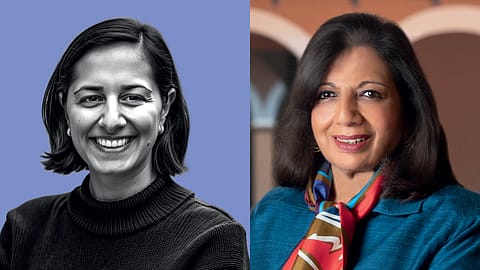
Claire Mazumdar brings strong academic and professional credentials to the role.
Kiran Mazumdar-Shaw, founder and chairperson of Biocon, has set in motion a clear succession plan as she prepares the four-decade-old group and India’s largest biotechnology enterprise for its next phase of growth—one driven by advanced biotechnology innovation and artificial intelligence.
Her chosen successor is her niece, Claire Mazumdar, a 37-year-old biotech specialist who currently serves as founder-CEO of Bicara Therapeutics, a NASDAQ-listed company incubated by Biocon.
Though no date has been fixed for Claire to take charge, she is expected to join in the foreseeable future.
“I am the sole owner of Biocon, and I need to make sure that I put it in good hands,” Mazumdar-Shaw told Fortune India in an exclusive interview. “I have seen my niece Claire as my successor, because I think she has proved to me that she can run a company.”
One of the leading figures in developing the biotechnology ecosystem in India, Mazumdar-Shaw, 73, who also built Biocon into India’s largest biotechnology company, has no children. Her late husband, John Shaw, was vice chairman of the group.
Claire Mazumdar brings strong academic and professional credentials to the role. She holds a degree in Biological Engineering from Massachusetts Institute of Technology, an MBA from Stanford Graduate School of Business, and a PhD in Cancer Biology from Stanford School of Medicine.
From the family, she will be supported by other family members in the broader leadership ecosystem, including her brother, Eric Mazumdar, a professor at California Institute of Technology and an AI expert, and her husband, Thomas Roberts, a renowned oncologist with Massachusetts General Hospital in the US, said Kiran. If other members of the family also contribute to Biocon in a meaningful way in its future growth, she would also welcome them, she added.
Mazumdar-Shaw founded Bicara Therapeutics in the US to pursue global clinical trials for a novel cancer platform focused on bi-specific antibodies—designed to both shrink and destroy tumours.
Claire Mazumdar, who previously worked with venture capital firm Third Rock Ventures and medicine development company Rheos Medicines, took over as Bicara’s CEO in 2018. The company listed on NASDAQ in 2024 at a valuation exceeding $800 million, and now commands a market capitalisation of over $1.6 billion, even as its lead cancer therapy to cure head and neck cancer remains in clinical trials. Biocon currently holds only about a 10% stake in the company, post the NASDAQ listing.
In recent months, Biocon has undertaken a sweeping organisational overhaul. It has merged its generics and biologics businesses, simplified its corporate structure, and reduced debt. The move positions the company to capitalise on its biosimilars segment, which contributes roughly 60% of revenue. With 12 products already in the market and around 20 in the pipeline, Biocon is aiming to strengthen its position as a global biosimilars leader. The merged Biocon Biologics was valued at $5.5 billion in 2025 and ranks among the world’s top five biosimilar companies by revenue.
Mazumdar-Shaw emphasised that technology will anchor future growth, with a focus on differentiated biosimilars and original biologic drugs, alongside deeper integration of AI across platforms.
{{#most-powerful-women-snapshot-individual.slug}} {{/most-powerful-women-snapshot-individual.slug}} {{^most-powerful-women-snapshot-individual.slug}} {{/most-powerful-women-snapshot-individual.slug}} {{#showRanking}} {{current-rank}} {{/showRanking}} {{#photo.0.url}}
{{name}}
As part of this transition, Shreehas Tambe, a long-time Biocon executive handpicked by Mazumdar-Shaw in 1997, took over as CEO and managing director of the merged entity from April 1.
At Syngene International, another key group company, old Biocon hand Siddharth Mittal will take over as MD and CEO from July 1, succeeding Peter Bains. Mazumdar-Shaw noted that Syngene’s contract development and manufacturing (CDMO) capabilities remain underleveraged—a gap the new leadership aims to address, alongside expanding into AI-driven research.
(For details of the succession plan and Biocon's vision for the future, read the May 2026 issue of Fortune India, out now)
Follow Fortune India
Frequently Asked Questions
NEXT STORY