Govt mandates 95 RON standard for E20 petrol from April 1; survey flags mileage impact in older vehicles
/ 3 min read
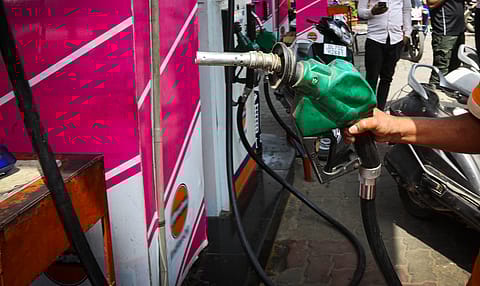
Most vehicles manufactured between 2023 and 2025 onward have been engineered or recalibrated to run on E20 fuel. | Credits: Sanjay Rawat
Govt mandates 95 RON standard for E20 petrol from April 1; survey flags mileage impact in older vehicles
The Indian government has mandated a minimum RON of 95 for E20 petrol from April 2026, raising concerns about mileage and maintenance in older vehicles. While newer models are E20-ready, older cars face challenges due to ethanol's distinct properties, potentially leading to increased wear and maintenance costs.
This summary is AI-generated, and Fortune India is not responsible for its content or any associated copyright issues.
In a notification dated February 17, Petroleum ministry directed oil marketing companies to supply E20 petrol conforming to Bureau of Indian Standards specifications while maintaining a minimum RON of 95 across all states and UTs.
Most vehicles manufactured between 2023 and 2025 onward have been engineered or recalibrated to run on E20 fuel. | Credits: Sanjay Rawat
Setting new standards for E20 petrol sold across India, the government has mandated that from April 1, 2026, ethanol-blended petrol (up to 20% ethanol) must have a minimum Research Octane Number (RON) of 95, according to a report by LocalCircles.
Higher octane fuel is more stable under compression and reduces the risk of engine knocking — a phenomenon in which fuel burns unevenly inside the engine cylinder, potentially leading to long-term engine damage.
In a notification dated February 17, the Petroleum ministry directed oil marketing companies to supply E20 petrol conforming to Bureau of Indian Standards specifications while maintaining a minimum RON of 95 across all states and Union Territories.
Compatibility concerns for older vehicles
Most vehicles manufactured between 2023 and 2025 onward have been engineered or recalibrated to run on E20 fuel. However, concerns persist for older vehicles.
Ethanol has chemical properties distinct from petrol, it absorbs moisture and can degrade rubber and plastic components over time. This increases the risk of corrosion, seal deterioration, and wear in fuel systems not designed for higher ethanol blends.
Since India mandated E20 petrol nationwide in 2025, comprising 20% ethanol blended with 80% petrol, many owners of older cars and two-wheelers, particularly those built before 2022 and calibrated for E5 or E10, have reported operational challenges. A significant proportion of petrol vehicles currently on Indian roads are not fully E20-compatible.
Mileage and maintenance issues
While policymakers position E20 as a key step toward reducing emissions and lowering crude oil imports, user experiences have been mixed.
Ethanol has a lower energy density than petrol, which can affect fuel efficiency. Although official estimates suggest a 1–6% drop in mileage, several independent user surveys indicate reductions of 10–20% in older vehicles.
Vehicle owners have taken to social media platforms to report decreased mileage, higher NVH (noise, vibration, and harshness) levels, starting troubles, and, in some cases, moisture separation in fuel tanks.
Others cite accelerated wear in fuel pumps, injectors, gaskets, seals, and fuel lines. Maintenance costs have reportedly risen due to more frequent servicing and part replacements. Some anecdotal accounts also describe reduced engine compression in motorcycles after prolonged E20 usage, though such claims lack large-scale technical validation.
With E20 now the default petrol grade in most regions, access to lower-ethanol alternatives such as E0 or E5 has become limited, leaving owners of non-compatible vehicles with fewer options and concerns about long-term durability and warranty coverage.
{{#most-powerful-women-snapshot-individual.slug}} {{/most-powerful-women-snapshot-individual.slug}} {{^most-powerful-women-snapshot-individual.slug}} {{/most-powerful-women-snapshot-individual.slug}} {{#showRanking}} {{current-rank}} {{/showRanking}} {{#photo.0.url}}
{{name}}
Automakers are adapting proactively
Automakers, however, are proactively adapting. Most models introduced from 2025 onward are fully E20-ready, incorporating ethanol-resistant materials and engine recalibration to maintain performance and efficiency.
Broader automotive trends indicate gradual diversification rather than a direct backlash. While there is no definitive trade data linking E20 to a sell-off of older petrol vehicles, diesel has retained a steady share in the passenger vehicle market.
Meanwhile, electric vehicle (EV) sales have grown rapidly, nearly 70–80% year-on-year, although EVs still account for around 4–8% of total sales depending on the segment. Hybrid adoption is also rising, driven by fuel costs, emissions goals, and long-term ownership economics rather than solely E20-related concerns.
Overall, while E20 has influenced consumer sentiment — particularly among owners of older petrol vehicles — there is no clear evidence yet of a large-scale structural shift driven exclusively by ethanol blending. The transition appears gradual, shaped by policy objectives, evolving vehicle technology, and broader market dynamics.
NEXT STORY