India flex workspace stock crosses 100 MSF; sector eyes $10 billion valuation by 2028
/ 3 min read
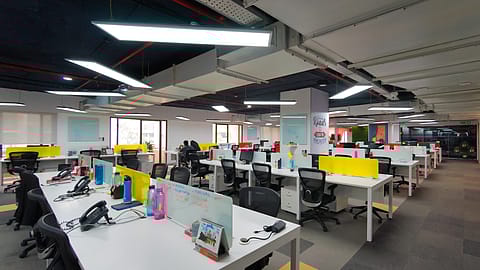
Average deal sizes have more than doubled, from 25 seats in 2023 to 53 seats in 2025, indicating rising confidence in flexible workspaces as a core real estate strategy. | Credits: IndiQube
India flex workspace stock crosses 100 MSF; sector eyes $10 billion valuation by 2028
India’s flex workspace sector has surpassed 100 million sq ft and is on track for a $9–10 billion valuation by 2028, shifting from rapid expansion to profitability-led growth. Driven by GCCs and large corporates, average deal sizes have doubled, institutional investment is rising, and multiple listed operators have turned profitable, signalling a maturing, scalable asset class.
This summary is AI-generated, and Fortune India is not responsible for its content or any associated copyright issues.
This shift is being driven by robust enterprise leasing, with Global Capability Centres accounting for nearly 40% of new seats in recent quarters.
Average deal sizes have more than doubled, from 25 seats in 2023 to 53 seats in 2025, indicating rising confidence in flexible workspaces as a core real estate strategy. | Credits: IndiQube
India’s flexible workspace sector has crossed the 100 million sq ft milestone and is poised to reach a $9–10 billion valuation by 2028, marking a transition into a profitability-led growth phase, according to the Q3 FY26 Flex Office Report by myHQ by ANAROCK.
The report highlights a strategic pivot by operators from aggressive expansion to margin discipline, supported by a surge in enterprise demand. Large corporates are now leading the sector’s growth, replacing the earlier startup-driven expansion cycle and bringing greater scale, stability, and long-term occupancy across markets.
GCCs accounting for nearly 40% of new seats in recent quarters
This shift is being driven by robust enterprise leasing, with Global Capability Centres (GCCs) accounting for nearly 40% of new seats in recent quarters. Average deal sizes have more than doubled, from 25 seats in 2023 to 53 seats in 2025, indicating rising confidence in flexible workspaces as a core real estate strategy. The BFSI sector has also significantly expanded its coworking footprint, signalling increased trust in operators’ compliance, and infrastructure capabilities.
Utkarsh Kawatra, Co-founder and CEO of myHQ, said the sector has crossed a “defining threshold,” driven by structural shifts such as rising GCC participation and larger enterprise deals. He said that flexible workspace providers are increasingly competing with conventional commercial real estate on parameters like flexibility, speed, and capital efficiency, while achieving profitability milestones.
On the supply side, operators continue to scale through large-format campus developments and expansion into Tier-1.5 and Tier-2 cities. Key markets such as Mumbai, Bengaluru, and Hyderabad saw significant desk additions during the quarter. In a notable transaction, DevX acquired a 27-storey tower in Ahmedabad, one of the largest single-tower acquisitions in the sector, underscoring growing confidence in large-scale flex infrastructure.
Emerging micromarkets to watch include Sarjapur and Hebbal in Bengaluru, Kokapet in Hyderabad, Hinjewadi in Pune, and OMR in Chennai, alongside the expanding Ahmedabad–Kochi–Indore Tier-2 corridor.
Operators are also diversifying beyond traditional workspace offerings. New on-demand products such as executive day passes and private cabins are gaining traction, while value-added services—including IT, food and beverage, parking, and fit-outs—now contribute 12–16% of total revenues. The MICE (Meetings, Incentives, Conferences, and Exhibitions) segment is emerging as a high-margin vertical, helping offset occupancy gaps and positioning flex spaces as hybrid work and experience hubs.
The report also notes rising institutional participation, with increased investments from global funds and a growing IPO pipeline. As public market dynamics evolve, consolidation is expected to accelerate, with larger operators acquiring smaller players, particularly in high-growth Tier-2 markets. The sector is also likely to shift toward profitability-based valuations rather than traditional EBITDA metrics.
Operator-level data indicates strong desk growth at IndiQube, increasing average centre sizes at Smartworks, rising revenue per member at WeWork India, and an occupancy gap at Awfis. Financial performance across these players reflects improving fundamentals, including profitability progress, revenue growth, and expansion in value-added services.
In a key milestone, multiple listed flexible workspace operators reported net profits simultaneously for the first time in Q3FY26, signalling a structural shift in the sector. WeWork India and Smartworks both posted profits during the quarter, while three of the four listed players expanded EBITDA margins year-on-year. Smartworks recorded the highest margin expansion at 490 basis points.
NEXT STORY