Iran war impact: Rising crude, natural rubber prices may push tyre costs higher, squeeze margins
/ 2 min read
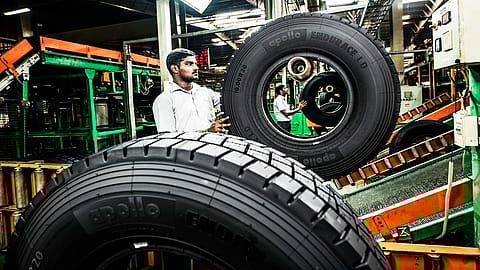
The tyre industry is the largest consumer of natural rubber in India, accounting for roughly 65–70% of total consumption. | Credits: Apollo tyres
Iran war impact: Rising crude, natural rubber prices may push tyre costs higher, squeeze margins
The ongoing rise in crude oil and natural rubber prices could significantly impact India's tyre industry by increasing manufacturing costs. As key petrochemical inputs become more expensive, tyre makers may face squeezed margins and might need to raise prices to maintain profitability, especially if geopolitical tensions continue to fuel market volatility.
This summary is AI-generated, and Fortune India is not responsible for its content or any associated copyright issues.
With crude-linked inputs and natural rubber prices trending upward, tyre manufacturers could face mounting cost pressures, potentially prompting gradual price increases across OEM and replacement markets
The tyre industry is the largest consumer of natural rubber in India, accounting for roughly 65–70% of total consumption. | Credits: Apollo tyres
Persistently high crude oil prices could eventually start weighing on the cost structure of India’s tyre industry, as key petrochemical inputs linked to oil move higher. Industry experts say sustained firmness in crude could increase the prices of derivatives such as synthetic rubber and carbon black—materials that form a significant portion of tyre manufacturing costs.
“Sustained high crude prices could eventually raise the cost of petrochemical inputs such as synthetic rubber, carbon black and other derivatives, which together account for nearly two-fifths of the industry’s raw-material cost,” says Poonam Upadhyay, Director at Crisil Ratings. “Natural rubber, which contributes another 40–45%, has also been trending higher. If these trends sustain, tyre makers could face pressure from both sides of the input structure once existing raw material inventories are exhausted.”
Petrochemical-based inputs account for nearly two-fifths of the industry’s raw-material expenses. In parallel, natural rubber—another key component that contributes about 40–45% to the overall raw-material basket—has also been trending upward. If both trends persist, tyre makers could face pressure from both ends of the input cost spectrum once existing inventories purchased at earlier prices are exhausted, according to analysts.
Synthetic rubber, imports add to the pressure
“Synthetic rubber is a crude derivative and its prices generally track crude oil movements, albeit with some lag,” says Srikumar Krishnamurthy, Senior Vice President and Co-Group Head, Corporate Ratings at ICRA Limited. He notes that natural rubber prices have historically also been influenced by crude trends, partly because India meets only about 55–60% of its domestic demand through local production, with the rest met via imports.
The tyre industry is the largest consumer of natural rubber in India, accounting for roughly 65–70% of total consumption. In developed markets, higher use of synthetic rubber in tyres—driven by climatic and road conditions—means crude-linked price movements can indirectly influence global natural rubber prices as well.
Industry flags possible price pass-through
Automotive industry executives say the evolving geopolitical landscape is adding another layer of uncertainty. “Tyres are heavily dependent on petroleum derivatives such as synthetic rubber, so any sustained rise in global crude oil prices will inevitably push tyre manufacturing costs higher,” says Uday Narang, Founder and Chairman of Omega Seiki Mobility.
According to Narang, rising energy market volatility—amplified by geopolitical tensions—could raise input costs across the automotive supply chain. If crude and natural rubber prices remain firm, tyre manufacturers may eventually consider calibrated price increases across both OEM and replacement markets to protect profitability.
Echoing a similar view, Upadhyay of Crisil Ratings says if crude remains elevated alongside firm natural rubber prices, tyre makers may eventually need to consider calibrated price increases to offset the dual raw-material pressure and protect profitability. Any revisions, if required, are likely to be implemented gradually across segments, including both the OEM and replacement markets.
NEXT STORY