'Treat AI as a digital ally': Microsoft India's Rajiv Kumar on the future of work
/ 4 min read
The initiative could affect about 8,750 employees, or roughly 7% of its US workforce. Globally, Microsoft employs around 228,000 people.
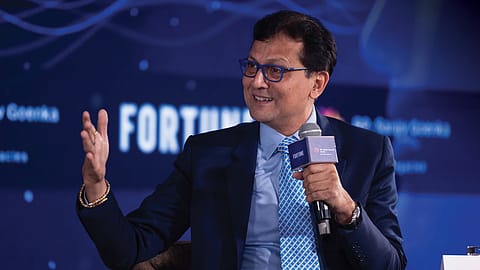
Managing Director and President Rajiv Kumar
As artificial intelligence reshapes industries and triggers workforce restructuring across the global technology sector, Microsoft India Development Center managing director and president Rajiv Kumar believes the technology will ultimately create more opportunities than it destroys, provided workers are willing to continuously learn and adapt.
In a blog published by Microsoft about the future of work and the changing nature of engineering careers, Kumar said the conversation among young professionals is already shifting from fears of job displacement to understanding how they can work alongside AI.
“When I look at where India’s technology story is headed, I see an extraordinary opening, not disruption,” Kumar said. “In every conversation I have with young engineers today, the question has shifted from ‘Will AI replace me?’ to ‘How do I collaborate with AI?’”
However, it is to be noted that his comments come at a time when the technology industry is investing heavily in artificial intelligence while simultaneously reshaping workforces. Microsoft alone laid off more than 15,000 employees during 2025 as it redirected resources toward AI and cloud infrastructure. Meanwhile in the six months of 2026, the company also introduced the first retirement buyout programme in its 50-year history, offering voluntary exits to long-serving US employees.
The initiative could affect about 8,750 employees, or roughly 7% of its US workforce. Globally, Microsoft employs around 228,000 people.
The broader industry is making an even bigger bet on AI. Alphabet, Microsoft, Meta and Amazon are expected to spend nearly $700 billion combined in 2026 to meet growing demand for AI services and infrastructure.
Yet Kumar argued that every major technology transition has eventually generated new categories of jobs. “Virtually every major technology wave in history has ultimately created more opportunities than it destroyed. The internet gave rise to roles that simply didn’t exist in 1995. AI is doing the same thing right now,” he said.
According to Kumar, new positions such as AI trainers, agent specialists and AI security experts are already emerging across Indian companies. “The real question is not whether new jobs will exist but how ready we are to step into those roles,” he added.
Skills, not job titles, will define careers
Kumar pointed to rapid changes in workforce requirements as evidence that adaptability will become a defining career advantage. The World Economic Forum’s Future of Jobs Report 2025 estimates that 39% of core job skills will change by 2030. In India, about 63% of the workforce is expected to require significant upskilling or reskilling by the same year.
Around 30% of Indian employers have already adopted skills-based hiring, significantly higher than the global average of 19%, while more than 85% of organisations worldwide are prioritising upskilling and reskilling in response to AI-driven change.
Microsoft’s own Work Trend Index 2026 report found that 66% of AI users globally say the technology enables them to spend more time on high-value work, while 58% report producing work they could not have done a year earlier. Nearly half of interactions with AI copilots are focused on analysing information, solving problems and creative thinking rather than routine execution.
{{#most-powerful-women-snapshot-individual.slug}} {{/most-powerful-women-snapshot-individual.slug}} {{^most-powerful-women-snapshot-individual.slug}} {{/most-powerful-women-snapshot-individual.slug}} {{#showRanking}} {{current-rank}} {{/showRanking}} {{#photo.0.url}}
{{name}}
“This is what the shift from command to collaboration looks like in practice,” Kumar said. He urged young engineers to treat AI as a “digital ally” and outlined three principles that will determine success in the AI era.
The first is that fundamentals matter more, not less. Engineers with a deep understanding of systems, algorithms and architecture will continue to be the ones trusted to build scalable technologies and make critical decisions.
Second, “momentum beats mastery”. Kumar said professionals must continuously experiment with new tools, iterate quickly and keep learning. The third principle is judgment. “AI can help you code; it cannot decide your goals, understand your customer, or define what matters,” he said. “That judgment, informed by experience, ethics, and empathy, is what sets great professionals apart.”
India’s AI Moment
Kumar believes these shifts place India in a particularly strong position in the global AI race.
“Our country combines an extraordinary engineering talent pool, second largest in the world, with digital ambition and the ability to innovate at scale in the age of AI,” he said.
He pointed to Microsoft’s India Development Center, the company’s largest research and development hub outside the United States, as evidence of the country’s growing role in shaping global technology. The Hyderabad-based centre has operated for 27 years and contributes to products and innovations used worldwide.
“The teams here aren’t adapting to the future; they are helping shape world-class innovation, not as participants, but as architects,” Kumar said.
For engineers entering the workforce, he said traditional career paths are giving way to continuous learning and reinvention. The strongest signal in the AI era, he argued, is not a perfect résumé but proof that an individual is still learning, building and adapting.
“With strong fundamentals, a bias for action, and the judgment to know what actually matters, they can be a driver of innovation in an AI-powered world, not a passenger watching it happen.”
So far, Microsoft has largely spared its India operations from widespread, company-wide job cuts, despite rolling out global restructuring and layoffs that impacted divisions such as Xbox and LinkedIn.
NEXT STORY