
Fortune India Startup Summit: You can have all the technology, but if people are not skilled, it is useless, says Microsoft’s Rajiv Kumar
ADVERTISEMENT
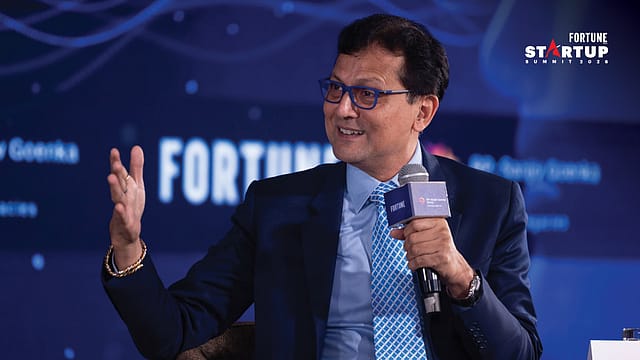
India’s generative AI story is less about building large language models (LLMs) and more about how effectively they are being used, said Rajiv Kumar, Managing Director & President, Microsoft India Development Centre, at the Fortune India Startup Summit held in Bengaluru on Thursday. For the tech giant, the focus is on three areas—infrastructure, skilling, and enterprise adoption—in India, he added. “You can have all the technology, but if people are not skilled, it is useless,” Kumar said, adding that the company aims to train 20 million people, including 2 million educators.
"Satya Nadella’s visits to India and Microsoft’s total commitment of over $20 billion reflect how important this market is for us," he said. Kumar also highlighted that the real success in AI disruption will come from diffusion. “90% of the conversation is about LLMs. But an LLM is not the product—it is an enabling technology. The real success will come from diffusion,” Kumar said, pointing to the growing adoption of AI across sectors.
He said that India’s approach does not necessarily require building full-scale LLMs immediately. “You don’t always need a large model. You can use Indic models for interaction, translate, call a larger model, and translate back. For example, a user speaks in Telugu, the system translates it, processes it using a larger model, and translates the response back. That allows you to build localised solutions without massive upfront investment.”
While concerns remain around India not having a sovereign LLM yet, Kumar argued that the gap is not structural. “Are we behind? Yes. But can we catch up? Absolutely,” he said, noting that companies such as Krutrim, Sarvam, and Bharat.ai are already building smaller, specialised models. He attributed the current lag largely to computational constraints. “We are limited by GPUs. If I had one GPU, I could sell it today,” he said, adding that this is a temporary bottleneck. Kumar also highlighted the role of government intervention through the India AI Mission, which is enabling access to compute. “About 34,000 GPUs are available today at fractional cost... [we] intend to scale this to between 50,000 and 200,000,” he said.
Meanwhile, what stands out is India’s developer momentum. According to Kumar, India already has around 27 million developers on GitHub, making it the second-largest base globally. “In the next two to three years, we are going to overtake the U.S.,” he said, adding that India is also number two in terms of AI projects and could soon take the top spot.
On sovereign AI, Kumar said the push is being driven as much by geopolitics as by cultural context. “Countries don’t want a ‘kill switch’ to be controlled by someone else,” he said. At the same time, there is a growing need to ensure that local history and languages are accurately represented in AI systems, rather than relying on models trained largely on English-language data.
He also highlighted the role of large-scale public platforms as examples of AI diffusion. The government’s e-Shram platform has onboarded over 300 million informal workers, using AI to match jobs and skills, while eSanjeevani has enabled over 410 million telemedicine consultations. In the private sector, Apollo Hospitals is using AI as a “co-pilot” for doctors, leading to “20–30% efficiency gains”.
For enterprises, however, adoption is still tempered by concerns around flexibility and control. “The biggest risk is getting locked into one model,” Kumar said. For this, Microsoft’s strategy, he added, is to offer model choice. “Every model is better at something. The idea is to use the best model for the right scenario,” he said, pointing out that its platforms support thousands of models, including those from OpenAI and Anthropic.
According to Kumar, the competitive edge will come from data. “Most models are trained on public data. The real question is how you customise them using your own data without exposing it,” he said.