Noel vs. Chandra: Air India is key pain point as FY26 losses surge 10X of estimates
/ 3 min read
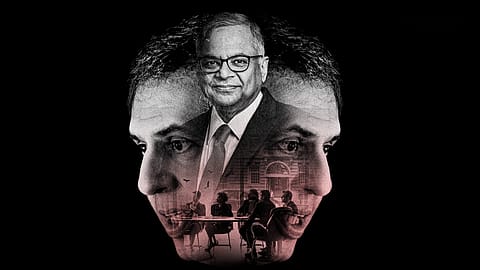
Credits: Anirban Ghosh
Noel vs. Chandra: Air India is key pain point as FY26 losses surge 10X of estimates
Tata Group’s Air India has become the biggest flashpoint between Tata Trusts chairman Noel Tata and Tata Sons chairman N. Chandrasekaran, as FY26 losses are set to soar past ₹21,000 crore—ten times budgeted estimates. The airline’s deep financial stress, and CEO Campbell Wilson’s resignation are intensifying concerns over strategy, governance and the group’s capital allocation priorities.
This summary is AI-generated, and Fortune India is not responsible for its content or any associated copyright issues.
Tata Digital losses also in focus; cumulative losses of select firms seen at around ₹30,000 crore ahead of June board meeting
THIS STORY FEATURES
Credits: Anirban Ghosh
Tata Group-owned airline Air India has emerged as a major pain point for Tata Sons, with the airline expected to end FY26 with a humongous loss of upward of ₹21,000 crore. This has become one of the key points of concern in the boardroom tensions between Tata Trusts chairman Noel Tata and Tata Sons chairman Natarajan Chandrasekaran.
According to Tata Group sources, while Noel Tata has raised concerns about the mounting losses in some businesses of the group—among them Tata Digital, Tata Electronics and Tejas Networks, it is Air India which is the biggest area of concern owing to the sheer size of the losses it is grappling with. In fact, while the losses for the year were budgeted at over ₹2000 crore, the actual losses being expected for the fiscal are ten times that estimate.
“Air India is clearly a huge problem for the group, even as steps have been taken to improve the quality of service. It is also true that the airline saw a tragic air crash but even so, the massive losses indicate a deeper problem in the airline which the management needs to fix urgently,” a source told Fortune India.
The crisis at the airline has acquired a new dimension with the resignation of managing director and chief executive Campbell Wilson. Chandrasekaran, who has passionately been working on Air India ever since the Tata Group made the bold acquisition in January 2022, will now have to find Wilson’s successor while working on a revival plan. That the year would end with a record loss was evident even with the nine-month number indicating losses of over ₹16,000 crore, the sources said.
In a statement following the announcement of his exit, Wilson referred to the acquisition and merger of four airlines, apart from modernization of systems and deployment of elevated service standards. However, that does not seem to have been enough for the airline which is now staring at an uncertain future. The development comes amidst the backdrop of the airline having placed a record order of 570 new aircraft.
Mounting losses in some businesses
According to estimates available with Fortune India, the cumulative losses on account of Air India and other loss-making ventures—among them Tata Digital, Tata Electronics and Tejas Networks—work out to upward of ₹30,000 crore. Tata Digital clocked losses of around ₹3,700 crore in the nine-month period in FY26, while the year is expected to end with losses of over ₹5,000 crore. Tata Neu, the super app which was expected to become a major success for the group, has not yielded the desired results. Bigbasket’s losses have also contributed significantly to the overall Tata Digital figure, while the group has invested heavily in it. The Tata Electronics story is also significant, since it was budgeted to return a ₹450 crore profit but is set to end FY26 with losses of nearly ₹3000 crore. Tejas Networks’ losses are also estimated at close to ₹1000 crore for the fiscal.
In the previous Tata Sons board meeting held on February 24, Noel Tata had sought a clear roadmap from Chandrasekaran on how he plans to contain these losses, and tied this to his extension for a potential third term. Chandrasekaran’s current term ends in February 2027. Chandrasekaran himself sought a deferment of a decision on the extension, seeking unanimity between the Tata Trusts and Tata Sons.
What will happen at the next Tata Sons board meeting?
Given these dynamics, the next board meeting of Tata Sons, slated for June, assumes significance since Noel Tata would be keen to see whether Chandrasekaran comes up with a loss-containment plan. “However, it is entirely possible that nothing major happens in the June board meeting,” a Tata Group insider said, indicating that things may be in limbo for some more time.
Noel Tata has also sought a clear commitment from Chandrasekaran that Tata Sons will stay private and not get listed. An application for this has already been filed by Tata Sons with the Reserve Bank of India though RBI has not responded to the request yet. The other “condition” put forward by Noel Tata is that Chandrasekaran should work towards finding a solution to the vexed issue of the Shapoorji Pallonji (SP) Group’s 18.4% stake, given the SP Group is wanting to partly monetise this holding given the leverage issues it is facing.
(For more details on the Tata Sons listing issue and the boardroom tensions, read the April 2026 issue of Fortune India, out now)
Follow Fortune India
NEXT STORY