Office market in India sees vacancy fall below 14% for first time since pandemic; rents cross ₹100/sq. ft: Cushman & Wakefield
/ 3 min read
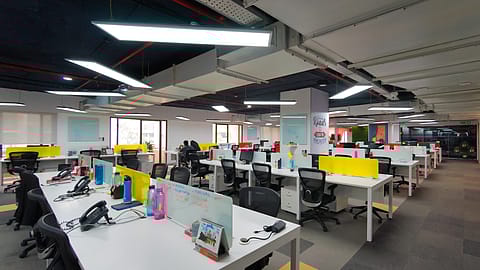
Market conditions are increasingly turning landlord-favourable, particularly in high-quality office micro-markets, and this trend is expected to persist through 2026.
Office market in India sees vacancy fall below 14% for first time since pandemic; rents cross ₹100/sq. ft: Cushman & Wakefield
India’s office market strengthened in Q1 2026 as vacancy across the top eight cities fell to 13.85%, dipping below 14% for the first time since the pandemic amid strong leasing and sharply lower new supply. Bengaluru and Mumbai led the tightening, while pan-India average office rents crossed ₹100 per sq. ft per month, signalling increasingly landlord-favourable conditions.
This summary is AI-generated, and Fortune India is not responsible for its content or any associated copyright issues.
Among key markets, Bengaluru continued to report sub-8% vacancy, with select micro-markets as low as 2%.
Market conditions are increasingly turning landlord-favourable, particularly in high-quality office micro-markets, and this trend is expected to persist through 2026.
India’s office real estate market sustained its momentum in Q1 2026, with vacancy levels tightening further amid strong occupier demand and a sharp slowdown in new supply across major cities, according to Cushman & Wakefield’s latest Office MarketBeat report.
Average vacancy across the top eight cities declined to 13.85%, down about 48 basis points quarter-on-quarter and 191 basis points year-on-year. This marks the first time since the pandemic that vacancy has fallen below the 14% threshold, extending a streak of 11 consecutive quarters of compression.
Bengaluru, Mumbai lead tightening trends
Among key markets, Bengaluru continued to report sub-8% vacancy, with select micro-markets as low as 2%. Mumbai also entered a single-digit phase with overall vacancy at around 9%, while prime business districts recorded sub-3% vacancy. Other cities such as Chennai, Pune and Kolkata also saw further tightening during the quarter.
The decline in vacancy was driven by steady leasing activity across sectors and a significant fall in new supply. Fresh completions stood at 8.8 million square feet (MSF) in Q1, down 43% sequentially and 18% year-on-year, largely on project delays. Bengaluru, Delhi NCR, and Chennai together accounted for the bulk of new supply while Pune, Hyderabad, and Kolkata saw no new completions, aiding faster absorption of vacant stock.
Rents cross ₹100/sq. ft for first time
With supply tightening and demand holding firm, rental growth gathered pace. The pan-Indian stock-weighted average rent crossed ₹100 per sq. ft per month for the first time. Hyderabad led the gains with nearly 12% annual growth, followed by Delhi NCR at around 10% while Chennai and Mumbai recorded approximately 6% increases each.
Market conditions are increasingly turning landlord-favourable, particularly in high-quality office micro-markets, and this trend is expected to persist through 2026.
Gross leasing volume (GLV) stood at around 22 MSF in Q1 2026, marking a 13% year-on-year increase and remaining well above the quarterly average since early 2023. Mumbai emerged as the top performer, recording a record 6.6 MSF of leasing, largely driven by renewals. Bengaluru and Hyderabad followed with 5.13 MSF and 3.15 MSF, respectively.
Global Capability Centres (GCCs) remained the key demand driver, accounting for nearly 40% of total leasing at around 8.7 MSF, up 38% year-on-year and the second-highest quarterly volume on record.
Sector-wise, IT-BPM led demand with a 23% share, followed by BFSI at 21%. Flexible workspace operators accounted for about 18%, while engineering and manufacturing firms contributed roughly 15%, highlighting a diversified demand base.
Net absorption stood at 11.51 MSF, declining 28% quarter-on-quarter and 24% year-on-year, primarily due to softer fresh leasing after a strong end to 2025 and slower supply completions, which delayed the conversion of pre-committed demand into occupied space.
Outlook remains resilient
Commenting on the outlook, Anshul Jain of Cushman & Wakefield said demand remains robust, with GCCs continuing to play a pivotal role in driving leasing activity. While around 61 MSF of new supply, largely premium Grade A+, is expected in 2026, strong absorption and pre-commitments are likely to keep vacancy levels broadly stable.
{{#most-powerful-women-snapshot-individual.slug}} {{/most-powerful-women-snapshot-individual.slug}} {{^most-powerful-women-snapshot-individual.slug}} {{/most-powerful-women-snapshot-individual.slug}} {{#showRanking}} {{current-rank}} {{/showRanking}} {{#photo.0.url}}
{{name}}
Veera Babu of the firm added that occupiers are increasingly prioritising high-quality, future-ready office spaces, reinforcing tight vacancy conditions in core business districts.
Despite global uncertainties, including geopolitical tensions in West Asia, the underlying demand for office space in India remains resilient, though the pace of expansion could see some near-term moderation.
Follow Fortune India
NEXT STORY