The FAQs are AI-generated, and Fortune India is not responsible for its content or any associated copyright issues.
PM Modi elevates India-Norway ties to Green Strategic Partnership; $100-bn EFTA investment, 30 business MoUs in focus
/ 3 min read
The commercial architecture of the visit rests on the India-EFTA Trade and Economic Partnership Agreement (TEPA), which came into force on October 1, 2025, after being signed in March 2024 following 16 years of negotiations.
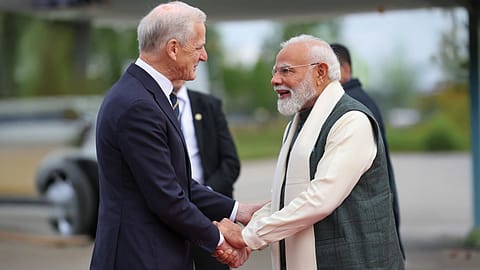
Norway Prime Minister Jonas Gahr Støre and Prime Minister Narendra Modi
Prime Minister Narendra Modi and his Norwegian counterpart Jonas Gahr Store on Monday expanded bilateral ties to a Green Strategic Partnership, unlocking a range of agreements spanning clean energy, maritime security, digital health, space cooperation and the blue economy — as India pushes to convert the momentum from its historic trade pact with Europe into concrete economic outcomes.
The commercial architecture of the visit rests on the India-EFTA Trade and Economic Partnership Agreement (TEPA), which came into force on October 1, 2025, after being signed in March 2024 following 16 years of negotiations. Under TEPA, the four-nation European Free Trade Association — Norway, Switzerland, Iceland and Liechtenstein — has collectively pledged $100 billion in foreign direct investment into India over 15 years: $50 billion in the first decade, and another $50 billion in the following five years, with an estimated 1 million direct jobs as the accompanying employment target. PM Modi called it "a blueprint for ensuring shared progress and prosperity" between India and Norway.
India-Norway bilateral trade, while modest in absolute size, has been growing steadily. India's merchandise exports to Norway rose from $270 million in 2014 to $439 million in 2025, while services exports reached $876 million in 2024. Total India-EFTA trade hit $24.4 billion in 2024-25, with Norway ranking as the 33rd largest investor in India with bilateral trade at $1.1 billion. Under TEPA, more than 99% of Indian exports now enter EFTA markets duty-free, benefiting textiles, engineering goods, chemicals and IT services.
Deals on the table
A business roundtable attended by both Prime Ministers and Crown Prince Haakon saw the signing of 30 business MoUs, the broadest commercial engagement between the two countries to date. Store confirmed an MoU on "developing high-tech quality health services, closer cooperation on digital health, artificial intelligence, research and health technology." An ISRO-Norwegian Space Agency MoU was also formalised to deepen collaboration on Arctic science, climate monitoring and ecosystem protection.
Both sides signed a triangular development cooperation agreement to leverage India's digital public infrastructure for human development in Global South countries — a framework that could extend models like UPI and Aadhaar to new markets. Norway also formally joined the Indo-Pacific Oceans Initiative, signalling Oslo's willingness to play a role in maritime security and the blue economy alongside India.
Norges Bank angle
The investment dimension of the visit carries significant market context. Norges Bank, which manages the world's largest sovereign wealth fund with assets exceeding $2 trillion, is currently India's second-largest foreign portfolio investor (FPI), with holdings valued at approximately ₹1.42 lakh crore as of mid-2025 — having tripled in value since 2022. Its largest India bets include HDFC Bank (stake worth $2.04 billion), Bharti Airtel ($1.17 billion) and Infosys (over $1 billion). Earlier this year, the fund's Finance Minister Jens Stoltenberg told FM Nirmala Sitharaman that "India's economic growth offers lots of opportunities to invest and grow," with sovereign wealth and pension fund flows through TEPA identified as a priority channel.
Store said the visit was important because "in times of uncertainty and rapid changes, polarisation and conflicts, it is important to strengthen and build contacts with countries with whom we share fundamental values." Modi echoed this, saying both countries believe in a "rules-based order, dialogue and diplomacy," and that "no issue can be resolved through military conflict." He added that India and Norway agreed on the need to reform global institutions and eliminate terrorism in all its forms — a pointed reference to Norway's solidarity with India after the Pahalgam attack, for which PM Modi expressed "heartfelt gratitude."
The PM summed up the strategic intent: "From the Arctic to outer space, from green shipping to the blue economy, from energy security to food security, our cooperation is reaching new frontiers."
Frequently Asked Questions
NEXT STORY