Real estate capital markets rebound in FY26; deal activity at 7-year high: Anarock
/ 3 min read
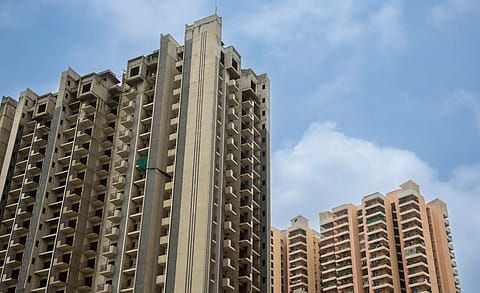
The number of deals rose sharply to 60, the highest in seven years, up from 41 transactions in FY25. | Credits: Sanjay Rawat
Real estate capital markets rebound in FY26; deal activity at 7-year high: Anarock
India’s real estate capital markets rebounded strongly in FY25-26, with total deal value rising to $4.3 billion, up 13% over FY23-24 and 16% over FY24-25, Anarock Capital’s FLUX FY26 report shows. Activity hit a seven-year high of 60 deals, driven by broader participation across asset classes, rising domestic capital and a shift from concentrated mega-deals to more balanced, city-specific investments.
This summary is AI-generated, and Fortune India is not responsible for its content or any associated copyright issues.
The sector recorded total deal value of $4.3 billion during the year, marking a 13% increase over FY23-24 and a 16% rise compared to FY24-25.
The number of deals rose sharply to 60, the highest in seven years, up from 41 transactions in FY25. | Credits: Sanjay Rawat
India’s real estate capital markets staged a strong recovery in FY25-26, rebounding from two years of subdued activity to reach levels last seen in FY21-22, according to Anarock Capital’s FLUX FY26 Annual Edition.
The sector recorded total deal value of $4.3 billion during the year, marking a 13% increase over FY23-24 and a 16% rise compared to FY24-25. The recovery was driven by a broader and more balanced deal environment, with increased participation across asset classes and investors.
“India's real estate capital markets have transitioned from a phase of concentration and caution to one of breadth and conviction,” said Shobhit Agarwal, CEO of Anarock Capital. He added that the market is deepening, with more deals, participants and asset classes despite a challenging global backdrop.
Large transactions dominate activity
Unlike previous years, where large transactions dominated activity, FY26 saw a more distributed flow of capital. The largest deal accounted for just 9% of total deal value, compared to 37% in FY24 and 41% in FY25, indicating a structural improvement in market depth.
The number of deals rose sharply to 60, the highest in seven years, up from 41 transactions in FY25. Average deal size declined to $71 million, reflecting wider participation across a broader range of ticket sizes rather than reduced investor appetite.
Equity remained the preferred investment route, accounting for 77% of total deal value, a return to long-term trends after a distortion in FY25 due to a large hybrid transaction. Debt made up the remaining 23%, with no hybrid deals recorded during the year.
Commercial office assets emerged as the top-performing segment, attracting $1.6 billion across 14 deals, with an average deal size of around $116 million, up from the previous year. Strong demand led by Global Capability Centres (GCCs) continued to support investor confidence.
Domestic investors also increased their presence in the office segment, traditionally dominated by foreign capital.
Retail real estate made a notable comeback, contributing 9% of total deal value after minimal activity in the previous two years. A key transaction was Blackstone’s $377 million acquisition of South City Mall in Kolkata, the largest equity deal of the year, signalling renewed institutional interest in consumption-driven assets.
The residential segment remained stable, with 26 institutional deals and an average deal size of about $25 million. Strong bank lending growth continues to provide developers with cost-effective financing alternatives, although institutional capital remains active for established players.
The industrial and logistics segment saw its share decline to 10% from 47% in FY25, though investor interest remains intact, supported by e-commerce demand and the evolution of warehouses into technology-enabled fulfilment hubs.
{{#most-powerful-women-snapshot-individual.slug}} {{/most-powerful-women-snapshot-individual.slug}} {{^most-powerful-women-snapshot-individual.slug}} {{/most-powerful-women-snapshot-individual.slug}} {{#showRanking}} {{current-rank}} {{/showRanking}} {{#photo.0.url}}
{{name}}
A key trend during the year was the rising share of domestic capital. Foreign investors’ contribution declined from 82% in FY22 to 52% in FY26, while domestic investors’ share increased from 15% to 38%. In absolute terms, domestic investments reached $1.64 billion—the highest in at least seven years.
This shift is being driven by rising domestic wealth, improved transparency and growing confidence in real estate as an asset class.
NCR leads city-wise activity
At the city level, NCR accounted for the highest share of deal activity at 23%, followed by Mumbai Metropolitan Region (17%), Bengaluru (13%), and Chennai (9%). Kolkata’s share rose sharply to 9%, supported by the South City Mall transaction. Multi-city deals across India fell sharply to 18% from 50% in FY25, indicating a more targeted, city-specific investment approach.
Follow Fortune India
NEXT STORY