Skyroot gears up for ‘Vikram 1’ rocket launch, sees big opportunities in telecom sector
/ 2 min read
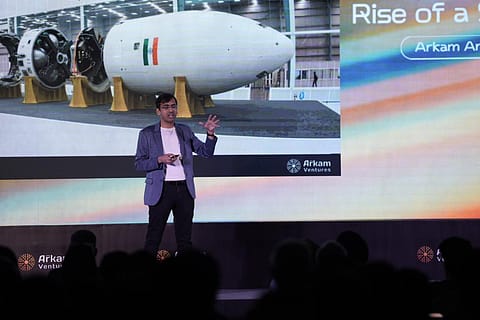
Pawan Kumar Chandana, co-founder and CEO of Hyderabad-based Skyroot Aerospace.
Skyroot gears up for ‘Vikram 1’ rocket launch, sees big opportunities in telecom sector
Skyroot Aerospace, led by CEO Pawan Kumar Chandana, is gearing up for the launch of Vikram-1, India's first private sector rocket, with expectations of revolutionising telecommunications and AI-driven data centers. The launch, anticipated in the next few months, marks a significant step in India's burgeoning space economy, projected to grow from $13 billion to $40 billion by 2030.
This summary is AI-generated, and Fortune India is not responsible for its content or any associated copyright issues.
With the launch schedule likely to be finalised in the coming weeks, Skyroot Aerospace expects demand to take off significantly in at least two key segments in the near future.
Pawan Kumar Chandana, co-founder and CEO of Hyderabad-based Skyroot Aerospace.
Ahead of the much-awaited launch of the country’s first private sector rocket, Pawan Kumar Chandana, co-founder and CEO of Hyderabad-based Skyroot Aerospace, sees big opportunities emerging in the telecommunications sector as well as in AI-driven data centres in the near future.
Skyroot anticipates high demand from telecommunications payloads
With the required clearances for the launch expected to be finalised by the Indian National Space Promotion and Authorization Centre (IN-SPACe) in the coming weeks, the company expects the launch of Vikram‑1 within the next two to three months. The firm is anticipating strong demand from telecommunications payloads in the future. The Vikram-1 rocket, currently in the final stages of launch preparation, has been built using about 95% indigenous components, light weight carbon materials and 3D printing.
Speaking at the annual meet of early-stage venture capital firm Arkam Ventures, an early backer of the company, Chandana said Skyroot Aerospace is targeting a future where launch frequency could scale from one launch a month to multiple launches in a single day. While opportunities such as space mining and space tourism may open up over the long term, given the trajectory of private space technology companies globally, he said AI-driven data centres in space could become a reality much sooner.
“Some GPS clusters have already been launched right now, and Space X has announced in the next five years they will put a large number- because that's where everybody knows is the largest thing. Since it is still in the establishment phases, I think everybody will eventually do it,” Chandana added. According to recent reports China’s Aerospace Science and Technology Corporation is looking to put gigawatt-class digital infrastructure in orbit in the next 5 years.
A recent India Spacetech 2026 report by Arkam Ventures estimates that the country’s space economy could grow at nearly twice the pace of the global market, expanding from the current $13 billion to almost $40 billion by 2030. The growth is expected to be driven by companies offering solutions centred on cost-efficient engineering, strong manufacturing capabilities, and a new generation of startups developing advanced space technologies for global customers.
300 space-tech startups have emerged in India
Highlighting the rapid expansion of the ecosystem, the report said nearly 300 space-tech startups have emerged in India over the past five years. It also pointed out that access to facilities of the Indian Space Research Organisation (ISRO) and technology transfer initiatives have provided a significant boost to the sector, helping startups reduce development timelines and lower the cost of bringing products to market.
Rahul Chandra, Managing Director, Arkam Ventures, said, “We foresee five Indian startups feature among the world’s top 10 companies in vehicle launch, situational awareness, earth observation satellite manufacturing, and space debris handling.”
The report also estimates Indian private sector players enabling nearly 40 to 45 launches each year for global customers, manufacture nearly one-third of the world’s Earth Observation satellites, and emerge as prominent exporter of avionics, GNSS, SATCOM, and ground RF systems.
Follow Fortune India
NEXT STORY