State Budget 2026–27: Karnataka announces measures to strengthen GCC and AI sectors
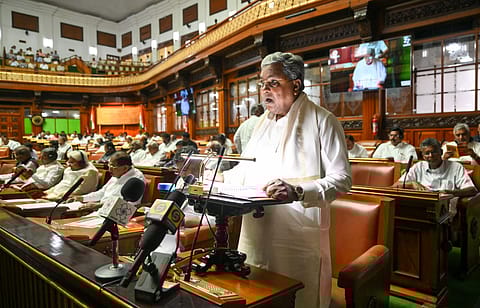
State Budget 2026–27: Karnataka announces measures to strengthen GCC and AI sectors
Karnataka's 2026–27 Budget, presented by Chief Minister Siddaramaiah, focuses on enhancing the GCC and AI sectors. Key initiatives include the Super 100 industry–academia program, AI and Robotics Technology Park, and a new IT park in Mangaluru. The state anticipates significant investments and aims to boost employment and IT exports, with Mysore emerging as a second IT hub.
With a focus on developing Mysuru as the state’s second IT hub, Karnataka expects software exports to reach ₹11.5 lakh crore by 2030. In the state Budget, the government also announced plans to set up an AI and Robotics Technology Park in Bengaluru and a GCC-focused IT park in Mangaluru.
Presenting his 17th Budget, Chief Minister Siddaramaiah announced several schemes and initiatives aimed at leveraging the state’s dominance in the GCC and IT sectors. Under the Local Economy Accelerator Program (LEAP), launched last year with an outlay of ₹1,000 crore, the government in the 2026–27 Budget will launch a Super 100 industry–academia adoption programme to boost employment opportunities, in collaboration with the Karnataka Digital Economy Mission, a non-profit backed by the state. To incubate entrepreneurs in Tier-II and Tier-III cities such as Hubballi, Kalaburagi, Hosakote, and Mysore, the Karnataka State Electronics Development Corporation Limited (KEONICS) will set up plug-and-play LEAP Labs.
What are Siddaramaiah's Budget announcements?
In his Budget speech, Siddaramaiah highlighted advancements in AI and robotics and announced several initiatives to strengthen the sector. “To further strengthen the AI sector this year, the government announced that the AI and Robotics Technology Park (ART-PARK) under IISC will establish a robotics and AI campus called the Bangalore Robotics and AI Innovation Zone (BRAINz) in collaboration with ISRO and KEONICS. A Center of Excellence for AI will be set up at IIIT Raichur at a cost of ₹5 crore,” said Siddaramaiah. Further, the government is also planning to set up a drone testing facility in Chikkaballapur district.
With major global Electronics System Design and Manufacturing (ESDM) and semiconductor companies such as Foxconn, Lam Research, and Applied Materials already operating in the state, the government said it expects investments of around ₹45,000 crore from firms in the sector.
On the new initiatives announced in the Budget Sanjeev Kumar Gupta, CEO, Karnataka Digital Economy Mission (KDEM), said, "The launch of Karnataka Skill Intelligence and Strategy Unit (KSISU), being established under the Karnataka Skill Development Authority in collaboration with KDEM, will bring a data-driven approach to workforce planning while the Super 100 Industry-Academia Adoption Programme will deepen our long-term partnerships between industry and academia. With India's skilled workforce still around 4-5%, every rupee invested in skilling creates a multiplier effect for employability, innovation capacity and economic productivity."
What is dedicated GCC policy
With Bengaluru housing the largest number of Global Capability Centres (GCCs) in India, and in line with the dedicated GCC policy announced in 2024, the government in the Budget has proposed the establishment of a new IT park by KEONICS in Mangaluru to promote GCC expansion beyond the state capital. With the state contributing nearly 43% of India’s IT exports, the government expects software exports to reach ₹11.5 lakh crore by 2030 under the new IT Policy 2025–30. “With the support extended to the IT sector, more than 30,000 employees are working in 100 companies in Mysore. To ease the congestion in Bengaluru and to strengthen economic activities beyond the city, Mysore city will be developed as the second IT city of the state,” Siddaramaiah said.
Disclosing the growth figures, the government said Karnataka recorded an 8.1% GSDP growth at constant prices in 2025–26, reflecting broad-based expansion across sectors. The agriculture sector registered a robust growth of 9.1% while the industrial sector grew 6.7% and the services sector expanded 8.1% during the fiscal year.
“During the first half of 2025–26, FDI equity inflows to the state stood at $9.4 billion, accounting for 26.7% of the nation’s total inflows. While several other major state economies such as Maharashtra, Gujarat, and Delhi recorded a decline in FDI inflows during this period compared to the previous year, Karnataka registered a significant increase of 2.6 times, underscoring its growing attractiveness as an investment destination. Further, with the implementation of the Industrial Policy 2025–30, a greater inflow of investment is anticipated in the coming years,” the Chief Minister, who also holds the finance portfolio, said.