The FAQs are AI-generated, and Fortune India is not responsible for its content or any associated copyright issues.
'The new Uber and Airbnb of real estate': Jimmy Mistry on Della Townships' asset-light disruption
/ 5 min read
From a 30-key glamping resort in Lonavla to a ₹46,480 crore township pipeline spanning 4,288 acres across India, Jimmy Mistry wants to do to luxury real estate what Uber did to taxis.
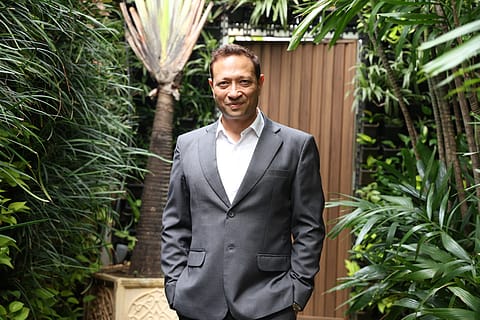
Jimmy Mistry, founder & CMD, Della Group
There is a word Jimmy Mistry keeps coming back to: disruption. Not in the casual, buzzword way that many startup founders deploy it, but in the precise, architectural sense of someone who has spent his career redesigning things that most people took for granted.
Mistry, founder and CMD of Della Group, is a self-described design futurist. And when he sits down to explain what Della Townships is building, the reference frame he reaches for is not a legacy developer, not a hospitality chain, but a technology platform.
“We become the new Uber or the new Airbnb of the real estate industry,” he says in a freewheeling chat with Fortune India. “We are an asset-light real estate model.” That is a bold pitch, but it is also one backed by a pipeline that Della Townships said crossed ₹46,480 crore in gross development value across 12 luxury township projects spanning 4,288 acres in 10 cities as of May 2026.
Removing the two biggest barriers
To understand why Mistry draws that analogy, you have to understand what he says is broken about traditional real estate expansion. “Buying a land is a complicated affair,” he says. “The larger the land parcel, the more the complications. Buying a land in Bihar is different from buying a land in Maharashtra. It’s different from buying a land in Gujarat. Then getting the approvals.”
So Della built its model around taking those two hurdles — land ownership and regulatory approvals — out of its own direct scope. The result is the CDDMO model, or conceptualisation, design, development, marketing and operations, which Della has used in township partnerships such as the Pune project with Hiranandani Communities and Krisala Developers.
Mistry also adds an important structural layer. The core real-estate development SPV, he says, “generally consists only of the landowner and, where applicable, financial or strategic investors. Della does not typically hold equity in the core real estate development SPV.” Instead, a second SPV is created for the hospitality and experience-led assets, with “74% ownership by the landowning company and 26% sweat equity held by Della.”
That distinction matters. Della is not typically taking equity in the land-development company itself. Its ownership sits in the hospitality and experiential layer — the resorts, food and beverage destinations, destination wedding venues, MICE (meetings, incentives, conferences, exhibitions) infrastructure, adventure ecosystems, and theme-based assets such as golf courses and racecourses that sit on top of the township. That is where Della says its IP, brand, underwriting capability, operational know-how and long-term revenue platform justify the 26% sweat equity.
“As a result, the hospitality SPV benefits from the revenue potential of a 300-key hospitality ecosystem while requiring capital deployment for only a fraction of that inventory,” Mistry says, describing a model in which only about 125 keys are funded through project-level capex and the rest are structured through sale-and-leaseback.
Niranjan Hiranandani on Della
When the interview turned to sceptics who doubt Della’s scale, Mistry played a video byte from Niranjan Hiranandani, recorded at the Pune launch event. The words are worth reproducing.
“I am very proud to tell you that instead of looking at something outside or somebody from a foreign country to think of an ideal proposition to create a USB for our project in Pune, we talked and discussed and decided that it should be Jimmy Mistry and Della,” Hiranandani said. “I am actually looking forward to your actually producing that project which is going to be greater than what is there in Hiranandani Gardens. People will not recognise us from Hiranandani Gardens but from this project.”
Coming from a developer who helped create one of Mumbai’s most recognisable integrated urban clusters, that is not a casual endorsement.
{{#most-powerful-women-snapshot-individual.slug}} {{/most-powerful-women-snapshot-individual.slug}} {{^most-powerful-women-snapshot-individual.slug}} {{/most-powerful-women-snapshot-individual.slug}} {{#showRanking}} {{current-rank}} {{/showRanking}} {{#photo.0.url}}
{{name}}
A ₹46,480 crore pipeline
The numbers, at least on paper, are eye-catching. Della Townships said that it had crossed ₹46,480 crore GDV, covering projects across 10 cities and 4,288 acres. The company said these townships would combine luxury residential, hospitality, wellness, retail and commercial infrastructure under an integrated, experience-led strategy.
During the conversation, Mistry broke down parts of that pipeline from a screen share: Pune at ₹1,350 crore, Raipur at over ₹2,200 crore, Nagpur at a combined ₹3,700 crore across two projects, and Ahmedabad as the headline development with 1,100 acres in Viramgam and ₹16,000 crore GDV. Della’s public material has since also highlighted wellness centres in collaboration with Mayr Life, golf resorts designed with Gary Player, and motorsport infrastructure designed by Tilke Engineers & Architects.
Mistry says more partnerships are now in place. “There are brand partnerships with Mayrlife for wellness, Tilke for FIA grade Racing circuit and celebrity golf course designer Gary Player for Championship golf course designs for Della Townships,” he said in his follow-up response. “Apart from this we have World Trade centre for Ahmedabad Township and Aurangabad Township.”
The revenue story
According to Mistry, one common criticism of Della stems from people mixing up two different businesses. “The ₹200 crore balance sheet with a ₹70 crore EBITDA is purely on the resort operation side. That’s a different business entity,” he says.
That distinction still holds. ET Realty had reported that Della Group was targeting ₹700 crore in revenue and ₹450 crore in EBITDA by FY27, up from a FY25 revenue base of around ₹200 crore that was primarily driven by the existing Lonavla resort. Jimmy Mistry clarified that the ₹450 crore EBITDA target includes the resort operations as well, not just the township-linked business.
That means the FY27 number should be read as a broader group-level target tied to the hospitality base plus the township and experience-led expansion, rather than as pure real-estate development income. It also fits Mistry’s explanation that Della is aligned to operational performance: “In scenarios where the asset incurs losses, Della does not charge an operator’s fee.”
He adds that Della also underwrites a per-key development benchmark of about ₹1.25 crore, with cost overruns beyond agreed thresholds being absorbed by Della, and that it contractually aligns itself to operational performance by assuring break-even within the first year. “For instance, the company targets approximately 40 destination weddings in the first operational year,” he says, which he argues materially helps occupancy ramp-up and early stabilisation.
The long game
On the IPO question, Mistry remains explicit that capital is not the immediate need. The plan — for 2027 or 2028 — is to gradually move from being primarily an operator-plus-equity partner in hospitality SPVs toward owning more of those assets outright.
“Right now, when we are talking of going public in 2027 or 2028,” he says, “it is purely to make sure that we start owning the assets.”
For a founder who began with 30 glamping keys on the edge of a mountain in Lonavla, the Uber and Airbnb comparison is not just rhetorical flourish. Whether Della can execute at the scale its GDV pipeline suggests will be tested over the next few years. But with its two-layer SPV structure, hospitality-led positioning and focus on monetising experiences alongside real estate, Della Townships is attempting a model that differs from a conventional developer.
Follow Fortune India
Frequently Asked Questions
NEXT STORY