The FAQs are AI-generated, and Fortune India is not responsible for its content or any associated copyright issues.
We want to become a leading player in rocket launch business globally by 2030: Skyroot co-founder Pawan Kumar Chandana
/ 4 min read
Earlier this week, the company became the first space tech unicorn in India with the latest funding round of $60 million, valuing the company at $1.1 billion.
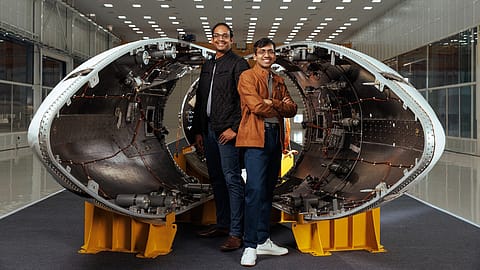
Skyroot Aerospace founders Naga Bharath Daka (left) and Pawan Kumar Chandana
From the first sub-orbital test flight in 2022, Vikram-S, Skyroot Aerospace has come a long way. The space tech start up is in the final stages for the launch of Vikram – 1, the first privately-developed orbital test flight. The rocket was flagged off to the launch site - Satish Dhawan Space Centre – from Hyderabad last month. The company also plans to launch Vikram-2, which has over one tonne payload capacity, by the end of the next year. Earlier this week, the company became the first space tech unicorn in India with the latest funding round of $60 million, valuing the company at $1.1 billion.
In an exclusive interview with Fortune India, Skyroot Aerospace co-founder Pawan Kumar Chandana shares the next major milestones for the startup. Edited excerpts:
With the latest round of funding, Skyroot has achieved a major milestone by becoming the first space tech unicorn in the country. The company is also planning the next space launch. Kindly take us through the upcoming frontiers?
Chandana: As we speak, the entire Vikram 1 rocket, which is India’s first private orbital rocket flight, is at the launch site. The launch will be attempted soon. So, that is the next milestone. It will be a major boost for India’s space sector, Skyroot and also for the global space sector as there are very few companies providing launch services, as it is a very complex technology. And we will be one of the few people doing it. So, the world will have more access to space and it will be a major milestone for the Indian space programme and space capabilities.
How is the demand dynamics for private orbital flights?
Chandana: About 70%-80% of the market for us is global and the remaining is domestic market. Most of it is commercial. And with first mission being a test flight, we have only few customers. We will be announcing the details of the customers soon as they are all under authorisation process at present for launch into the orbit. There will be multiple payloads in the first mission. It is a mix of Indian and global payloads.
Which are the nations/geographies that have approached for orbital launch, a service, which you yourself term as “Uber for space”? and who are the potential customers?
Chandana: Majorly companies from three geographies – U.S., Europe and South East Asia. The demand pertains to two major types of payloads. One is communication satellites, which provide communication, data transmission services. The other is earth observation satellites for clicking images from the space. There are satellites that can watch in night and various spectrums. These images are used for various industries like agriculture, energy, urban planning, and observing global warming and weather prediction. About fifteen industries use the images and analytics from the images. It is itself a multi-million-dollar industry. So communication and earth observation are the two main industries.
What is the growth dynamics for private orbital launches and what kind of opportunities does it present?
Chandana: Today, as we speak, there are around eleven thousand satellites in orbit. Within the next four years, it will become close to fifty thousand. It will almost be five times of what it is today. That is a phenomenal growth and most of the satellites will be offering communication services and earth observation services. One of the biggest applications for the communication satellite services is the broadband internet from space directly to earth. We believe that billions of people will be connected with high speed internet from space in the future.
Domestically, satellite communication based high speed internet is one of the key opportunities the big conglomerates are tapping into. What kind of opportunity lies ahead for a start up like Skyroot in this context?
{{#most-powerful-women-snapshot-individual.slug}} {{/most-powerful-women-snapshot-individual.slug}} {{^most-powerful-women-snapshot-individual.slug}} {{/most-powerful-women-snapshot-individual.slug}} {{#showRanking}} {{current-rank}} {{/showRanking}} {{#photo.0.url}}
{{name}}
Chandana: We should have self-reliance in domestic satellite initiatives in the country. If we have options in India, it will be good for them for launching their satellites without dependence on foreign options. That is number one. And now the satellite ecosystem is evolving not only globally but also in India. More such launch plans will emerge from India creating a vast ecosystem.
Yours is a company which has become a unicorn without having a revenue channel so to say, but this is where the whole concept of patient capital for deep tech initiates comes into play. But with the launches lined up, what is your guidance on earnings and revenue?
Chandana: Basically, launches are very attractive market as there are only couple of players globally which are regularly launching into the orbit. And it is a very massive market. By 2030, it is estimated to cross $40 billion. Just the launch service part of the whole space ecosystem. It has very less number of players. So that is why it is a very attractive market. It depends on how regularly we can launch. That will be demonstrated this year and then we will get into commercial launches from next year onwards.
Since the commercial launch is next year, what is the upcoming launch about?
Chandana: Right now, the initial launches will be the test flights. We need certain test flights to demonstrate the capability to reliably put satellites into the orbit. After the initial few launches, which could typically be two to three launches, there will be regular commercial flights.
Any plans on the total number of missions to be launched in the short to medium term, or say by 2030 or so?
Chandana: It is too early to say, but by 2030, we want to become one of the leading players in the launch business globally.
You talked about Vikram 1, which is scheduled to be launched. By when can we see it lift off?
Chandana: It will take some weeks. We are yet to announce the launch date. It is difficult to tell now. But it is likely to be launched in June or July. We are in the process of vehicle readiness. We have just started the assembly activities at the launch site (Satish Dhawan Space Centre). A lot of testing and interfacing with the launch site has to be done. There might be some challenges but hopefully it will happen in the next two months.
Kindly share some details on the progress of Vikram 2?
Chandana: Vikram 2 is a bigger vehicle with payload of over a tonne. First stage of the rocket, which lifts the rocket, is same as Vikram 1. The development is going on in full swing. We are targeting the flight in next year-end.
Frequently Asked Questions
NEXT STORY