Willie "Slasher" Walsh comes with a storied legacy. Can he put IndiGo on a different flight plan?
/ 6 min read
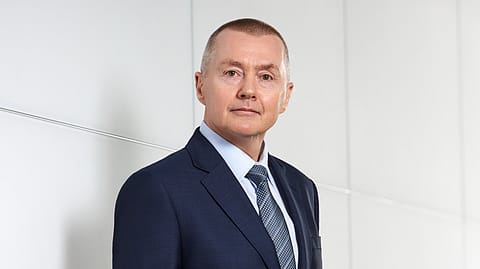
Willie Walsh | Credits: IATA
Willie "Slasher" Walsh comes with a storied legacy. Can he put IndiGo on a different flight plan?
Willie “Slasher” Walsh, famed for ruthless turnarounds at Aer Lingus and British Airways, is set to become IndiGo’s most high-profile CEO amid its worst operational crisis. Tasked with restoring reliability, rebuilding trust and enforcing financial discipline, he inherits an airline juggling mass cancellations, regulatory ire, ambitious global expansion and soaring fuel costs in a volatile geopolitical and economic climate.
This summary is AI-generated, and Fortune India is not responsible for its content or any associated copyright issues.
Walsh must restore IndiGo’s reputation for operational reliability, rebuild trust among stakeholders, and reestablish the airline’s position as a disciplined, efficient market leader
Willie Walsh | Credits: IATA
In the topsy-turvy world of aviation, Willie Walsh, the sharpshooting incoming CEO of IndiGo, has a rather peculiar nickname: Slasher.
As if it’s not obvious, that moniker befell him a little over two decades ago, when, as the CEO of then-government-owned Irish airline Aer Lingus, he slashed costs by 30 percent and 2,500 jobs. That the name came, despite having spent years on the other side of the negotiating table, as a pilot didn’t really matter to Walsh.
What mattered to Walsh was making no apologies for focusing on profit and turning around the airline from a money-losing enterprise into a profitable one.
Years later, after being brought in to ensure financial discipline at Britain’s storied airline, British Airways, Walsh showed his mettle when he ruthlessly pushed through cost cuts, passenger benefits, and weakened the British Airways flight attendant’s union, albeit at the cost of what some would say, British Airways’ famed service excellence.
Nevertheless, it’s perhaps those dogged, hard-nosed operational skills that prompted Rahul Bhatia, the founder of India’s largest airline, IndiGo, to turn to Walsh to run the airline, which has faced its toughest few months recently. On March 31, IndiGo announced that Walsh will take charge as CEO in August this year, making him the company's most high-profile leader since its inception.
IndiGo’s CEOs over the past two decades have included the likes of Bruce Ashby, Aditya Ghosh, Gregory Taylor, Ronojoy Dutta, and, of course, Pieter Elbers. Elbers had been the chairman of the Netherlands-based KLM before he took charge at IndiGo. But, in Willie Walsh, the new CEO designate, IndiGo has now brought one of the world’s foremost airline executives, a formidable negotiator, and a prudent top dog who doesn’t back away from a fight, to lead the airline in one of the world’s fastest-growing aviation markets.
“He does bring a lot of credibility and experience, but this is more like a statement of intent where Mr Bhatia has picked up the ‘top man’ for the job,” a senior aviation expert says. Walsh was key to the formation of the €33.213 billion International Airlines Group, a British Spanish multinational airline holding company that comprises British Airways and Iberia, the flag carriers of the United Kingdom and Spain, respectively, along with Vueling and Aer Lingus.
“He is an iconic and accomplished aviation leader and brings a rare combination of global perspective, operational expertise of having built strong customer-focused airlines, deep industry experience, and a values-driven leadership, making him exceptionally suited to lead IndiGo at this pivotal cusp of growth,” Rahul Bhatia, the Managing Director of IndiGo, said.
What does IndiGo need now?
While the uncertainties caused by the war could swing either way by the time Walsh takes the corner office, his immediate mandate is clear: he must restore IndiGo’s reputation for operational reliability, rebuild trust among stakeholders, and reestablish the airline’s position as a disciplined, efficient market leader, particularly after the massive cancellations in December that recently threatened this standing.
The troubles, which began on December 2 last year, spiralled out of control by December 5th when over 1,600 of its scheduled 2,200 flights were canceled, turning air travel into an absolute nightmare. Soon enough, the government capped airfares and publicly rebuked the airline and its management over the situation. The crisis was triggered by the implementation of the Flight Duty Time Limitations (FDTL), which were intended to ensure adequate rest for airline crew.
Coincidentally, Walsh, as the director general of IATA, had said that the FDTL rules in India appeared to be more restrictive than those in other jurisdictions, even though he felt that it was only a matter of time before it settled down.
{{#most-powerful-women-snapshot-individual.slug}} {{/most-powerful-women-snapshot-individual.slug}} {{^most-powerful-women-snapshot-individual.slug}} {{/most-powerful-women-snapshot-individual.slug}} {{#showRanking}} {{current-rank}} {{/showRanking}} {{#photo.0.url}}
{{name}}
“The primary causes for the disruption were over-optimization of operations, inadequate regulatory preparedness, along with deficiencies in system software support and shortcomings in management structure and operational control on the part of IndiGo,” a four-member committee constituted by airline regulator DGCA later said in its report. In the aftermath, DGCA also warned Pieter Elbers and COO Isidre Porqueras and relieved SVP Jason Herter of his duties.
A month after the report was made public, Pieter Elbers abruptly resigned on March 10, a decision that was expeditiously approved by IndiGo's board of directors. Elbers offered to stay for the transition period, but the board announced that Rahul Bhatia, the founder and managing director of IndiGo, would serve as the interim CEO. The company has since brought Aloke Singh, the former CEO of rival airline Air India Express, to head strategy.
“Elbers had full autonomy,” says a senior industry observer. “Bhatia entrusted him completely. What happened was unfortunate, but now it’s a wait-and-watch as Walsh’s strategy takes shape.”
Under Elbers, IndiGo has been looking to shed its low-cost tag and position itself as a unique model that offers premium services as well. That’s also why IndiGo had begun offering its version of business-class seats on select routes, along with a loyalty program that lets members redeem points for flights. Under Walsh, though, these programs, which add costs, are certain to come under scrutiny.
“I doubt IndiGo is in a position to roll back its international expansion, though the path forward may evolve and require some course corrections,” Alok Anand, the chairman of Acumen Aviation, an aircraft asset management and leasing company, told Fortune India earlier. “At the same time, supply-chain constraints are likely to persist longer than expected, especially with two major wars unfolding this year. IndiGo has been on a strong growth trajectory for many years and is likely to continue that path.”
Then, even if the war in the Middle East comes to an end, it will be a long time before oil prices stabilize. Aviation Turbine Fuel, which accounts for as much as 40 percent of airlines' costs, saw a sharp rise on April 1, when prices doubled to a record high of over Rs 2 lakh. Indian airlines have already announced fuel surcharges to partially pass on the increase in ATF costs to passengers, a move that could cushion the immediate impact on airline cost structures.
“For FY2027, ICRA had projected net losses to narrow to Rs11,000 to Rs 12,000 crore from Rs 17,000 crore to Rs 18,000 crore in FY2026, supported by growth in passenger traffic,” Kinjal Shah, Senior Vice President and Co-Group Head, Corporate Ratings, ICRA Limited, tells Fortune India. “However, the initiation of the West Asian conflict since the end of February 2026, resulting in flight cancellations, rerouting for select long-haul international routes, increasing fuel burn, higher costs owing to additional airport charges as more aircraft remain on ground, increase in fuel cost due to the elevated ATF prices and depreciation of the INR against the USD now pose a downward bias to the FY2027 net loss forecasts.”
“A new CEO will face several immediate pressure points, like operational reliability, managing scale, international expansion, fleet and supply-chain uncertainty, cultural evolution, and shareholder and founder expectations,” Anand had told Fortune India earlier.
Then, there is also the massive influx of aircraft coming IndiGo’s way. Last year, the airline received an aircraft a week, and putting them into service now might be a daunting task amid uncertain times. IndiGo has more than 900 aircraft on order with Airbus, while rival Air India is awaiting delivery of 570 aircraft. Over the past few years, IndiGo has also shifted its strategy to fly more long-haul routes, using its mix of Airbus A350 aircraft and A321 XLRs. These aircraft would give IndiGo the capacity to fly directly from India to destinations such as the UK, Europe, Bali, and Venice, among others.
Alongside this, IndiGo has been stitching up codeshare agreements with global aviation giants such as Qantas, Japan Airlines, Virgin, British Airways, and Malaysia Airlines, allowing their passengers to travel to destinations in India via IndiGo. A codeshare agreement is an agreement to issue and accept tickets for flights operated by a partner airline. Through its partners, IndiGo flies to 80 destinations worldwide.
“His familiarity and tenure with IATA likely give him an understanding of global regulatory dynamics, bilateral air service agreements, and airline safety frameworks,” investment banking firm Jefferies said in a report. “The expedited decision minimizes leadership vacuum, ensures continuity in execution, and signals the board’s intent to proactively address emerging operational and industry challenges.”
For now, though, Walsh’s appointment seems to have certainly brought some cheer for IndiGo. Shares of InterGlobe Aviation, the parent company of IndiGo, rallied nearly 10% on Monday after the announcement. The question, though, remains: Can Walsh the Slasher slash anymore at the lean, mean machine?
Follow Fortune India
NEXT STORY