
Pieter Elbers took IndiGo on a different flight path. Will IndiGo stay on course?
ADVERTISEMENT
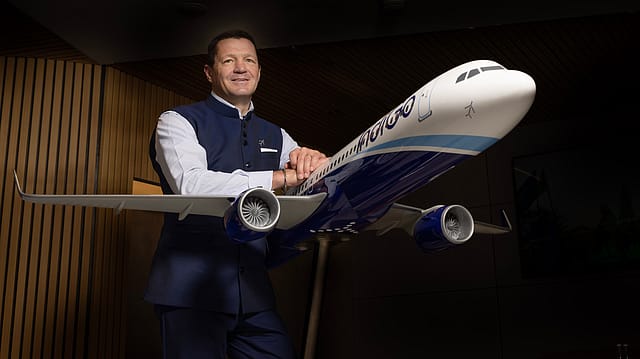
The decision didn’t quite come as a shocker.
Afterall, in the aftermath of IndiGo’s cancellation fiasco in December last year, there were rumors that Elbers would end up paying the price. The buck certainly did stop with the CEO of India’s largest airline. The scale of cancellations, despite decades of exceptional excellence, was unprecedented and brought India’s aviation sector to a standstill. The debacle also overshadowed Russian President Vladimir Putin’s high-profile visit to India.
IndiGo and Elbers kept apologising for the mishap, which affected over 3 lakh passengers and led to the cancellation of over 2,500 flights. Such was the crisis that, from the aviation watchdog, DGCA, to India’s competition commission, everybody was on IndiGo’s tail. The Narendra Modi government, too, came under fire from the opposition for promoting monopolies in the country. IndiGo offered more than its share of monetary compensation and even paid up a fine imposed by the DGCA.
But, in the end, it seems it didn’t quite matter.
Pieter Elbers, the India-loving CEO of IndiGo, resigned on March 10, a decision that seems to have been expeditiously approved by the board of directors of IndiGo. Elbers offered to stay for the transition period, but the board announced that Rahul Bhatia, the founder and managing director of IndiGo, would serve as the interim CEO. Bhatia had immediately flown back to India from Switzerland as the IndiGo crisis unfolded in December, and in many ways was seen as critical in stabilising it.
“With immediate effect, Pieter Elbers will be stepping down as InterGlobe Aviation Limited ’s (IndiGo) CEO,” IndiGo said in a statement. “The Board of Directors would like to thank Pieter for his contribution and service to the organisation and wishes him well in his future endeavours.” In his resignation letter, Elbers had sought a waiver of his notice period.
Bhatia, the company's managing director, has already sent an email to more than 37,000 IndiGo employees, apologising for the burden they bore due to the mishap last year. Scenes during the disruption showed angry passengers threatening employees, and reports even suggested that some ground staff were manhandled.
“His tenure, like most in aviation leadership, was a blend of achievements and setbacks,” Alok Anand, the chairman of Acumen Aviation, an aircraft asset management and leasing company, says. “The most notable success was steering IndiGo’s evolution from a highly efficient domestic low-cost carrier toward the ambition of becoming a global airline. The most significant shortcoming was the failure to sufficiently adapt the organisation’s operational culture to the complexities of international flying, something that became evident during the operational disruption in 2025.”
Eventful transition
Despite the hurried sendoff, it’s safe to say that Elber’s four years at the helm of IndiGo have rewritten the airline’s flight path.
Elbers joined IndiGo from KLM, where he had been the CEO, and took charge a few months before Air India’s Campbell Wilson. The post-Covid-19 period was a transitional period for airlines—among the worst affected—limping back to normalcy. In India’s context, IndiGo, which controlled more than half the market, and Air India, which was sold to Tata Group by the government with the public hope of a turnaround, would both have expat CEO’s, whose mandates were similar: building a global airline from India.
As CEO of KLM, the 55-year-old Elbers had credibility, having seen the airline through a period of phenomenal growth, with revenues growing from around €9 billion in 2014 to €11 billion by 2019. At the time of his joining, IndiGo flew to around 90 destinations, of which 15 were international.
Soon, Elbers and IndiGo followed up with what’s now referred to as the mother of all aviation deals when it beat the 93-year-old Air India to announce the purchase of 500 aircraft from the France-headquartered Airbus. Air India had only a few weeks before that announced the purchase of 470 aircraft. Today, IndiGo has more than 900 aircraft on order with Airbus, while Air India is awaiting delivery of 570 aircraft.
Then, as Air India began laying the groundwork to build a twin strategy of building a full-service carrier and a low-cost carrier, as part of its transition program, IndiGo responded in its own style, tilting away from being a pure low-cost carrier into a hybrid one. Air India’s twin strategy was to cater to the growing demand of a diverse market, for the value-conscious flyer and the frequent flyer, used to the comforts of a full-service carrier.
IndiGo soon introduced IndiGo Stretch, a stripped-down version of the business class offered by full-service airlines, and a loyalty programme that allows points to be redeemed for flights, making it the only low-cost carrier (LCC) in India to offer such a programme. In many ways, it also signalled the premiumisation of brand IndiGo, to move away from the label of a low-cost carrier.
“The India of today is different from what it was 18 years ago,” Elbers told Fortune India in 2025. India has been evolving and will continue to do so in the next five years. If we are the market leader, we want to be an airline for all business segments. But we do it in a way that is tailor-made.”
Elbers was also instrumental in IndiGo’s shift in strategy to fly more long-haul routes with its mix of Airbus A350 aircraft and the A321 XLRs. These aircraft would give IndiGo the capacity to fly directly to destinations such as the UK, Europe, Bali, and Venice, among others from India.
“To make India a global aviation giant, you need to have airlines of a particular size,” Elbers had said in 2025. “If we want to compete with Singapore Airlines and Emirates, we cannot be a domestic Indian airline. For way too long, international traffic has been outsourced to hubs outside India's geographical borders. This is a good time for India to start building it. Domestic consolidation creates stability, but it is also a prerequisite to compete internationally”.
Alongside this, the 55-year-old has also been helping stitch up IndiGo’s codeshare agreements with global aviation giants such as Qantas, Japan Airlines, Virgin, British Airways, and Malaysia Airlines, allowing their passengers to travel to destinations in India via IndiGo. A codeshare agreement is an agreement to issue and accept tickets for flights operated by a partner airline. Through its partners, IndiGo flies to 80 destinations worldwide.
All that meant that IndiGo marked a period of high growth under Elbers, with its market share peaking at 66 percent in 2025, and the airline also beating Air India to emerge as the country’s largest international carrier. In the process, IndiGo began flying to as many as 45 destinations abroad and 97 domestic destinations.
Last year, Elbers and IndiGo also brought the IATA summit to India after some 40 years. IndiGo chaired the summit, attended by CEOs of many global airlines, and even announced a deal to purchase 30 additional wide-body Airbus A350 aircraft. Narendra Modi, India’s prime minister, gave the keynote address and, in many ways, was the high point of Elbers’ tenure.
“I doubt IndiGo is in a position to roll back its international expansion, though the path forward may evolve and require some course corrections,” adds Anand. “I’m not particularly convinced by the wet-lease model as a long-term strategy for expansion. In the current market, aircraft availability is likely to improve in the coming months as oil prices surge again, potentially reducing demand for older-generation aircraft. That may allow IndiGo to dry lease some of these aircraft to backfill capacity instead.”
What went wrong?
Despite all the accolades and the uncharted flight path, the abrupt departure has raised eyebrows, and the tone of Rahul Bhatia’s message, soon after taking charge, pointed to the company’s unhappiness over what unfolded in December last year.
"What happened last December should never have taken place,” Bhatia said in an email to IndiGo’s employees. “Our customers did not deserve it, and neither did all of you, especially the frontline employees who bore most of the brunt for no fault of theirs.”
For IndiGo, the troubles began in November last year when the airline began cancelling flights. By early December, the situation had become alarming, with delays of over seven hours or cancellations, before it all spiralled out of control on December 05. By that day, over 1,600 of its scheduled 2,200 flights had been cancelled, turning air travel into an absolute nightmare. India’s key airports were jammed by exasperated flyers, some of whom vented their anger on employees of the Gurugram-based airline, forcing the central government to act swiftly.
Soon enough, the government capped air fares and even publicly rebuked the airline and its management for the situation. Officials of the airline were called in for meetings and issued show-cause notices, even as the Directorate General of Civil Aviation (DGCA) put on hold a policy aimed at increasing pilots' rest. The crisis was caused by the implementation of the Flight Duty Time Limitations (FDTL), intended to ensure adequate rest for airline crew.
The primary causes for the disruption were over-optimisation of operations, inadequate regulatory preparedness, along with deficiencies in system software support and shortcomings in management structure and operational control on the part of IndiGo,” a four-member committee constituted by airline regulator DGCA said in its report. The DGCA also issued a caution to Elbers, a warning to the company’s COO, Isidre Porqueras, and asked Jason Herter, Senior Vice President, to be relieved of his duties.
“While Pieter Elbers has cited personal reasons for his resignation, it is difficult to ignore the likelihood that the December 2025 crisis played a role,” adds Anand. “It appears to have been a catalyst for the decision. Under different circumstances, IndiGo might have secured a successor before announcing the leadership transition.”
Interestingly, Elbers’ departure also comes at a time when Air India is scouting for a new CEO, with Campbell Wilson set to leave before his term ends. Since the crash of AI 171 in June 2025, Air India has been struggling with an image problem and a slow turnaround under Wilson, prompting the Tata Group to look for a successor.
India is the world’s third-largest aviation market, and its airports have grown from 74 in 2014 to 163 in 2025. The government wants to raise that to 350-400 by 2047. By 2040, passenger traffic is expected to grow sixfold to around 1.1 billion. India’s commercial airline fleet is predicted to grow from 400 in 2014 to around 2359 in March 2040. The total employment due to the aviation sector in 2040 is expected to be around 25 million.
So, what will likely be the challenge for a new CEO for IndiGo? “A new CEO will face several immediate pressure points, like operational reliability, managing scale, international expansion, fleet and supply-chain uncertainty, cultural evolution, and shareholder and founder expectations,” adds Anand.
For now, though, the old hand of Bhatia at the cockpit has meant a calming of nerves at a time when the global airline industry has been turbulent. Perhaps that’s also why IndiGo's shares rose 3%, while the broader Sensex slipped some 1.5%, a day after the resignation was announced. Nevertheless, filling Elbers’ shoes may not be an easy affair for IndiGo.