Zomato, Blinkit shift focus to gig workers' welfare as policy spotlight intensifies
/ 2 min read
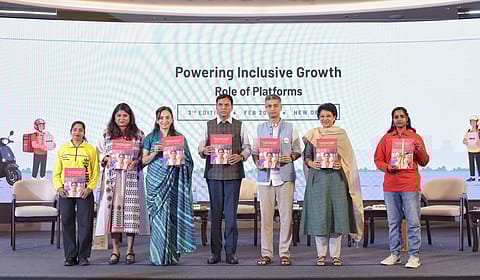
(L-R) Anjalli Ravi Kumar, Chief Sustainability Officer, Eternal, Ms. Manmeet Kaur Nanda, Additional Secretary, Department of Empowerment of Persons with Disabilities, Mansukh Mandaviya, Hon’ble Minister, Ministry of Labour and Employment, and Ministry of Youth Affairs and Sports, Aditya Mangla, CEO, Zomato, and Pooja Sharma Goyal, Udaiti Foundation
Zomato, Blinkit shift focus to gig workers' welfare as policy spotlight intensifies
At a New Delhi conference, Zomato and Blinkit emphasized gig workers' welfare, aligning platform growth with social security and inclusion. The event, supported by Startup India and DPIIT, highlighted the need for robust safeguards and social security for gig workers, reflecting a shift in focus from scale-first disruption to sustainable platform building.
This summary is AI-generated, and Fortune India is not responsible for its content or any associated copyright issues.
At the third ‘Powering Inclusive Growth’ conference, policymakers and platform leaders call for stronger social security, financial inclusion, and safety nets for India’s expanding gig workforce.
THIS STORY FEATURES
(L-R) Anjalli Ravi Kumar, Chief Sustainability Officer, Eternal, Ms. Manmeet Kaur Nanda, Additional Secretary, Department of Empowerment of Persons with Disabilities, Mansukh Mandaviya, Hon’ble Minister, Ministry of Labour and Employment, and Ministry of Youth Affairs and Sports, Aditya Mangla, CEO, Zomato, and Pooja Sharma Goyal, Udaiti Foundation
As India’s platform economy scales into the millions, the debate around worker welfare is moving from boardrooms to policy corridors. At the third edition of the ‘Powering Inclusive Growth: Role of Platforms’ conference in New Delhi, Zomato and Blinkit placed gig workers' wellbeing at the centre of the conversation.
Hosted in collaboration with Startup India and the Department for Promotion of Industry and Internal Trade (DPIIT), the event brought together policymakers, industry leaders, civil society, and startups to examine how platform-led growth can be aligned with social security, safety, and inclusion.
Union Minister for Labour and Employment and Youth Affairs and Sports, Dr. Mansukh Mandaviya, attending as chief guest, highlighted the need to pair opportunity with safeguards.
“It is encouraging to see platforms come together to advance delivery worker wellbeing. Platform work has opened opportunities for millions, but growth must be accompanied by robust safeguards and access to social security,” he said, urging companies to register themselves and their workers on the E-Shram portal.
The message reflects the government’s broader push to formalise gig work and expand the social security net for platform workers.
Inclusion as economic imperative
The conference also foregrounded accessibility and diversity within the gig ecosystem. Manmeet Kaur Nanda, Additional Secretary, Department of Empowerment of Persons with Disabilities, called for measurable inclusion across corporate India.
“True inclusion is measured by economic empowerment, and accessibility must be foundational. Corporates must commit to meaningful PwD hiring and close the inclusion gap across platforms and workplaces,” she said, adding that the department stands ready to support such efforts.
For Zomato and Blinkit, both part of Eternal, the focus on worker welfare marks a recalibration in narrative, from scale-first disruption to sustainable platform building.
“Delivery partners are the backbone of the platform economy and our businesses. Investing in their wellbeing is fundamental to our growth,” said Aditya Mangla, CEO, Zomato. “Ensuring financial security, healthcare access and long-term opportunity is essential to strengthening this model.”
Anjalli Ravi Kumar, chief sustainability officer at Eternal, said the dialogue has grown more action-oriented with each edition. “This year, we centred the conversation on health, safety and financial inclusion—areas that shape the everyday realities of delivery partners. Sustained progress requires both innovation and collaboration,” she said.
From safety to structural reform
The first panel, advancing diversity, safety, and inclusion in platform work, explored how strengthened safety measures, improved urban mobility conditions, skilling initiatives and tech-enabled safeguards can enhance wellbeing for platform workers.
{{#most-powerful-women-snapshot-individual.slug}} {{/most-powerful-women-snapshot-individual.slug}} {{^most-powerful-women-snapshot-individual.slug}} {{/most-powerful-women-snapshot-individual.slug}} {{#showRanking}} {{current-rank}} {{/showRanking}} {{#photo.0.url}}
{{name}}
Subsequent discussions focused on expanding access to insurance, pension instruments and welfare schemes through technology-led solutions and simplified interfaces.
The emphasis signals a shift in how India’s gig economy is being framed. Once seen primarily as a flexible employment engine powering food delivery and quick commerce, the sector is now being evaluated through the lens of social security, gender inclusion, and long-term financial resilience.
As regulatory scrutiny intensifies and platform work becomes a structural feature of India’s labour market, the sustainability of the model may hinge less on order volumes and more on how effectively companies embed safeguards into their growth strategies.

Follow Fortune India
NEXT STORY