CII suggests four-pillar macro strategy with fiscal transparency, revenue and expenditure measures ahead of Budget 2026
/ 3 min read
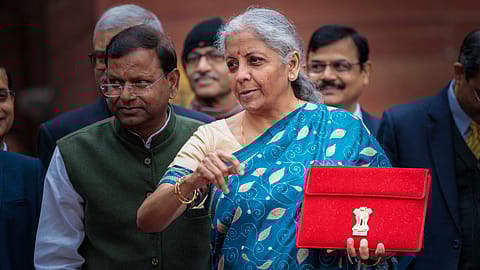
Finance Minister Nirmala Sitharaman | Credits: Narendra Bisht
CII suggests four-pillar macro strategy with fiscal transparency, revenue and expenditure measures ahead of Budget 2026
The Confederation of Indian Industry (CII) has proposed a four-pillar macroeconomic strategy for Budget 2026, focusing on debt sustainability, fiscal transparency, revenue mobilization, and expenditure efficiency. With India's economy in a 'Goldilocks' phase of high growth and low inflation, CII emphasizes disciplined fiscal management and institutional reforms to maintain this momentum.
This summary is AI-generated, and Fortune India is not responsible for its content or any associated copyright issues.
The next Union Budget must continue the economic momentum created by convergence of high growth and low inflation, CII said
Finance Minister Nirmala Sitharaman | Credits: Narendra Bisht
Ahead of Budget 2026, Confederation of Indian Industry (CII) today called for a four-pillar approach for macro-economic stability with debt sustainability, fiscal transparency, revenue mobilisation, and expenditure efficiency at its core.
“India stands at a pivotal juncture in its growth journey. With real GDP expanding by a healthy 8.0 per cent in the first half of FY26 and inflation remaining well anchored, the economy is displaying what the RBI has aptly termed a “Goldilocks” scenario of strong growth coexisting with price stability. This favourable alignment reflects the government’s proactive fiscal stance and prudent macroeconomic management,” said CII in a press release issued here today.
“India has achieved a rare convergence of high growth, low inflation, and improving fiscal indicators. The next Union Budget must continue this momentum through disciplined fiscal management and deeper institutional reforms.” said Chandrajit Banerjee, Director General, CII.
Debt and Fiscal Front
CII said first, at the core, is adherence to the government’s debt glide path targeting 50±1 per cent of GDP by FY31. “Maintaining Central debt at roughly 54.5±0.2 per cent of GDP and the fiscal deficit at 4.2±0.1 per cent of GDP in FY27 will preserve macro credibility while supporting growth,” CII said.
“Strengthening public finances, however, must extend beyond the Centre to States and Urban Local Bodies (ULBs), whose fiscal positions increasingly shape overall debt dynamics and the durability of macroeconomic stability,” it added.
It also called for improving predictability and reinforce institutional credibility. “CII recommends reviving the Medium-Term Fiscal Framework with a rolling 3–5-year roadmap for revenue, expenditure, and debt. A Fiscal Performance Index should be institutionalised to assess the quality of public finances across the Centre and States and link performance to fiscal transfers, encouraging prudent and reform-oriented states,” it said.
Revenue Mobilization
Raising concerns on tax to GDP ratio, CII said revenue mobilisation remains central to long-term fiscal sustainability. “India’s tax-to-GDP ratio at 17.5 per cent (centre and state combined) remains below that of major emerging economies,” it said.
“To finance the developmental needs of the country, India needs to increase its tax-GDP ratio. Leveraging the data from India’s world-class digital infrastructure could help detect tax evasion and expand tax base” Banerjee said.
“To unlock value from public assets, government should announce a three-year privatisation pipeline of Public Sector Enterprises (PSEs) in the non-strategic sectors as announced in the Strategic Disinvestment Policy,” CII said.
“As an interim measure, CII recommends undertaking calibrated disinvestment, gradually reducing government stake in PSEs to 51 per cent, retaining majority ownership, and eventually to 26–33 per cent over time. Parallely, efforts at full privatisation should continue,” as per CII.
Expenditure Management
CII stressed on subsidy reform as the other pillar of the strategy. “Public Distribution System (PDS), covering 813 million people or 57 per cent of the population, faces challenges of outdated data and leakages,” it said.
{{#most-powerful-women-snapshot-individual.slug}} {{/most-powerful-women-snapshot-individual.slug}} {{^most-powerful-women-snapshot-individual.slug}} {{/most-powerful-women-snapshot-individual.slug}} {{#showRanking}} {{current-rank}} {{/showRanking}} {{#photo.0.url}}
{{name}}
“Updating beneficiary lists using the latest Household Consumption Expenditure Survey (2023–24), narrowing coverage to the bottom 15 per cent, and shifting towards cash or voucher-based transfers can enhance efficiency while also promoting dietary diversification,” CII added.
Similarly, fertiliser subsidies, which accounts for 39 per cent of total central subsidies, should transition to a Direct Benefit Transfer (DBT) model to curb misuse and promote balanced fertiliser use. Issuing the DBT amount or fertiliser coupons before sowing can address farmers’ concerns about upfront expenses.
“Centrally Sponsored Schemes (CSS), which constitute 11 per cent of Central expenditure, also need to be consolidated to reduce fragmentation. Prioritising high-impact areas such as education, health, skilling, and climate resilience, while leveraging digital tools for monitoring, can yield better outcomes and fiscal savings,” it added.
Follow Fortune India
NEXT STORY