Davos 2026: Raising per capita income will be India’s bigger economic test, says Gita Gopinath
/ 2 min read
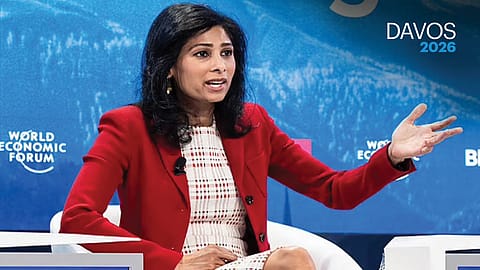
Speaking at a session titled ‘Can India Become the Third-Largest Economy’, Gopinath said India is well positioned to overtake Germany and Japan by 2028
Davos 2026: Raising per capita income will be India’s bigger economic test, says Gita Gopinath
At the World Economic Forum 2026, Gita Gopinath emphasized that while India is poised to become the world's third-largest economy, the real challenge lies in raising per capita income. Despite strong growth and infrastructure progress, structural issues like land acquisition and labor market rigidity could hinder productivity and job creation, necessitating continued reforms.
This summary is AI-generated, and Fortune India is not responsible for its content or any associated copyright issues.
WEF Davos 2026: Harvard economist says sustained reforms and productivity gains are key as India moves closer to third-largest economy status
Speaking at a session titled ‘Can India Become the Third-Largest Economy’, Gopinath said India is well positioned to overtake Germany and Japan by 2028
India is on course to become the world’s third-largest economy within the next few years, but sustaining that rise will depend on how effectively the country raises per capita income and productivity, stated Harvard economist Gita Gopinath at the World Economic Forum (WEF) Annual Meeting 2026 in Davos.
Speaking at a session titled ‘Can India Become the Third-Largest Economy’, Gopinath said India is well positioned to overtake Germany and Japan by 2028, and possibly earlier, if current growth trends continue.
‘“Based on current projections, India gets there by 2028. It could even be sooner, depending on how GDP numbers are revised,” she said, adding that it would be difficult to see India missing that milestone unless there is a major global shock.
Growth milestone likely, reform challenge larger
While the size of the economy is set to expand, Gopinath maintained that the more demanding task for policymakers lies in converting growth into higher living standards.
“The challenge for India is about raising per capita income to higher levels,” she said, stressing that this would require maintaining reform momentum even as macroeconomic conditions remain stable.
India, growing at around 6.5%, remains the fastest-growing major economy amid a sluggish global environment, supported by large infrastructure investments, digital public platforms and a widening manufacturing base, as per the panellists.
Gopinath cited progress in physical and digital infrastructure and tax reforms, including the Goods and Services Tax (GST), as key positives, alongside macroeconomic stability with inflation in low single digits.
However, she pointed to structural constraints that could limit productivity gains and employment generation. Land acquisition difficulties, lack of clean land titles, slow judicial processes and rigidities in labour markets continue to weigh on manufacturing and large-scale job creation, she said. Some states, including Andhra Pradesh, are experimenting with land and regulatory reforms that could offer templates for wider adoption.
Cracking the labour market code
Labour market flexibility and skilling of human capital are equally critical, Gopinath noted, observing that India’s growth has historically been capital-intensive. “If India wants to be part of large global supply chains, addressing labour constraints and skill mismatches becomes essential,” she said.
Union Minister Ashwini Vaishnaw, who was also part of the panel, said India’s growth trajectory rests on a decade of structural transformation driven by public investment, inclusive growth, manufacturing and simplification.
Industrialist Sunil Bharti Mittal cautioned that intensifying global competition and trade uncertainties could test momentum, even as India continues to integrate with global value chains.
NEXT STORY