The FAQs are AI-generated, and Fortune India is not responsible for its content or any associated copyright issues.
Govt steps up diplomacy to secure key shipping routes, including Hormuz
/ 4 min read
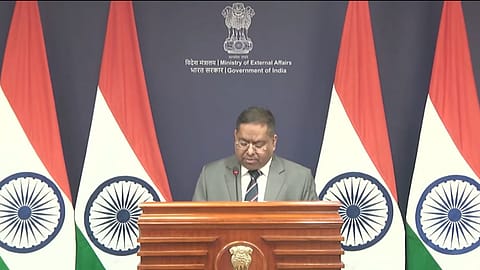
Ministry of External Affairs (MEA) Official Spokesperson Randhir Jaiswal
Govt steps up diplomacy to secure key shipping routes, including Hormuz
The government has intensified high-level diplomacy to secure key maritime routes, especially the Strait of Hormuz, amid West Asia tensions. Prime Minister Narendra Modi’s talks with U.S. President Donald Trump and External Affairs Minister S. Jaishankar’s engagements with Israel, Australia and AZEC partners aim to safeguard trade, energy flows and supply chains while projecting India as a stabilising regional player.
This summary is AI-generated, and Fortune India is not responsible for its content or any associated copyright issues.
External Affairs Minister S. Jaishankar has also held discussions with key global partners, including Israel and Australia, focusing on regional security and economic cooperation
Ministry of External Affairs (MEA) Official Spokesperson Randhir Jaiswal
The Ministry of External Affairs (MEA) on Wednesday said the government has intensified high-level diplomatic engagement to safeguard India’s economic interests and ensure secure maritime trade, particularly along key global routes such as the Strait of Hormuz.
Speaking at an inter-ministerial briefing, MEA spokesperson Randhir Jaiswal highlighted Prime Minister Narendra Modi’s recent conversation with U.S. President Donald Trump as an important step in this direction.
"Prime Minister Narendra Modi held a conversation with the President of the United States, focusing on strengthening strategic cooperation between the two countries, with both sides reiterating their commitment to ensuring stability and keeping critical global sea routes, including the Strait of Hormuz, open for safe maritime trade and energy flow," said Jaiswal.
Focus on maritime safety and global trade
With tensions in West Asia impacting shipping lanes, the government is working with multiple countries to ensure the safe return of its vessels currently operating near the Strait of Hormuz. Jaiswal said, “We are in discussions with several countries regarding the Strait of Hormuz. We are trying to ensure that, firstly, our remaining ships there also return safely.”
India has been positioning itself as a stabilising player, balancing geopolitical risks with its growing economic and energy needs.
Expanding diplomatic and energy ties
External Affairs Minister S. Jaishankar has also held discussions with key global partners, including Israel and Australia, focusing on regional security and economic cooperation.
Jaiswal said, "During his conversation with the Israeli Foreign Minister, the two leaders exchanged views on the ongoing conflict situation in West Asia, regional security concerns, and efforts to maintain humanitarian access and stability in the region."
Recommended Stories
Discussions with Australia focused on trade, defence, critical minerals, and strengthening supply chains under the Comprehensive Strategic Partnership.
India also took part in the Asia Zero Emission Community (AZEC) meeting hosted by Japan, where countries explored ways to boost clean energy cooperation and make supply chains more resilient.
"The External Affairs Minister participated in the AZEC (Asia Zero Emission Community) meeting convened by Japan, where member countries discussed enhancing clean energy cooperation, green transition pathways, and building more resilient and diversified global supply chains," Jaiswal added.
Energy security remains key priority
On oil imports, the government reaffirmed its approach of buying crude from multiple sources to meet domestic demand amid uncertain global market conditions.
RANK
COMPANY NAME
REVENUE
(INR CR)
(INR CR)
{{#current-rank}} {{current-rank}} {{/current-rank}} {{^current-rank}} {{rank}} {{/current-rank}} {{name}} {{#revenue}} {{revenue}} {{/revenue}} {{^revenue}} {{noi}} {{/revenue}}
Jaiswal said, "We continue to buy oil from diversified sources, keeping in mind the energy security needs of 1.4 billion people, the current situation in the international market, and the global situation we have to deal with."
The government is also coordinating closely with major Gulf producers such as the UAE and Qatar to ensure steady energy supplies.
Energy supply chain remained resilient despite disruptions
Sujata Sharma, Joint Secretary in the Petroleum Ministry, said India’s energy supply chain remained resilient despite disruptions. “While the West Asia crisis impacted energy flows, timely government intervention ensured uninterrupted domestic availability. Priority was given to PNG and LPG consumers, maintaining 100% supply continuity, while CNG supply for transport also remained stable,” she said.
To strengthen availability, domestic LPG production at refineries was ramped up, and booking intervals were revised to 25 days in urban areas and 45 days in rural regions. Commercial LPG supply has been restored to 70%, with priority extended to essential sectors such as healthcare, education, pharmaceuticals, steel, automobiles, seeds, and agriculture.
The government also doubled the availability of 5 kg cylinders and enabled access to alternative fuels such as kerosene and coal. Sharma added that domestic LPG supply remains stable with no distributor shortages, while online bookings remain robust at 98% and 93% of deliveries are completed through authentication-based systems.
Over 20 lakh MSMEs were registered on Udyam portal
Meanwhile, Dr Rajneesh, Additional Secretary and Development Commissioner at the Ministry of MSME, said strong momentum in the sector. Over 20 lakh MSMEs were registered on the Udyam portal during February–March, taking the total number of registered units to over 8 crore.
“Credit support remains robust, with outstanding lending to MSMEs exceeding ₹36.7 lakh crore and quarterly credit growth at 23.5%. The collateral-free lending limit has been doubled from ₹10 lakh to ₹20 lakh for micro and small enterprises from April 1,” he said while adding that credit guarantee support remained strong, with more than 5.27 lakh guarantees worth ₹92,000 crore issued during the two-month period. Liquidity support through the TReDS platform has also expanded significantly, with invoice discounting volumes rising from ₹4,300 crore in 2022 to over ₹7 lakh crore currently, including ₹85,000 crore in February–March.
Indian seafarers in the Gulf region are safe
On maritime operations, Mukesh Mangal, Additional Secretary at the Ministry of Ports, Shipping and Waterways, said all Indian seafarers in the Gulf region are safe. “No incident involving Indian-flagged vessels has been reported in the last 24 hours,” he said.
The DG Shipping control room has handled 6,449 calls and over 13,343 emails so far, including 157 calls and 215 emails in the past 24 hours. The government has also facilitated the safe repatriation of 2,337 Indian seafarers, including 75 in the last 24 hours, he added.