Union Budget 2026 Updates: 'We are giving a push to growth momentum,' says FM Sitharaman at post-Budget press meet
/ 41 min read
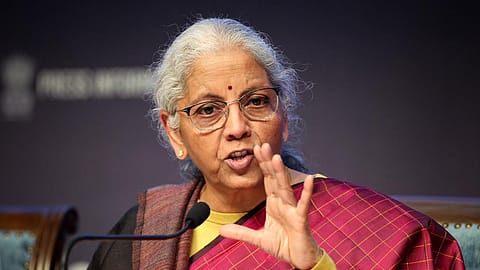
Finance Minister Nirmala Sitharaman at the post-Budget press meet, on Sunday. | Credits: Narendra Bisht
Union Budget 2026 Updates: 'We are giving a push to growth momentum,' says FM Sitharaman at post-Budget press meet
FM Sitharaman posed with red ‘bahi-khata’ tablet ahead of Budget 2026 speech.
This summary is AI-generated, and Fortune India is not responsible for its content or any associated copyright issues.
Union Budget 2026 LIVE updates: Union Finance Minister Nirmala Sitharaman tabled the Union Budget for the financial year 2026–27 in the Lok Sabha, marking the first time the annual Budget has been tabled on a Sunday.
Finance Minister Nirmala Sitharaman at the post-Budget press meet, on Sunday. | Credits: Narendra Bisht
Tarun Garg, MD & CEO, Hyundai Motor India Ltd., on the Union Budget
"Further building on the mega GST 2.0 reforms, the Union Budget 2026–27 presents a long-term focused roadmap that accelerates India’s rise as a global manufacturing hub and Atmanirbhar Bharat. Focus on the rare earth corridor, EV Battery and Electronics manufacturing, MSME empowerment, inclusivity and AI investments position India for global leadership. The strong push for tourism, rural growth and enhanced regional connectivity will further spur economic activity and open new avenues for advanced mobility, logistics and transportation solutions. With a bold capital outlay, simplified taxation and improved ease of doing business, this Budget is a decisive step towards a healthy and Viksit Bharat, reinforcing confidence in India’s growth story."
Sindhu Gangadharan, SAP Labs India Chairperson, Nasscom; President, Indo German Chamber of Commerce
“Union Budget 2026 strengthens the policy backbone required for India to operate as a global technology and AI execution hub. The focus on cloud infrastructure and long-term clarity for cloud services directly addresses a core constraint in scaling enterprise platforms, the ability to run regulated, data-intensive workloads with confidence and continuity. For GCCs, this creates the conditions to move beyond delivery into ownership, where India increasingly designs, builds, and runs core platforms and mission-critical systems for global enterprises. Greater predictability in tax and compliance frameworks is critical when technology platforms are designed to run for years. For large, globally distributed engineering and operations teams, clarity reduces friction in decision-making and allows accountability for core platforms and products to sit firmly in one place. This matters for GCCs that are moving into full-stack ownership, where India increasingly builds, runs, and scales enterprise platforms for global customers. When this predictability is complemented by sustained investments in advanced skilling, strong education-to-employment pipelines, and a sharper focus on women in STEM, it reinforces India’s ability to deliver trusted, enterprise-grade technology at scale.”
Union Budget 2026 reinforces India’s growth momentum
“The Union Budget 2026 reinforces India’s growth momentum through a strong and sustained commitment to infrastructure and urban development, with public capital expenditure rising to Rs. 12.2 lakh crore in FY27. What stands out equally is the Budget’s sharp focus on Tier-2 and Tier-3 cities like Chandigarh, Indore, Ludhiana etc. This shift is already translating into growing demand for organised real estate development. These markets are attracting not only local homebuyers but also growing interest from investors across India and abroad who are increasingly looking beyond metros for long-term value,” Mohit Goel, Managing Director, Omaxe Ltd
Balbir Singh Dhillon, Brand Director, Audi India
"The Union Budget’s strong emphasis on infrastructure and capital expenditure is a positive enabler for India’s mobility landscape. Improved highways and intercity connectivity, especially across Tier-II and Tier-III markets, are strengthening the ownership and usage ecosystem for luxury automobiles. The government’s focus on fiscal prudence, macroeconomic stability, and ease of doing business reinforces confidence for long-term investments in the automotive sector. Initiatives like the development of rare earth corridors and the advancement of ISM 2.0 under the India Semiconductor Mission are timely and critical. They signal a clear intent to build resilient domestic supply chains and a technology-driven manufacturing ecosystem that will support the future of automotive and electric mobility in India."
Budget 2026 represents a meaningful step for India’s electronics manufacturing
“The Union Budget 2026 represents a meaningful step for India’s electronics manufacturing landscape, including the consumer durables sector, particularly through its emphasis on strengthening export competitiveness and improving the operating environment for exporters. Measures focused on duty rationalisation and cost efficiencies will help Indian manufacturers remain competitive in global markets while navigating ongoing supply-chain and pricing pressures,” Saket Gaurav, CMD, Elista, said.
Raamdeo Agrawal, Chairman & Co-founder, Motilal Oswal Financial Services Ltd. on Budget
"This Budget is a masterstroke for India’s digital future. The 100% tax holiday for data centers until 2047 is a '1,000-pound gorilla' move. This is similar to the 90s software boom all over again. We are already adopting AI; now we are building the 'AI Factory of the World,' firing up massive capex in power, cables, and infrastructure. The fine print is equally vital; widening the IT services definition finally provides transfer pricing certainty for GCCs, signalling to the world that India is open for high-end tech business. However, we must be realistic about the impact of STT on capital markets. The STT hike and the removal of dividend set-offs seem to be bringing a headwind to markets. They make many high-frequency and arbitrage trades unviable, which will squeeze market liquidity and leverage in the short term. But with a prudent 4.3% fiscal deficit and a 12.2 lakh crore capex push, the long-term earnings story remains the real hero for India. Watch out for forthcoming monetary policy for continued credit growth of 13-15% to get nominal GDP growth of 10%+."
Devansh Jain, Chair, RE Committee , PHDCCI and Executive Director, INOXGFL Group, on Budget 2026
"We thank the Government of India led by Hon'ble Prime Minister Shri Narendra Modi, and Hon'ble Finance Minister Shrimati Nirmala Sitharaman for presenting the Union Budget. The Union Budget 2026–27 underscores the Government of India’s sustained commitment to building a resilient, low-carbon energy system—an approach that closely aligns with INOXGFL Group’s integrated clean energy strategy across renewables, manufacturing and infrastructure. The continued policy support for battery energy storage systems, including customs duty exemptions for lithium-ion cell manufacturing, along with duty relief for key solar manufacturing inputs, will play a critical role in strengthening grid stability and accelerating large-scale renewable integration. These measures are particularly relevant for developers and manufacturers working to build end-to-end domestic clean-energy value chains. The Budget’s ₹20,000 crore allocation for carbon capture, utilisation and storage (CCUS) further complements India’s transition by offering a pragmatic decarbonisation pathway for energy-intensive industries, while preserving industrial competitiveness and energy security. Overall, the Budget reflects a balanced and forward-looking energy vision—one that combines clean energy deployment with infrastructure expansion, manufacturing depth and self-reliance. We commend the government for laying a strong and credible foundation to support India’s long-term clean energy growth and industrial transformation."
Union Budget 2026: PM Modi’s vision meets industry optimism
Following the presentation of the Union Budget 2026, Prime Minister Narendra Modi highlighted a forward-looking and futuristic roadmap for India—balancing fiscal discipline with high growth, boosting capital expenditure, and creating new opportunities across sectors. The Budget, he said, is designed to propel India toward becoming the world’s third-largest economy while making citizens’ dreams of prosperity a reality.
Creator Labs plan gives big boost to India’s esports ecosystem
“The Government’s announcement of Creator Labs in schools and colleges is a timely and significant validation for India’s growing esports ecosystem. Through the last two editions of College Rivals, we’ve worked closely with student representatives and campus communities across 100+ institutions in 20+ cities in the country, often starting with the fundamental task of helping college authorities recognise esports as a credible platform for skills, careers and digital creativity. This kind of national-level support will go a long way in strengthening institutional confidence, and will accelerate the mainstream adoption of esports, animation and competitive esports as part of India’s future-ready youth economy,” Sumedha Mahajan, Head of Marketing, Ampverse DMI.
“This budget is a strong signal that India wants”
“This budget is a strong signal that India wants its next generation of global consumer brands to be MSME-led and digital-first. The removal of the courier export cap and the push towards invoice-based financing are game-changers for platforms like us. Faster liquidity for sellers and smoother cross-border trade allows us to help Indian hype brands scale globally without being constrained by capital or logistics. This is exactly the kind of structural support the ecosystem needed,” Ackshay jain, co-founder, culture circle.
Budget is expected to translate into stronger demand for travel and accommodation
“The Union Budget 2026’s increase in public capital expenditure to ₹12.2 lakh crore, marking a nearly 9% rise over last year, reinforces the government’s long-term focus on infrastructure-led growth. Enhanced connectivity, urban expansion, and development of commercial and logistics hubs are expected to translate into stronger demand for travel and accommodation across emerging and established markets,” Jaideep Ahuja, Managing Director & CEO, Ahuja Residences Private Ltd.
Parth Jindal, President, Cement Manufacturers’ Association, on Budget 2026
"The ₹20,000-crore CCUS outlay for various sectors, including Cement, fundamentally alters the decarbonisation landscape for India’s emissions intensive industries. CCUS is a significant enabler for large scale decarbonisation of industries such as Cement and this intervention directly addresses the technology and cost requirements of the Cement sector in context. The Cement Industry, fully aligned with the Government of India’s Net Zero commitment by 2070, views this support as critical to enabling the adoption and scale up of CCUS technologies while continuing to meet the Country’s long term infrastructure needs.”
Govt's intent is to have strong monetisation pipeline: DEA Secy Anuradha Thakur
DEA secretary Anuradha Thakur said the government's intent is to have a strong asset monetisation pipeline. Last year, it was announced that there will be a pipeline for monetisation and we will reap dividends.
A pragmatic Budget, thoughtfully steered by FM @nsitharaman: Sanjiv Goenka, Chairman, RP-Sanjiv Goenka Group
#Budget2026 outlines a steady path anchored in fiscal discipline. The higher capital expenditure of ₹12.2 lakh crore, increased defence allocation, and sustained focus on manufacturing, MSMEs, connectivity, wellness systems, and sports development reinforce long-term growth fundamentals.
A pragmatic budget, thoughtfully steered by Hon’ble FM @nsitharaman.
MSMEs won't face capital crunch: FM Sitharaman
With the fund announced in the budget for small industries, the MSMEs will be given equity support, liquidity support and professionals support. MSMEs will not face any dearth of funds, Sitharaman said in the press meet.
Rare earth corridors will have multi-decade advantage for the Indian economy: FM
Finance Minister Nirmala Sitharaman today said rare earth corridors announced in the budget will have multi-decade advantage for the Indian economy. "A scheme for rare earth permanent magnets was launched in November 2025. We now propose to support the mineral-rich States of Odisha, Kerala, Andhra Pradesh, and Tamil Nadu to establish dedicated rare earth corridors to promote mining, processing, research and manufacturing," Sitharaman had said in the Budget.
Hardeep Singh Brar, President and CEO, BMW Group India, on Budget 2026
"The Budget 2026–27 reflects a clear intent to balance fiscal consolidation with the need to sustain growth momentum. The reduced estimates for fiscal deficit reinforce assurance in India’s macro-economic stability and commitment to fiscal discipline. A declining debt-to-GDP ratio will gradually free up resources for priority sector expenditure. At the same time, increase in capital expenditure will accelerate infrastructure development, improve road quality and enhance mobility ecosystems. The Government’s focus on logistics improvement such as accelerating customs clearance of goods (via AEO programme) will make them available for manufacturing activity faster. Also, the reforms in tax compliances like longer validity of Advance Rulings in customs duty (from 3 to 5 years) will give more certainty to business operations. These long-term investments from the centre will have a direct multiplier effect on auto market. Budget has reinforced the fundamentals that matter most to the auto segment - economic stability, policy predictability and sustained infrastructure development. Recent initiatives taken before the budget like GST reforms and conclusion of various FTA's are already very positive steps taken by the Government for auto sector. For premium customers, confidence is the biggest driver, and this Budget further strengthens that confidence while creating the right conditions for long-term, sustainable growth in mobility."
Will ensure tech-led growth: Sitharaman
Government will use technology for the benefit of the common man.
We are giving a push to growth momentum: FM Nirmala Sitharaman
We are laying the path and giving a push to maintain the growth momentum. We want to ensure growth momentum and sustained economic growth. Primarily we are looking at an ecosystem with structural reforms, which will go on. reforms will continue with an aim of improving productivity and employment generation.
FM hopes rare earth corridors to replicate success of defence corridors
FM Sitharaman expressed confidence that India’s rare earth corridors will achieve similar success as the country’s established defence corridors, noting their potential to drive strategic growth and industrial development.
FM denies ignoring poll-bound states in the Budget
Finance Minister Sitharaman denied ignoring poll-bound states in the Union Budget.
Anish Shah, Group CEO & MD, Mahindra Group on Budget 2026
“The proposal to establish a dedicated ₹10,000 crore SME growth fund and incentives for industry clusters is a positive step toward enabling future job creation, supporting enterprise scaling, and boosting competitiveness of small and medium businesses. Initiatives to promote critical minerals, rare earth corridors and enhanced electronics and capital goods manufacturing are forward-looking and essential for a resilient industrial ecosystem that can thrive amid global uncertainties.
And, most importantly, the emphasis on sabka saath, sabka vikaas is commendable. The actions to ensure every community has access to resources and opportunities will enable robust and sustainable economic growth. Overall, Budget 2026 signals continuity in policy direction, a firm commitment to sustainable and inclusive growth, and efforts to unlock India’s economic potential at scale. We believe these measures can accelerate innovation, enhance value-added manufacturing and strengthen India’s standing in the world.”
Nikhil Sharma, Managing Director and COO, South Asia, Radisson Hotel Group, on Budget 2026
"We welcome the Union Budget 2026–27 presented by the Hon’ble Finance Minister, which lays the foundation for hospitality and tourism to scale responsibly across India while reinforcing the sector’s role in employment generation and regional economic growth. The focus on sustainable and experiential tourism, including the development of Himalayan trails, the continued push for Buddhist circuits, and the strong policy thrust on the Northeast, will support the growth of diverse tourism segments while enabling more balanced regional development. These measures are expected to encourage longer stays, wider travel dispersal, and stronger demand for quality accommodation and services across tier-2 and tier-3 markets.
One of the key initiatives is the announcement to set up a National Institute of Hospitality and strengthen the Council for Hotel Management, recognising that skilling will be critical to the sector’s long-term sustainability. The hospitality industry has been reinforcing its talent pipelines through structured training programmes, partnerships with hospitality institutes, and focused efforts to build local capabilities. Overall, the Budget’s integrated approach to infrastructure, destination development, and skill-building creates a positive environment for tourism and hospitality to scale responsibly. Radisson Hotel Group’s expansion across emerging destinations, including the Northeast, and its continued investment in skill development are closely aligned with this direction, supporting the creation of sustainable jobs and resilient tourism ecosystems."
Santosh Iyer, MD & CEO, Mercedes-Benz India, on Budget 2026
“Budget's strong focus on infrastructural development, with addition of Rs 1 lakh crore in capex, is a step in right direction developing the country’s evolving mobility ecosystem. Better highways and improved intercity connectivity have historically driven luxury car demand in India. The fiscal prudence reflected in the 4.3% deficit target, combined with strong focus on exports, sends a strong signal of macroeconomic stability, which may lead to a less volatile currency. Overall, the emphasis of the budget is on strengthening ease of doing business, and the deferral of customs duty payments up to 30 days, can improve cash flow significantly. This budget primarily focuses more on long-term gains, rather than immediate ones.”
Ashishkumar Chauhan, MD & CEO, NSE on Budget 2026
“The Union Budget 2026–27—the first from the Kartavya Bhavan and the ninth consecutive budget by the Hon’ble Finance Minister—reinforces the message that strong growth and fiscal discipline can advance together. It stays firmly on the consolidation path, with the fiscal deficit easing from 4.4% to 4.3% of GDP and debt-to-GDP declining from 56.1% to 55.6%, keeping India on track toward the 50% ±1% target by FY31. This signals macro stability and policy credibility to investors and markets.”
Jagannarayan Padmanabhan, Senior Director & Global Head, Consulting, Crisil Intelligence on high speed rail corridors
The Finance Minister’s announcement of seven high-speed transport corridors is critical not just for capacity creation, but for enabling technology adoption through advanced signalling, traffic management and higher-spec rolling stock. These corridors will significantly reduce inter-city travel times and support seamless multimodal people movement by integrating rail, road, metro, bus and aviation networks. Given their long gestation, success will hinge on access to long-term financing and appropriately structured moratoriums.
Tax certainty and ease of compliances dominate tax reforms: Gokul Chaudhri, President-Tax, Deloitte India
Gokul Chaudhri, President-Tax, Deloitte India, said, "Tax certainty and ease of compliances dominate the tax reforms that are embedded in the budget proposals. Firstly, we now have a stable and pragmatic safe harbor for service exports that quality as information technology. This sector brings in significant foreign capital, export earnings, and material job creation. As global capital arrives for capital intensive data centers there is a proposed tax holiday until 2047 for foreign companies providing cloud services to global customers using data-centre infrastructure located in India. Taken together, these measures represent a timely and strategic intervention by the Ministry of Finance - balancing investment promotion while encouraging long-term commitments to domestic digital infrastructure."
Deepak Gupta, co-founder, Style Lounge
Budget 2026 is basically telling us one thing: India wants to power the AI era, not just participate in it. When you pair ~7% economic growth with a ₹12.2 lakh crore public capex push and a tax holiday till 2047 for global cloud and data-center players using India infrastructure, it’s a clear bet on compute sovereignty.
AI is only as strong as the compute behind it. Data centers are the new industrial corridors, except they move intelligence, not cargo. If India builds serious data-center capacity and talent, our future exports won’t just be services, but AI outcomes delivered from India to the world. The countries that own compute will shape the models and the ones shaping models will shape the economy.
Sensex crashes over 2,000 points as FM's speech ends
Sensex crashed more than 2,300 points from the day's high while the Nifty 50 fell to 24,571.75.
FM announces attracting global business and investment
To boost investment in data centres, I propose a tax holiday till 2047 for foreign companies providing global cloud services using data centres located in India, subject to serving Indian customers through an Indian reseller. A safe harbour of 15% on cost will apply where data centre services are provided by a related entity. For electronics manufacturing, I propose a safe harbour of 2% of invoice value for non-residents warehousing components in bonded warehouses. To support semiconductor manufacturing, I propose a five-year income tax exemption for non-residents supplying capital goods, equipment, or tooling to fab manufacturers in bonded zones. To attract global talent, I propose an exemption on non-India-sourced income of non-resident experts for a period of five years, under notified schemes. I also propose to exempt all non-residents paying tax on a presumptive basis from Minimum Alternate Tax (MAT).
FM's proposals on Direct Taxes and New Income Tax Act
"In July 2024, I announced a comprehensive review of the Income Tax Act, 1961. This review has been completed in record time, and the Income Tax Act, 2025 will come into effect from 1 April 2026. The simplified Income Tax Rules and Forms will be notified shortly. The forms have been redesigned so that ordinary citizens can comply with ease," FM announced.
Budget 2026: Defence spending rises to ₹5.94 lakh crore in FY27
The Union Budget pegs defence expenditure for FY27 at ₹5.94 lakh crore, up from Rs 5.68 lakh crore in FY26.
FM says duty exempted on fish catch by Indian vessels in EEZ, high seas
Sitharaman announced duty exempted on fish catch by Indian vessels in EEZ and high seas.
Crisil view on smaller-ticket municipal issuances
Crisil View: Given smaller-ticket municipal issuances and just ₹1,000 crore issued in 2025, the ₹100-crore incentive for single municipal bond issues above ₹1,000 crore marks a meaningful push to scale urban infrastructure financing. Bharat Vistar, the multilingual AI platform that links AgriStack portals with ICAR’s best practice packages, should enable farmers access trusted, local language advisories and data driven decision support. Embedding advanced digital tools should help make Indian agriculture more resilient, future ready and higher earning for farmers. The move is pertinent in the context of increased climate and weather-related events that impact agriculture sector.
FM anounces import exemptions on battery manufacturing to boost EV industry
Finance Minister Nirmala Sitharaman announced continued exemptions on the basic Customs Duty exemption given to Capital goods used for manufacturing lithium-ion cells for batteries to those used for manufacturing. Lithium-ion cells for battery energy storage systems.
STT on futures raised to 0.05%: FM Nirmala Sitharaman
The government on Sunday proposed an increase in the securities transaction tax (STT) on futures and options (F&O) trading to 0.05%, Finance Minister Nirmala Sitharaman announced while presenting the Union Budget 2026-27.
Relief for critical minerals, cancer drugs, aircraft parts; personal imports tariff halved, says FM
Finance Minister Nirmala Sitharaman has announced a set of customs duty revisions aimed at supporting domestic manufacturing and reducing costs across key sectors.
She said Basic Customs Duty (BCD) will be exempted on the import of capital goods needed for processing critical minerals in India, as well as on specified parts used in the manufacture of microwave ovens. The finance minister also proposed a customs duty exemption on 17 cancer-related drugs to provide targeted relief for critical healthcare requirements. To encourage civil aviation manufacturing, Sitharaman announced a reduction in BCD on components and parts used in the production of civilian aircraft. Separately, she said the tariff rate on personal goods imports will be cut from 20% to 10%.
New National Institute of Design to boost design education: FM
The Indian design industry is expanding rapidly and yet there is a shortage of Indian designs. "I propose to establish through Challenge Route a new National Institute of Design to boost design education and development in the eastern region of India," said FM.
Major overhaul for IT services tax rules
All IT services will be clubbed under a single category with a uniform safe harbour margin of 15.5%, simplifying compliance. The safe harbour threshold has been raised sharply from ₹300 crore to ₹2,000 crore, and approvals will now follow an automatic, rule-based model, offering greater certainty and ease of doing business for IT firms, said FM.
Relief for small taxpayers: FM
"I propose a scheme for small taxpayers wherein a rule-based automated process will enable obtaining a lower or nil deduction certificate instead of filing an application with the assessing officer. For the ease of taxpayer holding securities in multiple companies, I propose to enable depositories to accept Form 15G or Form 15H from the investor and provide it directly to various relevant companies," said Nirmala Sitharaman.
New I-T Act in effect from April 1
The new Income Tax Act will come into effect from April and the tax returns date has been extended to March 31.
Proposed dedicated freight corridor to enhance India’s rail freight network: Crisil
Crisil View: This proposed Dedicated Freight Corridor from Dankuni in West Bengal to Surat in Gujarat, spanning ~1,850 km, will create a direct east–west linkage, enhancing India’s rail freight network, and link the existing eastern and western ones. It will facilitate quicker movement of raw materials, such as coal and finished steel from the manufacturing regions of eastern India towards consumption areas in the west. It will also improve rail modal freight share (~26% as of this fiscal) and should help lower the cost of logistics.
Focus on seven strategic sectors is significant step: Crisil
Crisil View: The focus on seven strategic sectors is a significant step towards becoming a vital part of global value chains in electronics, semiconductors and a global manufacturing hub for other sectors. This is in tune with the goal of increasing India's manufacturing sector share from 17.1% of GDP (fiscal 2026 estimates) to 25% by 2035. These seven sectors accounted for 32.1% of the manufacturing gross value added (GVA) as of fiscal 2024
Deadline for filing revised I-T returns extended: FM
Finance Minister Nirmala Sitharaman proposed extending the time limit for filing revised income-tax returns from December 31 to March 31, allowing taxpayers to revise returns on payment of a nominal fee. Union FM Nirmala Sitharaman said, "I propose to extend time available for revising returns from 31st December to up to 31st March with the payment of a nominal fee. I also propose to stagger the timeline for filing of tax returns - individuals with ITR 1 and ITR 2 will continue to file till 31st July and non-audit business cases or trust are proposed to be allowed time till 31st August."
Govt to tax buyback proceeds for all types of shareholders
FM said that the government to tax buyback proceeds for all types of shareholders.
Automated rule-based process proposed for small taxpayers
Finance Minister Nirmala Sitharaman proposed introducing a rule-based, automated process for small taxpayers from FY27, aimed at simplifying compliance and reducing the burden on taxpayers.
FM introduces 6-month foreign asset disclosure scheme for tax payers
FM Sitharaman introduced six-month foreign asset disclosure scheme for tax payers.
TCS rate on overseas tour package reduced from 5-20% to 2%: FM
TCS rate on overseas tour package reduced from 5-20% to 2%. TDS on LRS for purpose of education reduced.
New push to strengthen women-led enterprises
The government has announced Self-Help Entrepreneur (SHE) Marts to promote women entrepreneurship, aimed at improving market access and business growth for women-led ventures.
Tax holiday till 2047 proposed for foreign cloud service providers: FM
Nirmala Sitharaman announced that tax holiday till 2047 proposed for foreign cloud service providers.
FM says no interest on penalty during appeal before first authority
Sitharaman said taxpayers will not incur interest liability on penalty amounts during the period of appeal before the first appellate authority, regardless of the appeal outcome.
Automated rule-based process proposed for small taxpayers
Finance Minister Nirmala Sitharaman proposed introducing a rule-based, automated process for small taxpayers from FY27, aimed at simplifying compliance and reducing the burden on taxpayers.
Govt to borrow ₹11.7 lakh crore from dated securities to fund fiscal deficit: FM
Sitharaman said that the government will borrow ₹11.7 lakh crore from dated securities to fund fiscal deficit.
FM announces comprehensive review of Income Tax Act 1961
FM announces a comprehensive review of the Income Tax Act 1961. This was completed in the record time and the income tax Act 2025 will come into effect from April 2026. The simple income tax forms will be notified shortly.
FM on interest awarded by motor accident claims
FM Nirmala Sitharaman said, "I propose that any interest awarded by the motor accident claims tribunal to a natural person will be exempt from income tax and any TDS on this account will be done away with."
FM's Budget is a model blueprint for the long-term development of economy: Sumit Singhania, Partner, Deloitte India
The finance minister’s 9th Budget is a model blueprint for the long-term development of Indian economy, solidly founded on all rounded growth in infrastructure, MSME sector, financial inclusion and leveraging youth potential to capture gains of emerging new technologies. Equity support for MSMEs, dedicated rare earth mineral corridors, new waterway projects are forward looking policy measures laying the road for sustainable economic growth, said Sumit Singhania, Partner, Deloitte India.
Crisil view on capital goods
Crisil view: Capital goods covering areas such as earth moving and mining equipment, heavy electrical machinery, machine tools, food processing machinery, and similar sectors represent roughly 1.8 % of GDP and account for about 12 % of the nation’s manufacturing output. Renewed emphasis on these sectors will help reduce imports in critical industries, especially where import dependence exceeds 50%.
Crisil View: Capex to GDP at ₹12.2 lakh crore is at 3.1% of Crisil’s GDP estimate for next fiscal
Crisil View: Capex to GDP at ₹12.2 lakh crore is at 3.1% of Crisil’s GDP estimate for next fiscal. The budget estimate for this fiscal was also 3.1%. Grants in aid for capital creation typically should add another 1% points to this.
Emphasis on services sector would provide a pathway to fulfil aspirations of youthful India: Kishan Arora, Partner, Grant Thornton
Renewed emphasis on services sector would provide a pathway to fulfil aspirations of a youthful India focusing on enhancing skilling with its "Education to Employment" initiative, said Kishan Arora, Partner, Grant Thornton.
FM proposes overseas tour TCS cut to 2%; simplified I-T rules to be notified soon
Nirmala Sitharaman said simplified income tax rules will be notified shortly and added that the TCS rate on overseas tour packages will be reduced to 2%, down from the earlier range of 5% to 20%.
Govt has accepted recommendation of 16th Finance Commission
FM said the government has accepted recommendation of 16th Finance Commission to retain vertical share of devolution at 41%.
Fiscal deficit reduced below 4.5% of GDP, says FM Sitharaman
FM Sitharaman said fiscal deficit reduced below 4.5% of GDP.
FM proposes key components to promote labour intensive textile sector
For the labour-intensive textile sector, Finance Minister Nirmala Sitharaman proposed an integrated programme with key components. The Minister emphasised that the first pillar of her plan, the National Fibre Scheme, aims to "achieve self-reliance in natural fibres like silk, wool, and jute, as well as man-made and new industrial-age fibres."
Debt-to-GDP pegged at 55.6% for FY27, says FM
Finance Minister Nirmala Sitharaman said the government has set the debt-to-GDP ratio at 55.6% for FY27 in the Union Budget, outlining the medium-term fiscal position as it balances public spending needs with fiscal consolidation.
High-level committee on banking for Viksit Bharat: FM
Finance Minister Nirmala Sitharaman has proposed setting up a high-level committee on banking for Viksit Bharat to carry out a comprehensive review of the banking sector. The Budget also outlines a proposal to restructure Power Finance Corporation and REC Limited, two major state-owned NBFCs under the Ministry of Power.
Roughly 9% increase in capex underlines the govt’s sustained and consistent focus on infra: Raghav Madan, director, Deloitte
The roughly 9% increase in capital expenditure in this budget underlines the government’s sustained and consistent focus on infrastructure over the last decade, reinforcing continuity rather than signalling a one-off push. The budget outlines an encouraging and forward-looking vision for upgrading India’s logistics ecosystem. Initiatives like the East–West Dedicated Freight Corridor have the potential to significantly improve freight movement across underdeveloped regions, while the planned operationalisation of 22 new national waterways over the next five years signals a long-term, integrated approach to multi modal logistics development, said Raghav Madan, director, Deloitte.
Plan to operationalise 20 new national waterways over 5 years: FM
The government has announced plans to operationalise 20 new National Waterways over the next five years, aimed at strengthening inland water transport and improving logistics efficiency.
Budget 2026 signals tax stability with clear focus on widening tax base: Kishan Arora, partner, Grant Thornton Bharat
Kishan Arora, partner, Grant Thornton Bharat, said, Budget 2026 signals tax stability with a clear focus on widening the tax base through growth initiatives rather than further tinkering with GST rates. Govt's focus on expanding domestic manufacturing points will gradually substitute import dependency giving impetus through Reform Express initiatives to further enhance "Make in India" campaign in spirit and form.
Khelo India Mission for 10 years announced
Finance Minister Nirmala Sitharaman has proposed a 10-year Khelo India Mission for the sports sector, signalling a sustained policy push to strengthen grassroots talent and sporting infrastructure.
Scheme announced to revive 200 Legacy Industrial Clusters
Speaking on rejuvenating legacy industrial sectors, Finance Minister Nirmala Sitharaman announced a new scheme to revive 200 legacy industrial clusters.
The initiative aims to improve cost competitiveness, efficiency, and productivity, giving a fresh boost to traditional and established industrial hubs across the country.
Budget 2026: FM on artificial intelligence
FM proposes to set a high-powered education to employment and enterprise innovation standing committee to recommend measure that focus on services sector.
FM proposes content creator labs in 15,000 schools
Nirmala Sitharaman in her speech announced plans to set up “Content Creator labs” in 15,000 schools across India and establish five university townships near industry corridors to promote skill development and innovation.
One girls hostel in every district, says FM
Finance Minister Nirmala Sitharaman proposed one girls hostel in every district.
Loan-linked capital subsidy support scheme for veterinary collages announced
FM Sitharaman proposed loan-linked capital subsidy support scheme for veterinary collages, hospitals.
High-speed rail corridors announced
FM says 7 high-speed rail corridors to be built as development linkages between cities.
FM says govt to support states in setting up 5 hubs for medical tourism
Govt to support states in setting up five hubs for medical tourism, said Sitharaman.
New dedicated freight corridors announced in the Budget
Finance Minister Nirmala Sitharaman siad, "To promote environmentally sustainable movement of cargo, I propose to establish new dedicated freight corridors connecting Dankuni in the east to Surat in the west, operational 20 new waterways over the next 5 years, starting with national waterways 5 in Odisha to connect mineral-rich areas of Talcher and Angul and industrial centres like Kalinganagar to the ports of Paradip and Damra. A ship repair ecosystem, catering to inland waterways, will also be set up at Varanasi and Patna..."
FM says PFC, REC to be restructured; bond market push and NRI equity access also announced
Finance Minister Nirmala Sitharaman on Saturday said the government will undertake a restructuring of Power Finance Corporation (PFC) and Rural Electrification Corporation (REC). She also announced plans to introduce a market-making framework for the corporate bond market to enhance liquidity and depth. In a further reform measure, Sitharaman said individual residents living outside India will be permitted to invest in Indian equities.
FM proposes ₹5,000 crore for a new City Economic Regions scheme to spur urban-led growth
Finance Minister Sitharaman proposed an allocation of ₹5,000 crore for a new City Economic Regions scheme to spur urban-led growth. She also announced measures to ease equity market access for residents living overseas, proposing to allow investments through the portfolio route. Under the proposal, the individual investment limit for PROIs will be raised to 10% from 5%, while the overall investment cap is set to increase to 24% from 10%.
₹10,000 crore SME growth fund proposed: FM
FM Nirmala Sitharaman said ₹10,000 crore SME growth fund to create champions among MSMEs. FM proposes a three-pronged approach to help MSMEs grow – equity support via MSME growth fund FM also proposes to top up self-reliant Indian Fund with ₹2,000 crore.
Scheme to support states in setting up 3 dedicated chemical paths: FM
To enhance domestic chemical production and reduce import dependency, we will launch a scheme to support states in establishing three dedicated chemical paths through challenge route on a cluster based plug n play model, said FM.
FM proposes setting up of Infra Risk Fund to strengthen private developers risk management
In her Budget speech, the Finance Minister proposed setting up of Infra Risk Fund to strengthen private developers risk management.
FM Sitharaman announces FY27 public capex of Rs 12.2 lakh crore
FM Nirmala Sitharaman announces public capital expenditure of Rs 12.2 lakh crore for FY27. Deloitte Director Raghav Madan says the allocation is "good enough" as it is in line with the GDP growth. Budget also announced measures for infrastructure push in cities.
Semiconductor stocks rally on Semiconductor Mission 2.0 boost; Dixon, CG Power rally up to 5%
In the Union Budget 2026–27 presented on Sunday, Finance Minister Nirmala Sitharaman announced a major push for the semiconductor industry, unveiling Semiconductor Mission 2.0 with a sharply higher outlay of ₹40,000 crore. The initiative aims to strengthen India’s domestic ecosystem through industry-led research, dedicated training centres and support for mineral-rich states.
Reacting to the announcement, semiconductor and electronics-related stocks traded mostly higher during the special Budget session, as investors bet on sustained policy support for domestic manufacturing.
FM proposes ₹12.2 lakh crore for FY27
The Finance Minister said public capital expenditure has risen sharply from ₹2 lakh crore in 2014–15 to an allocation of ₹11.2 lakh crore in Budget Estimates for 2025–26. The Budget 2026 proposes to raise public capex further to ₹12.2 lakh crore to keep the momentum going, FM said.
FM proposes Biopharma Shakti with an outlay of ₹10,000 crore over next five years
India's disease burden observed to be shifting towards non communicable diseases like diabetes, cancer, and auto immune disorders. But biologic medicines are key to longevity and quality of life at affordable cost. To develop India as a global biopharma manufacturing hub, I propose Biopharma Shakti with an outlay of ₹10,000 crore over next five years... Strategy to include a biopharma focus network with three new national institutes of pharmaceutical education and research, and upgrading seven existing ones. It will also create a network of 1000 accredited India clinical trials sites, said FM.
FM proposes scheme to revive 200 legacy industrial clusters
FM proposes Mahatma Gandhi Gram Swaraj initiative to strengthen Khadi handloom and scheme to revive 200 legacy industrial clusters in Budget.
'Reform Express' is on its way, says FM
Nirmala Sitharaman on Sunday said the "Reform Express" is on its way and the government will keep the momentum. "Our Kartavya is to ensure every family, community, and sector has access to resources, amenities and opportunities," she said.
Biopharma Shakti: Biopharma Strategy for Health Advancement Through Knowledge, Technology and Innovation
FM said that biopharma strategy for health advancement through knowledge, technology, and innovation.
FM proposes interventions in six areas
1. Scaling up manufacturing in seven strategic and frontier sectors
2. Rejuvenating legacy industrial sectors
3. Creating champion MSMEs
4. Delivering a powerful push for infra
5. Ensuring long term security and stability
6. Developing city economic regions
Electronics scheme set for ₹40,000 crore outlay: FM
FM said that the Electronics Component Manufacturing Scheme, which was launched in 2025, has attracted investment commitments worth double its target. The government now proposes to raise the scheme’s outlay to ₹40,000 crore.
FM Sitharaman announces rare earth corridors
A scheme for rare earth permanent magnets was launched in 2025 November. We now propose to support mineral rich states of Odisha, Kerala, Andhra Pradesh, and Tamil Nadu to establish dedicated rare earth corridors, to promote mining, processing, research and manufacturing, said Sitharaman.
Emphasis on domestic manufacturing reflects a strategic effort: Manmeet Kaur, Partner at Karanjawala & Co.
The emphasis on domestic manufacturing reflects a strategic effort to reduce import dependence while generating employment, particularly in labour-intensive sectors. A 7% growth trajectory is feasible and can support further poverty reduction if driven by investment and exports rather than consumption alone. The key factor is whether growth translates into broad-based job creation and durable income gains, said Manmeet Kaur, Partner at Karanjawala & Co.
Sitharaman lists 'three Kartavyas' in her Budget speech
Finance Minister Nirmala Sitharaman on Saturday outlined what she described as the government’s “three Kartavyas” while presenting the Budget. Noting that this is the first Budget prepared in Kartavya Bhavan, she said the exercise was guided by three key responsibilities. The first, she said, is to accelerate and sustain economic growth by boosting productivity and competitiveness, while building resilience amid volatile global conditions.
The second Kartavya, Sitharaman said, is to fulfil the aspirations of the people by strengthening their capabilities and making them active partners in India’s journey towards prosperity.
The third, aligned with the vision of “Sabka Saath, Sabka Vikas”, is to ensure that every family, community, region and sector has access to resources, amenities and opportunities for meaningful participation in the economy.
We have pursued far reaching structural reforms, fiscal prudence, and monetary stability, says FM
We have pursued far reaching structural reforms, fiscal prudence, and monetary stability whilst maintaining a strong thrust on public investment. We have built domestic manufacturing capacity, energy security and reduced critical import dependencies. Simultaneously we have ensured that citizens benefit from every action of the government, undertaking reforms to support employment generation, agricultural productivity , household purchasing power, and universal services to people. These measures have delivered a high growth rate of around 7% and helped us make substantial strides in poverty reduction and improvement in the lives of our people, finance minister said.
Reform momentum is underway: FM
Need to sustain the momentum of structural reforms. Our government has undertaken comprehensive reforms. Over 350 reforms have been rolled out, including GST reforms. Centre is working with States on deregulation.
FM says, "This will be a 'Yuva-Shakti' driven Budget"
Finance Minister Nirmala Sitharaman said, this will be a 'Yuva-Shakti' driven Budget.
India’s economic journey has been defined by stability, fiscal discipline, sustained growth and moderate inflation: FM
Finance Minister Nirmala Sitharaman said India’s economic journey has been defined by stability, fiscal discipline, sustained growth and moderate inflation, as she underscored the government’s focus on long-term reforms. She said Prime Minister Narendra Modi has “chosen reform over rhetoric,” asserting that a series of structural reforms and policy initiatives have strengthened the country’s macroeconomic fundamentals and ensured overall economic stability.
Sensex, Nifty extend gains ahead of Budget presentation
Stock market benchmark indices Sensex and Nifty extended their gains in morning trade on Sunday, buoyed by expectations ahead of the Union Budget 2026–27. After a volatile start, the 30-share BSE Sensex recovered to rise 272.23 points, or 0.33 per cent, to 82,542.01. The broader NSE Nifty also traded in the green, gaining 66.9 points to reach 25,387.55.
Cabinet approves Union Budget
The Union Cabinet, chaired by Prime Minister Narendra Modi, has approved the Union Budget 2026. Finance Minister Nirmala Sitharaman will now table her ninth consecutive Budget in the Lok Sabha, the third of the BJP-led NDA government’s third term, amid global uncertainties and a slowdown in exports.
FM Sitharaman’s Kancheevaram saree signals continuity in handloom messaging
As Finance Minister Nirmala Sitharaman prepares to table the Union Budget 2026 in the Lok Sabha at 11 am on Sunday, attention has once again turned to a familiar but deliberate aspect of her Budget Day appearances—her choice of handloom attire.
Kancheevaram silk sarees originate from Kanchipuram in Tamil Nadu and are regarded as among India’s most premium handwoven textiles. Known for their use of pure mulberry silk, durability and intricate weaving techniques, Kancheevaram sarees trace their origins to the Pallava dynasty in the 7th century. The craft remains a key livelihood for thousands of weavers in Tamil Nadu and continues to occupy an important place in India’s handloom economy.
Market trades firmly ahead of Budget; Sensex up 200 pts, Nifty rises 0.2%
Indian benchmark indices were trading higher in early trade during Sunday’s special session, ahead of the Union Budget 2026–27 to be presented by Finance Minister Nirmala Sitharaman later today.
At 10:25 am, the BSE Sensex was up 225 points, or 0.27%, at 82,509, while the NSE Nifty50 gained 44 points, or 0.2%, to trade at 25,364.
Sitharaman is scheduled to present the Union Budget for FY27 in the Lok Sabha at 11:00 am. Following the budget speech, the budget documents will be tabled in both the Lok Sabha and the Rajya Sabha.
Hyundai Motor India achieves highest-ever monthly domestic sales of 59,107 units in Jan
Hyundai Motor India Ltd. recorded its “highest-ever” monthly domestic sales of 59,107 units in January 2026, registering a 9.5% year-on-year growth. HMIL also achieved its highest-ever total monthly sales of 73,137 units in January 2026, with a robust year-on-year growth of 11.5%, including monthly export sales of 14,030 units with year-on-year growth of 20.9%, the company said in a release.
Gold, silver futures fall 9% to hit lower circuit levels ahead of Budget
Gold and silver prices plunged up to 9% in futures trade on Sunday, hitting their lower circuit levels ahead of the Union Budget for 2026-27, as investors extended profit booking after the recent record-breaking rally. Finance Minister Nirmala Sitharaman will present the FY27 budget in Parliament later in the day. The rout extended for the second straight day, with the April contract for gold futures declining ₹13,711, or 9%, to ₹1,38,634 per 10 grams, touching its lower circuit level in the futures trade on the MCX. In the previous session, the yellow metal plunged ₹31,617, or 17.2%, to close at ₹1,52,345 per 10 grams, after hitting a record high of ₹1,93,096 per 10 grams on Thursday.
Infra sector looks for policy continuity: Raghav Madan, Director, Deloitte
"Investment in India’s infrastructure sector over the past decade has been transformative. As a result, the sector is not looking at a major reset, but rather a continuity of policy. We expect the government’s capital expenditure push to remain intact in Budget 2026, with scope for a modest increase over last year to bridge infrastructure gaps. There is also a significant opportunity to deepen public–private partnerships beyond roads into non-traditional segments such as urban transport, water, and social infrastructure. Asset monetisation will be another key lever—building on the success of the first National Monetisation Pipeline and expanding it into newer sectors. Overall, Budget 2026 is likely to focus on strong public investment, smarter private participation, and sharper asset efficiency," said Raghav Madan, Director, Deloitte.
Markets fluctuate in narrow range ahead of Budget presentation
Equity market benchmark indices Sensex and Nifty fluctuated in a narrow range in early trade on Sunday ahead of the Budget 2026-27 presentation. After opening the day on a positive note, the 30-share BSE Sensex later fluctuated and quoted 13 points up at 82,282.82. The 50-share NSE Nifty skidded 7.90 points to 25,312.75 after opening marginally higher.
Jobs and skilling to be key focus in the Budget
Employment generation and workforce skilling are expected to remain the focus areas in Finance Minister Nirmala Sitharaman's ninth consecutive budget today. Recent Budgets have relied on production-linked incentive schemes and higher infrastructure spending to support job creation, particularly in manufacturing and construction. However, economists note that employment gains have been uneven, with services absorbing most new workers while manufacturing-led hiring has lagged.
Formal job creation continues to face challenges such as skill mismatches, compliance costs and limited credit access for MSMEs, which remain among the country’s largest employers. Skilling programmes and digital training initiatives have expanded in recent years, but industry stakeholders argue that stronger alignment between education, vocational training and emerging sectors is essential.
Ahead of the Budget, businesses are seeking targeted incentives for labour-intensive industries, simplified compliance norms and support for first-time hiring. With millions entering the workforce each year, Budget 2026 will be closely watched for measures that can convert economic growth into durable employment gains.
EVs sector needs a thrust in the Budget, say automakers
Electric mobility remains a key focus ahead of the Budget, with automakers calling for continued EV incentives, faster charging infrastructure rollout and clear long-term policy signals. Stable taxation and sustained infrastructure spending are also seen as critical for competitiveness.
GST collections rise 6.2% YoY to ₹1.93 lakh crore in Jan
Gross GST collections rose 6.2% year-on-year to ₹1.93 lakh crore in January 2026, up from ₹1.82 lakh crore in the same period last year, reflecting steady consumption even as global uncertainty lingered. Domestic revenues did the heavy lifting, rising nearly 4.8% to ₹1.41 lakh crore, while import-related GST also grew at a faster pace.
Will the Budget take more initiatives to boost auto sector demand
FY26 has been exceptionally good for the auto sector with GST reduction and income tax cuts. India’s automobile industry is now looking for measures to revive demand, support electric mobility and ensure policy continuity. Recent government initiatives such as the FAME scheme, production-linked incentive (PLI) programmes for auto and battery manufacturing, and duty exemptions on key EV inputs have shaped the sector’s transition, while GST rationalisation has aided affordability.
Brokerages eye shift from order books to execution
As Nirmala Sitharaman prepares for her Sunday Budget presentation, the defence sector is no longer just looking for a higher allocation—it is looking for the liquidity to execute. Following the Operation Sindoor that happened in mid-2025, the ministry of defence reportedly exhausted 62% of its ₹1.72 lakh crore outlay by November 2025. Brokerages project a double-digit jump in defence capex for FY27, noting that sustained spending is critical to maintain the indigenisation momentum for platforms like HAL’s Tejas and BEL’s electronics suites.
Nuvama Institutional Equities expects an 8% growth in capital expenditure, with a tilt toward R&D, Unmanned Aerial Vehicles (UAVs), and anti-drone technologies to address new-age warfare requirements identified in recent months.
PwC calls for customs duty dispute resolution, slab rationalisation for ease of doing business
Customs duties and indirect tax system play a big role in how goods move across borders and how competitive Indian businesses are in global markets. Over the last few years, the government has made several changes to simplify the way imports and exports are taxed, reduce delays at ports, and support major initiatives like Make in India. But challenges remain. Ahead of Budget 2026, PwC has shared recommendations that aim to make the system even more predictable, efficient, and business-friendly. India uses a mix of basic customs duty, additional tariffs, and exemptions. There are multiple duty slabs, meaning goods fall into different categories with different rates. Some inputs (raw materials and parts) face high tariffs, while some finished products attract lower duties, especially under free trade agreements. This can sometimes create duty inversion where inputs cost more than finished products.
Budget seen as test of policy continuity, execution over big-bang announcements: Grant Thornton Survey
Industry sentiment is shifting decisively away from headline-grabbing announcements towards policy clarity, continuity and execution, according to Grant Thornton Bharat’s pre-Budget expectations survey. With the economy projected to grow at around 6.5–7% in FY26 and central government capital expenditure now more than three times its FY20 level, businesses are assessing how the Budget will sustain momentum while crowding in private investment. Against a backdrop of global uncertainty and a calibrated fiscal consolidation path targeting a deficit of about 4.4% of GDP, Budget 2026 is being watched as a signal of India’s medium-term economic intent.
ICAI urges govt to decriminalise direct taxes, limit prosecution only to wilful tax evasion
Institute of Chartered Accountants of India (ICAI) has said the government must decriminalise direct taxes, limiting prosecution only to cases of willful tax evasion. The move will bring the much needed fairness, the authority said. “With Budget 2026, the government must send a strong signal of trust by accelerating decriminalisation under direct taxes and limiting prosecution strictly to cases of wilful tax evasion. Removing dual penalties and rationalising punitive provisions will bring much-needed fairness and certainty to the tax system,” said Charanjot Singh Nanda, president, ICAI.
Will FM exempt long-term capital gains tax to attract FPIs?
Amid sustained foreign selling, investors are closely watching whether Finance Minister Nirmala Sitharaman will announce relief measures in the Union Budget to revive FPI sentiment, particularly on long-term capital gains (LTCG) tax. Currently, LTCG arises from the sale of capital assets such as stocks and property held for more than 24 months and is taxed at 12.5% across all capital assets. However, in the case of listed equity shares, equity-oriented mutual funds and units of business trusts, gains up to ₹1.25 lakh are exempt from tax. V.K. Vijayakumar, Chief Investment Strategist at Geojit Investments Ltd., said expectations of sweeping tax relief are muted this year, given the substantial income tax cuts announced in the 2025 Budget. However, selective tweaks remain possible. “If there is an increase in the exemption limit for long-term capital gains tax from the current ₹1.25 lakh to a higher threshold, that would be positive for the market,” he said.
Budget could recast agriculture as growth engine, not welfare sector, say experts
As the Budget 2026 approaches, expectations are building that agriculture will be positioned as a key growth driver rather than a sector reliant on welfare measures. Policymakers and industry leaders believe the Budget could mark a turning point in India’s medium-term growth strategy, placing agriculture at the centre of the country's economic agenda. Agriculture remains the largest employer in India, engaging nearly 45% of the workforce, but contributes less than one-fifth to the country’s gross value added (GVA). This stark disparity highlights longstanding structural and productivity challenges that experts say the upcoming Budget must address.
Tax relief for salaried class, customs duty tweaks likely as govt balances growth and fiscal discipline
Expectations are building around direct tax relief for the salaried class and targeted rationalisation of import and customs duties, with experts saying the government is likely to strike a balance between fiscal consolidation and growth support. Tax and policy specialists said the Budget could deliver meaningful relief to individuals, particularly salaried taxpayers while using calibrated tariff changes to strengthen domestic manufacturing and address long-standing duty distortions. On the indirect tax front, Krishan Arora, Partner – Indirect Tax at Grant Thornton Bharat, said the government is expected to maintain a measured approach to customs duties, with a sharper focus on sectors affected by inverted duty structures, such as textiles.
Sitharaman poses with red ‘bahi-khata’ tablet ahead of Budget 2026 speech
Travel and tourism industry flags connectivity gaps, tax relief as demand surges
As the Union Budget 2026 approaches, India’s travel and tourism industry is rallying around a common set of expectations centred on connectivity expansion, tax rationalisation and policy recognition of hospitality as core economic infrastructure. With domestic travel demand deepening across leisure, pilgrimage, weddings and business travel, industry leaders say the focus now needs to shift from demand creation to removing capacity and cost constraints.
Connectivity remains the sector’s most pressing concern. Travel companies are seeking faster implementation of the UDAN regional connectivity scheme, expansion of airport capacity in Tier II and Tier III cities, and higher allocations for rail infrastructure and last-mile connectivity. Industry executives say better coordination between air and rail planning is essential to support tourism circuits under Swadesh Darshan 2.0 and the PRASHAD pilgrimage scheme, as emerging destinations see rising footfalls.
Domestic aviation demand continues to scale, with passenger traffic crossing 15 crore between January and November 2025. However, companies warn that infrastructure bottlenecks could cap growth. Several regional airports revived in recent years remain underutilised due to commercial and operational challenges, underscoring the need to operationalise existing capacity alongside new investments.
Taxation is another major friction point. Airlines and travel platforms have reiterated calls to bring aviation turbine fuel under GST to ease cost volatility, while bus operators are seeking parity in GST treatment for non-AC tickets booked online versus offline. Hospitality companies are also pushing for GST rationalisation and restoration of input tax credit to improve competitiveness and affordability.
Hotel chains are urging the government to grant infrastructure status to hospitality, arguing it would unlock long-term financing, accelerate investment beyond metros and strengthen local employment ecosystems. Industry players are also seeking continued support for spiritual tourism corridors and relief on ESOP taxation to improve workforce stability across travel and hospitality businesses.
Nifty, Sensex open flat; Hindalco crashes 6.39%, Sun Pharma leads
The Nifty opened higher at 25,333.75, marginally up by 13.10 points, or 0.05%, above 25,320.65 in the previous session. Market breadth was mildly positive, with 21 stocks advancing and 18 declining, indicating a lack of strong directional momentum.
The trading session started with the Sensex opening higher at 82,388.97 compared with its previous close of 82,269.78, with 9 stocks advancing and 21 declining.
Hindalco crashed 6.39% in the early minutes of the trade, followed by Tata Steel, which was down by 2.51%. Sun Pharma leads, rising 3.49%, followed by Bajaj Auto, which was up by 1.43%.
Gift Nifty was trading at 25,360.50, falling by 59 points or 0.26%.
Consumer sector seeks steady hand on demand, taxes and manufacturing
Companies across FMCG, retail, consumer durables and agri-linked sectors are calling for a measured approach that supports consumption without stoking inflation, while addressing cost pressures and tax frictions.
A key ask is a boost to household spending power, especially among the middle class. Industry executives argue that sustained consumption growth will hinge on higher disposable incomes, with several pitching for income tax relief to revive discretionary demand amid rising input costs and currency volatility.
Tax clarity and GST rationalisation also feature prominently. Companies are seeking neutral treatment of post-sale discounts, relief from inverted duty structures, and faster refunds of accumulated input tax credits to ease working capital stress. Executives say incremental improvements to GST rules, rather than sweeping changes, would strengthen pricing discipline and operational stability.
Manufacturing and localisation remain another focus area. Consumer durables players have urged continuity in customs duty relief on critical components such as Open Cell panels, warning that any hike could raise television prices by around 10 percent and dampen demand. Others have sought duty rationalisation on key inputs, expansion of PLI schemes and support for component manufacturing to improve cost competitiveness.
Rural demand and agri infrastructure are also in sharp focus. Industry leaders have called for higher investment in logistics, cold chains and food processing, alongside policy support for domestic oilseed cultivation to reduce import dependence and stabilise prices.
Budget cues from the Economic Survey
If the Economic Survey tabled on Thursday serves as a cue for the upcoming Union Budget, a number of measures like thrust on manufacturing, strategic indispensability in global value chains, and value-added industrial output, with an overarching theme of Swadeshi and Aatma Nirbhar Bharat may be some of the key aspects in Finance Minister Nirmala Sitharaman’s Bahi Khata today.
Fiscal prudence and reliance on public private partnership (PPP) for infrastructure could be some of the key themes that may find resonance in the Budget.
CII suggests four-pillar macro strategy
Ahead of the budget, Confederation of Indian Industry (CII) has called for a four-pillar approach for macro-economic stability with debt sustainability, fiscal transparency, revenue mobilisation, and expenditure efficiency at its core.
“India stands at a pivotal juncture in its growth journey. With real GDP expanding by a healthy 8% in the first half of FY26 and inflation remaining well anchored, the economy is displaying what the RBI has aptly termed a “Goldilocks” scenario of strong growth coexisting with price stability. This favorable alignment reflects the government’s proactive fiscal stance and prudent macroeconomic management,” said CII.
Extend PLI to new sectors like AI, space: EY
EY has said the government should consider extending Production Linked Incentive (PLI) scheme to new technology segments such as AI, space, among others in the Budget.
“To stimulate private investments, the existing Production-Linked Incentive (PLI) scheme may be extended to cover new technology sectors such as AI, space, and robotics,” said Sameer Gupta, national tax leader, EY India.
“Additionally, public infrastructure investments in futuristic areas, including AI, GenAI, robotics, and space technology, may induce growth of private investment in these sectors,” Gupta said.
States seek more funds for infra
State governments on Saturday urged finance minister Nirmala Sitharaman to allocate higher funds under the Scheme for Special Assistance to States for Capital Investment (SASCI) in the upcoming budget, and continue with the scheme, quoting its significance for infrastructure creation in the states.
The scheme was launched in 2020-21 by the ministry to assist the state governments with capital expenditure and infrastructure in the states via 50-year interest free loans. The total allocation to the states under the scheme ever since it was launched stands at ₹4.25 lakh crore.
More focus on PPP for infrastructure in budget
The Union government may shift track on the infrastructure allocation in the upcoming budget with more focus on Public Private Partnership (PPP) and private sector participation for infrastructure creation rather than thrust towards public capital expenditure, which has been the strategy since Covid-19 pandemic while it may focus on the consumption engine, and a supply side boost in the economy.
the government has already announced public-private partnership (PPP) projects worth ₹17 lakh crore for the next three years. The budget may lay down the policy direction for having right PPP models across the key segments like highways, railways and power sector.
Of the total 852 projects to be taken up on PPP basis in the pipeline, 232 are central government projects worth ₹13.15 lakh crore while 620 projects worth ₹3.84 lakh crore will be taken up by the states and Union territories.
Decriminalize tax laws; penalize willful evasion only: ICAI
Institute of Chartered Accountants of India (ICAI) today said the government must decriminalize direct taxes, limiting prosecution only to cases of willful tax evasion. The move will bring the much needed fairness, the authority said.
“With Budget 2026, the government must send a strong signal of trust by accelerating decriminalisation under direct taxes and limiting prosecution strictly to cases of wilful tax evasion. Removing dual penalties and rationalising punitive provisions will bring much-needed fairness and certainty to the tax system,” said Charanjot Singh Nanda, president, ICAI.
PSU privatization can fetch Rs 10 lakh crore: CII
CII said its analysis shows that reducing the government’s stake to 51% in 78 listed PSEs could unlock close to ₹10 lakh crore.
“In the first two years of the roadmap, disinvestment strategy could target 55 PSEs where the Government holds 75% or less, mobilising around ₹4.6 lakh crore. In the subsequent stage, 23 PSEs with higher Government stakes (over 75%) could be disinvested, potentially bringing in ₹5.4 lakh crore,” it added.
CII suggests four-pronged plan for PSU privatization
CII has outlined a four-pronged comprehensive strategy to provide a fillip to the government’s privatisation plan, with a demand based approach from investors being the top pillar of the strategy.
“First, CII recommends a shift to a demand-based approach in selecting PSEs for privatisation. Second, to provide investors greater clarity and planning time, CII recommends that the government announce a rolling three-year privatisation pipeline, outlining which enterprises are likely to be taken up for privatisation during this period,” it said.
“Third, an institutional framework can strengthen oversight, accountability, and investor confidence, making privatisation predictable and professionally managed. Fourth, recognising that full privatisation of all non-strategic PSEs is a complex and time-consuming, CII recommends a calibrated disinvestment approach combined with a three-year roadmap, as an interim measure,” it said in a pre-budget recommendation on the matter.
CII suggests privatization of the PSUs in the budget
Industry body Confederation of Indian Industry (CII) has called for unlocking value from the country’s public sector enterprises through fast tracking privatisation. The industry body has suggested investor led three year pipeline for the same focusing on sectors where private sector can enhance efficiency and bring about global competitiveness.
“To sustain capital expenditure and address developmental priorities amid global economic uncertainties, the CII in its proposals for the union budget 2026–27, has urged the government to mobilise resources through a calibrated approach to privatisation, focusing on sectors where private participation can enhance efficiency, technology infusion, and global competitiveness,” CII said.
Currency volatility emerges as key challenge amid tariff risks, say experts
As the Union Budget 2026 draws closer, expectations are mounting on how the government will navigate robust domestic growth amid an increasingly uncertain global environment. According to experts, a key challenge for Budget 2026 will be managing currency volatility amid tariff risks.
Economists said the next challenge lies in ensuring growth translates into job creation, higher wages, and improved rural demand while also protecting the economy from external shocks.
Experts call for globally competitive education system
As preparations gather pace for the Union Budget 2026–27, education and skilling experts are calling for a decisive shift from policy intent to on-ground execution, with greater emphasis on quality, global credibility, and measurable student outcomes.
On the need of building a globally competitive education, Omar Chihane, Global General Manager, TOEFL, ETS, said, “As India looks ahead to the Union Budget 2026–27, the focus must shift from intent to execution in building a globally competitive education and skills ecosystem.”
Industry seeks amnesty in customs duty, faster trade, and fewer disputes, says PwC
As India gears up for the Union Budget 2026, PwC said industry stakeholders are looking for continuity in customs duty reforms, with a stronger push on faster trade facilitation, fewer disputes, and better support for domestic manufacturing.
Gautam Khattar, Principal, Price Waterhouse & Co LLP, said while India has successfully implemented amnesty-style programmes for dispute resolution in other tax areas, the customs regime continues to face a substantial backlog of disputes and has never seen a comparable dispute mitigation scheme.
Govt likely to peg FY27 fiscal deficit at 4.2%, says Standard Chartered
As the Union Budget for 2026–27 draws closer, the Centre is expected to remain committed to fiscal consolidation while continuing to support economic growth amid global uncertainty, according to a report by Standard Chartered Global Research.
The report projects that the government will adhere to its fiscal deficit target of 4.4% of GDP in FY26 and further reduce it to around 4.2% in FY27. However, it notes that the pace of consolidation is likely to moderate compared with the sharp correction between FY23 and FY26, during which the deficit was narrowed by more than two percentage points of GDP.
Budget should focus on private capex, long-term reforms: Crisil
Ahead of the Union Budget 2026, Crisil Chief Economist Dharmakirti Joshi said the government should focus on supporting private investment while maintaining macroeconomic stability.
Joshi said the Budget is being prepared in a relatively stable and comfortable economic environment. “The growth and inflation mix has turned out to be much better than expected,” he said, adding that global growth has also held up despite high volatility, rising tariffs, and policy uncertainty across major economies.
PwC calls for custom duty dispute resolution, slab rationalisation for ease of doing business
India’s customs duties and indirect tax system play a big role in how goods move across borders and how competitive Indian businesses are in global markets. Over the last few years, the government has made several changes to simplify the way imports and exports are taxed, reduce delays at ports, and support major initiatives like Make in India. But challenges remain. Ahead of Budget 2026, PwC has shared recommendations that aim to make the system even more predictable, efficient, and business-friendly.
Low tax buoyancy pushes govt to rely more on non-tax revenues: Ambit Capital
India’s phase of high tax revenue growth appears to be over, with softer hiring, slower income growth, and muted corporate profitability weighing on government finances, according to a pre-budget analysis by Ambit Capital.
“High tax growth period is behind us,” the report said, noting that gross tax revenue growth in FY26 has dropped sharply. It pointed out that “revenue momentum weakened sharply in FY26, with gross tax growth at 4% YoY in 8MFY26—the weakest since FY21.”
Budget FY27 to stay focused on fiscal discipline, modest spending push, says Emkay research
India’s upcoming Union Budget for FY27 is expected to focus on steady fiscal consolidation amid a mixed economic environment, according to a budget preview report by Emkay Research.
The report notes that the Budget comes at a time when private investment remains weak and global uncertainty is rising. “A mixed macro picture, missing vigor in private capex, global noises, and volatility in risk assets form the backdrop of the FY27 Budget,” it said.
India Inc. seeks further clarity on new Income Tax Act, urges govt to fix capital gains tax, TDS, TCS issues
Even as the government prepares to roll out the New Income Tax Act from April 1, 2026, industry leaders say further reforms are needed to make India’s tax regime simpler, clearer and less prone to litigation.
According to KPMG in India’s pre-Budget Survey 2026, businesses have urged the government to prioritise reforms in key problem areas, including TDS, TCS, capital gains taxation, and the assessment and litigation framework.
Tax sops, low-cost funding, altering affordable housing definition key to realty sector’s sustainability, say experts
The domestic real estate sector has called for structural changes in the upcoming budget, ranging from affordable financing, enhancing the exemption limit on housing loans and altering the definition of affordable housing.
“Persistent structural challenges in affordability, finance access, taxation, and regulatory framework continue to impact the real estate sector,” said Confederation of Real Estate Developers’ Associations of India (CREDAI).
Budget 2026: As capex allocation slows, will govt continue public infra push?
Budgetary allocation towards capital expenditure has slowed over the last few years. Data shows that year-on-year growth in capex allocation fell from 36% in FY23 and 33% in FY24 to 11% in FY25, before dropping sharply to just 0.9% in FY26.
In absolute terms, however, government spending on capital assets has steadily increased. Capex allocation has risen from ₹4.12 lakh crore in 2020-21 to ₹11.21 lakh crore in 2025-26, underlining the government’s continued focus on long-term asset creation despite tighter fiscal conditions. Experts have called for public infrastructure momentum to continue.
Budget 2026: Indian Railways in focus as capex momentum builds
Indian Railways is once again under the spotlight ahead of the budget, as policymakers and industry stakeholders look for cues on capital support, safety priorities and reform momentum for the national transporter. Over the past few years, railway allocations have remained on an upward trajectory, reflecting the government’s focus on infrastructure-led growth.
Income tax: Standard deduction likely to go up
With GST cuts and income tax cuts, the government has already done much to provide a fillip to consumption. The question really is what the options at hand are when it comes to consumption, now that major moves have already been taken in the current financial year. Will the exemption limit in the concessional tax regime further relaxed from the current nil tax on annual income of ₹12 lakh? Sources suggest some measures are being considered and the standard deduction is also likely to be enhanced from the current ₹75,000 in the new structure.
Tax relief for salaried class, customs duty tweaks likely as govt may balance growth, fiscal discipline
As the Union Budget 2026 approaches, expectations are building around direct tax relief for the salaried class and targeted rationalisation of import and customs duties, with experts saying the government is likely to strike a balance between fiscal consolidation and growth support. Tax and policy specialists said the Budget could deliver meaningful relief to individuals, particularly salaried taxpayers while using calibrated tariff changes to strengthen domestic manufacturing and address long-standing duty distortions.
On the indirect tax front, Krishan Arora, Partner – Indirect Tax at Grant Thornton Bharat, said the government is expected to maintain a measured approach to customs duties, with a sharper focus on sectors affected by inverted duty structures, such as textiles.
Will volatility persist post-Budget?
According to analysts, markets are likely to remain cautious in the near term, with volatility persisting as investors balance pre-Budget positioning against global headwinds.
“Investors traded cautiously ahead of the Union Budget 2026 scheduled for February 1, with markets set to remain open on Sunday. As per our expectations following the Economic Survey, the upcoming Budget is likely to be realistic yet ambitious in its outlook, with a clear focus on “Swadeshi,” which appears both inevitable and necessary in the current global landscape,” said Siddhartha Khemka - Head of Research, Wealth Management, Motilal Oswal Financial Services.
Vinod Nair, Head of Research, Geojit Investments, said that with geopolitical risks and global tariff pressures on the rise, the Union Budget is keenly awaited for cues on growth support and fiscal discipline. He added that while a deal to avert the latest U.S. government shutdown has provided temporary relief, global markets remain cautious ahead of the appointment of a new Federal Reserve Chair, as a more hawkish stance could tighten liquidity conditions and weigh on emerging markets.
How share market performed on budget day in last 10 years
Historically, Budget Day has delivered largely positive outcomes for the markets. Over the past decade, the BSE Sensex has ended higher on seven occasions and lower three times. The benchmark logged its sharpest gain of 5% on Budget Day in 2021, while it recorded its steepest fall of 2.4% on the eve of the 2020 Budget.
On February 1, 2025, Indian equity benchmarks ended on a muted note, after a highly volatile special trading session. The BSE Sensex ended marginally up by 5.39 points, or 0.01%, to settle at 77,505.96, while the NSE Nifty 50 slipped 26.25 points, or 0.11%, to close at 23,482.15.
Investor sentiment remained cautious as the government’s planned capital expenditure of ₹11.2 lakh crore was perceived as modest and below market expectations. However, FMCG and auto stocks outperformed after Finance Minister Nirmala Sitharaman announced zero income tax on annual income up to ₹12 lakh (₹12.75 lakh including standard deduction) under the new tax regime, boosting consumption-linked sectors.
Key sectors and stocks to watch today
Auto stocks: Shares of automobile companies will be in focus today as most players are set to announce their monthly sales numbers, which could provide fresh cues on demand trends and pricing momentum across segments.
Railway stocks: State-owned railway-linked stocks such as Indian Railway Finance Corporation (IRFC), Rail Vikas Nigam Ltd (RVNL), IRCTC and RailTel are expected to remain in the spotlight, along with select wagon makers and EPC players including Jindal Rail Infrastructure, Texmaco Rail & Engineering, Titagarh Rail Systems and Larsen & Toubro (L&T). The focus comes amid expectations of continued government support for railway infrastructure expansion and operational efficiency.
Defence stocks: Defence-related shares are likely to see heightened action as market participants anticipate a push for higher capital expenditure in the sector. Stocks such as Hindustan Aeronautics (HAL), Bharat Electronics, Cochin Shipyard, Paras Defence, Garden Reach Shipbuilders, Zen Technologies, Data Patterns and others will be closely tracked ahead of the Budget announcements.
Sitharaman’s 9th Budget in focus as growth, fiscal prudence take centre stage
All eyes are on Parliament as Finance Minister Nirmala Sitharaman prepares to present the Union Budget 2026 at 11:00 am today, marking her ninth consecutive Budget and a first in India’s parliamentary history with the exercise being tabled on a Sunday.
The Budget comes on the heels of an upbeat Economic Survey 2026, which pegged India’s GDP growth at a robust 7.4% in FY26 and projected a healthy 6.8-7.2% expansion in FY27. With inflation expected to remain benign at around 3.5%, nominal GDP growth could approach the 10% mark, creating a supportive backdrop for corporate earnings in the coming fiscal year.
Markets are entering Budget Day amid heightened expectations of fiscal prudence alongside growth-supportive measures. If the government manages to strike the right balance, equities could remain resilient, especially as a sustained correction in gold and silver prices may prompt investors to rotate out of precious metals and back into risk assets.
Stay with us as we bring you live updates, key announcements, market reactions and expert views as Budget 2026 unfolds.
NEXT STORY