The FAQs are AI-generated, and Fortune India is not responsible for its content or any associated copyright issues.
From tea stalls to 14 bn transactions, UPI’s next test is credit access, says Policybazaar’s Harsh Vardhan Masta
/ 4 min read
UPI succeeded by eliminating barriers that had long kept small merchants away from digital payments.
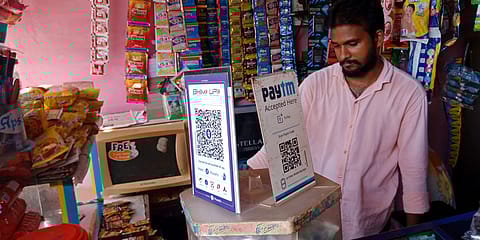
On UPI’s role in advancing financial inclusion across rural and semi-urban India, Masta said the platform made banking more accessible for millions. | Credits: Getty Images
After a decade of rapid growth that has transformed India’s payments landscape, the Unified Payments Interface (UPI) marked its 10th anniversary on April 11. From a nascent platform in FY17, UPI has expanded nearly 12,000-fold in transaction volume and more than 4,000 times in value, highlighting its central role in India’s digital economy.
Speaking to Fortune India, Harsh Vardhan Masta, Head of Payments at Policybazaar, said the impact of UPI is most visible in merchant adoption, particularly among small and informal businesses. “This is where UPI’s story becomes the most tangible. Walk through any Indian market today, from a South Delhi bazaar to a roadside chai stall in a small city, and you will see QR codes everywhere. That was not the case even five or six years ago,” he said.
According to Masta, UPI succeeded by eliminating barriers that had long kept small merchants away from digital payments. “No expensive POS machine needed, just a printed QR code that costs ten rupees. No separate merchant account, payments go straight into the shopkeeper’s existing bank account. No waiting for settlement, money arrives instantly. No technical knowledge needed, if you can use WhatsApp, you can accept UPI payments.”
He contrasted this with the card ecosystem, where merchants had to rent or buy a terminal, sign contracts, pay transaction fees, and wait a day or two for settlement. “There was simply no contest,” he added.
Masta said the larger impact lies in the financial trail created through digital payments. “A tea seller who used to deal entirely in cash now has a digital record of every sale through UPI. That transaction history is essentially a financial identity, something he never had before. A kirana store owner who could never walk into a bank and get a loan because he had no documents now has his UPI history speaking for him.”
UPI inclusion beyond urban India
On UPI’s role in advancing financial inclusion across rural and semi-urban India, Masta said the platform made banking more accessible for millions.
“Before UPI, digital payments meant remembering account numbers, IFSC codes, and navigating confusing net banking portals. UPI replaced all of that with a phone number or a simple ID. That single design choice changed everything,” he said.
He noted that UPI adoption initially remained concentrated in metros with better smartphones and faster internet while rural India continued to rely on cash. The turning point came with low-cost smartphones and cheap mobile data.
“Suddenly, a farmer in Madhya Pradesh or a tailor in a small town in Bihar could download a UPI app and start transacting,” he said.
Government welfare transfers such as PM-KISAN into Jan Dhan accounts also gave users a reason to engage with formal banking channels, while UPI became the easiest way to move funds. Features such as UPI 123PAY for feature phones and UPI Lite for low-value offline transactions further expanded reach.
“Because of this financial inclusion, at Policybazar we observe payments from Tier 3 and Tier 4 cities on a daily basis,” Masta said.
RANK
COMPANY NAME
REVENUE
(INR CR)
(INR CR)
{{#current-rank}} {{current-rank}} {{/current-rank}} {{^current-rank}} {{rank}} {{/current-rank}} {{name}} {{#revenue}} {{revenue}} {{/revenue}} {{^revenue}} {{noi}} {{/revenue}}
Biggest cybersecurity weakness
On cybersecurity challenges, Masta said UPI’s biggest vulnerability is not a sophisticated hack but misuse of trust. “UPI’s biggest security vulnerability is not some sophisticated hack. It is human trust being exploited,” he said.
Masta said the most common frauds are social engineering scams, where fraudsters impersonate banks or UPI helpdesks and create urgency. “They trick you into sharing your UPI PIN, or they send a collect request and convince you to approve it by saying it is a refund. You approve without reading carefully, and money leaves your account. This collect request scam is uniquely a UPI problem because of how the feature works,” he said.
He also flagged fake QR code scams, SIM swap attacks, and Android malware designed to intercept UPI credentials.
To address the risks, Masta called for stronger device-level authentication, biometrics beyond four-digit PINs, AI-driven fraud detection at the NPCI switch, and a unified fraud registry to help banks instantly share flagged accounts. “The generic ‘don’t share your OTP’ messaging is not working. People need to hear exactly what a scam call sounds like, exactly what a fake collect request looks like,” he said.
Why credit access is UPI’s biggest unfinished chapter
Looking back at 10 years of UPI, Masta described interoperability as its single greatest achievement.
“Before UPI, digital payments in India were walled gardens. Your Paytm wallet could only pay other Paytm users. Bank transfers needed account numbers and IFSC codes and often only worked during business hours. Cards worked at some shops but not others. Every system had its own boundaries,” he said. “UPI demolished all those walls. Today, you can use any app to send money to anyone at any bank, and it arrives in three seconds.”
He said India’s payments infrastructure compares favourably with global markets. “China’s digital payments are locked inside Alipay and WeChat Pay. America is still figuring out basic real-time bank transfers. Europe is fragmented across national systems. India built one unified, open payment network that handles over 14 billion transactions every month.”
However, he said the biggest unfinished chapter for UPI is credit access. “UPI has solved payments. Sending, receiving, and paying is effortless for hundreds of millions of Indians. But the harder and more important problem of getting affordable credit to people who need it remains largely unaddressed through UPI,” he said.
Masta noted that UPI already generates the data needed to solve this challenge. “If a small shopkeeper has been receiving fifty thousand rupees in UPI payments consistently every month for two years, that is powerful evidence of a viable business. That UPI transaction trail could replace the salary slips and tax returns that banks traditionally demand.”
While UPI’s credit line feature, launched in 2023, allows banks to link pre-approved loans to customer accounts, adoption has remained slow as lenders stay cautious amid tighter digital lending regulations.
“At Policybazar, we believe this is UPI’s most important unfinished chapter. If we can turn UPI payment data into credit access for the millions of small merchants and self-employed Indians who are locked out of formal lending today, that would be genuinely transformative,” he said while adding, “The infrastructure is ready. The data is flowing. What needs to catch up is the institutional willingness to trust that data and lend responsibly against it. That is the work of the next decade.”
Frequently Asked Questions
NEXT STORY