India’s fuel supplies secure despite West Asia crisis, Puri tells Parliament
/ 3 min read
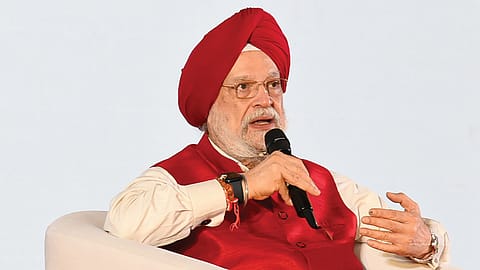
Union minister of petroleum and natural gas Hardeep Singh Puri
India’s fuel supplies secure despite West Asia crisis, Puri tells Parliament
India's fuel supplies remain secure despite the West Asia crisis, as Petroleum Minister Hardeep Singh Puri assured Parliament. The country has diversified its crude sources, reducing reliance on the Strait of Hormuz. While some cities report LPG shortages, the government attributes this to panic buying and has implemented measures to ensure steady supply.
This summary is AI-generated, and Fortune India is not responsible for its content or any associated copyright issues.
According to the minister, non-Hormuz sourcing has risen to around 70% of crude imports, compared with about 55% before the conflict began.
Union minister of petroleum and natural gas Hardeep Singh Puri
Petroleum and natural gas minister Hardeep Singh Puri on Wednesday told parliament that India’s fuel supplies remain secure despite disruptions to global energy flows caused by the ongoing conflict in West Asia, even as industry bodies in some cities have flagged shortages of commercial LPG.
Making a statement in the Lok Sabha, Puri said the global energy system was facing an unprecedented disruption after commercial shipping through the Strait of Hormuz—a route that normally carries about 20% of the world’s crude oil, natural gas and LPG supply—was affected by the escalating conflict involving Iran, Israel and the United States.
Despite the disruption, the minister said India had secured sufficient crude supplies and ensured uninterrupted availability of petroleum products across the country.
How secure is India’s crude supply position?
Puri said India’s crude supply position remains secure, with volumes secured exceeding what would normally have been delivered through the Hormuz route during the same period.
Before the crisis, around 45% of India’s crude imports transited the Strait of Hormuz, but the country has since expanded sourcing from other regions. According to the minister, non-Hormuz sourcing has risen to around 70% of crude imports, compared with about 55% before the conflict began.
India now imports crude from 40 countries, up from 27 in 2006-07, while domestic refineries are operating at very high utilisation levels, in some cases exceeding 100%.
Is there any shortage of petrol or diesel?
The minister said there is no shortage of petrol, diesel, aviation turbine fuel, kerosene or fuel oil in the country and retail outlets remain adequately stocked.
Additional allocations of public distribution system kerosene have also been issued to states to support households during the crisis.
Why has the government invoked the Essential Commodities Act?
To manage disruptions in gas supply, the government issued a Natural Gas Control Order on March 9 under the Essential Commodities Act, prioritising supply to households and transport fuel.
Under the order:
Domestic PNG and CNG receive 100% supply
Industrial consumers receive up to 80%
Fertiliser plants receive up to 70%, while refineries and petrochemical units absorb reductions.
The ministry said the move was necessary after imports of around 30 MMSCMD of natural gas were affected following disruptions at a Qatari facility.
{{#most-powerful-women-snapshot-individual.slug}} {{/most-powerful-women-snapshot-individual.slug}} {{^most-powerful-women-snapshot-individual.slug}} {{/most-powerful-women-snapshot-individual.slug}} {{#showRanking}} {{current-rank}} {{/showRanking}} {{#photo.0.url}}
{{name}}
Why has commercial LPG been regulated?
The government has also issued a LPG Control Order directing refineries to maximise LPG output and channel propane and butane streams towards domestic cooking gas supply.
As part of supply management, 20% of average monthly commercial LPG demand is currently being allocated through oil marketing companies in coordination with state governments.
Puri said the regulation was introduced to prevent hoarding and black marketing during a period of heightened demand and public anxiety.
What are restaurant bodies saying?
Hospitality associations in several cities have raised concerns about shortages of commercial LPG cylinders, warning that supply disruptions could affect restaurant operations.
The government, however, said field reports suggest the surge in demand is largely driven by panic booking and hoarding rather than a genuine supply deficit, and that measures such as booking limits and tighter monitoring are being enforced.
How is LPG supply being managed?
India previously sourced about 60% of its LPG imports from Gulf countries, including Qatar, the UAE, Saudi Arabia and Kuwait.
To offset potential disruptions, the government has diversified procurement to include supplies from the United States, Norway, Canada, Algeria and Russia. Refineries have also been directed to maximise output, leading to a 28% increase in LPG production in the past five days, according to the minister.
“This is not the moment for rumour-mongering or fake narratives,” the minister told Parliament, stressing that fuel availability across the country remains secure.
What has the government said about shipping through Hormuz?
Meanwhile, the Ministry of External Affairs said External Affairs Minister S. Jaishankar and Iran’s foreign minister have held three conversations in recent days, including discussions on shipping safety and India’s energy security.
Responding to reports that Iran may have allowed India-flagged vessels to pass through the Strait of Hormuz, the MEA said it would be “premature” to comment further beyond confirming the discussions.
Follow Fortune India
NEXT STORY