IndiGo, Cleartrip, ixigo issue alerts as Gulf airspace closures hit overseas travel
/ 3 min read
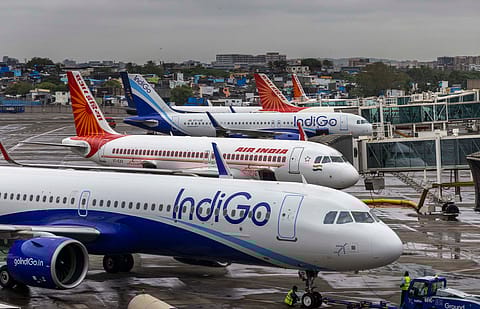
Credits: Narendra Bisht
IndiGo, Cleartrip, ixigo issue alerts as Gulf airspace closures hit overseas travel
The closure of Gulf airspace due to escalating tensions between Iran and Israel has severely disrupted global air travel, affecting major routes between Asia, Europe, and North America. Indian carriers, particularly Air India, face increased costs and delays. Travel platforms like Cleartrip and ixigo are advising passengers to check flight statuses and offering refunds and rerouting options.
This summary is AI-generated, and Fortune India is not responsible for its content or any associated copyright issues.
Countries including the United Arab Emirates, Kuwait, Oman, Jordan, Iraq and Iran imposed temporary airspace restrictions, while Israel shut its own skies and suspended civilian operations at Ben Gurion Airport
THIS STORY FEATURES
Credits: Narendra Bisht
Air travel across the Middle East was thrown into turmoil over the weekend after several Gulf nations shut their airspace indefinitely, responding to escalating hostilities between Iran and Israel and subsequent US airstrikes on Iranian targets. The sweeping closures have disrupted one of the world’s busiest aviation corridors, triggering widespread cancellations, diversions and rerouting of long-haul services linking Asia, Europe and North America.

Countries including the United Arab Emirates, Kuwait, Oman, Jordan, Iraq and Iran imposed temporary airspace restrictions, while Israel shut its own skies and suspended civilian operations at Ben Gurion Airport. Airlines scrambled to alter flight paths, with many services forced to take longer, fuel-intensive detours or suspend operations altogether.
Among the hardest hit were Indian carriers, particularly Air India, whose Europe and North America routes routinely transit Middle Eastern airspace. Industry executives said the closures have added hours to flight times on certain sectors, increased operating costs, and prompted precautionary cancellations as airlines reassess viable routings.
The fallout is significant for India. As of November 2025, the United Arab Emirates remained the country’s largest international aviation market, accounting for 1.1 million monthly seats and a commanding 27% market share. Capacity on the corridor was running 3% higher year-on-year, underscoring sustained demand. The international hub handled nearly 12 million passengers in 2025 and acts as the primary gateway to Europe, America, and Africa. They facilitate massive trade and tourism, with over 600 weekly flights connecting India and the UAE, serving as a vital link for Indian workers, students, and businesses.
For the UAE, India is its single most important international aviation partner, far ahead of the next-largest market, Thailand, which accounts for just 9%.
With such dense traffic flows, even short-lived restrictions ripple quickly through airline networks.
Airlines activate refunds, advisories and flexibility
Online travel platforms and carriers moved swiftly to manage passenger disruption.
Cleartrip advised travellers that flights to the region and connecting journeys “might be affected” due to ongoing airspace restrictions. The company asked customers to verify flight status with airlines before heading to the airport and said passengers whose flights were cancelled could request refunds through the app. It cautioned that refund validation from airlines could take five to seven working days before processing.
Ixigo said multiple carriers had announced cancellations, suspensions or rerouting of flights across affected regions due to airspace closures linked to heightened geopolitical tensions. The platform said it had begun proactive Voice AI calls to customers whose plans may be affected, providing real-time updates and assistance with changes or alternatives.
EaseMyTrip urged international travellers to monitor airline updates, keep return plans flexible and secure confirmed bookings in advance. “Airlines are actively rerouting flights to ensure passenger safety,” EaseMyTrip co-founder Rikant Pitti said in a post on X, warning of longer flight durations and schedule adjustments for those transiting through or around the region.
Low-cost carrier IndiGo extended the temporary suspension of select international flights that use Middle East airspace until 2 March 2026, 2359 hrs IST. The airline said impacted customers could opt for alternate flights or full refunds, and announced waivers for travel to and from the Middle East and other affected international sectors for bookings made on or before 28 February 2026.
{{#most-powerful-women-snapshot-individual.slug}} {{/most-powerful-women-snapshot-individual.slug}} {{^most-powerful-women-snapshot-individual.slug}} {{/most-powerful-women-snapshot-individual.slug}} {{#showRanking}} {{current-rank}} {{/showRanking}} {{#photo.0.url}}
{{name}}
Global carriers outside the region also suspended or diverted flights after the United States and Israel launched airstrikes on Iran, amplifying operational strain across hubs such as Dubai and Doha that typically function as major transit gateways between East and West.
For now, airlines are prioritising safety and network stability. But if the closures persist, the impact could deepen — pushing up fares on alternative routings, tightening seat availability on India–Europe and India–North America corridors, and placing further pressure on carriers already navigating volatile fuel prices and geopolitical risk.
Follow Fortune India
NEXT STORY