Cinépolis doubles down on ‘future-ready’ cinemas with Dwarka launch, eyes expansion beyond metro cores
/ 3 min read
The move marks a strategic push by Cinépolis India to build a structured cinema advertising business alongside its core exhibition operations.
Cinépolis doubles down on ‘future-ready’ cinemas with Dwarka launch, eyes expansion beyond metro cores
Cinépolis India is expanding its premium cinema offerings with a new multiplex in Dwarka, New Delhi, focusing on high-density micro-markets. The launch aligns with festive holidays, offering introductory pricing to attract audiences. This strategy reflects a shift towards format-led growth, emphasizing technology, experience, and accessibility to compete in the evolving multiplex industry.
This summary is AI-generated, and Fortune India is not responsible for its content or any associated copyright issues.
Festive pricing, premium formats, and micro-market targeting anchor the multiplex chain’s next phase of growth as it scales to 489 screens across India.
The move marks a strategic push by Cinépolis India to build a structured cinema advertising business alongside its core exhibition operations.
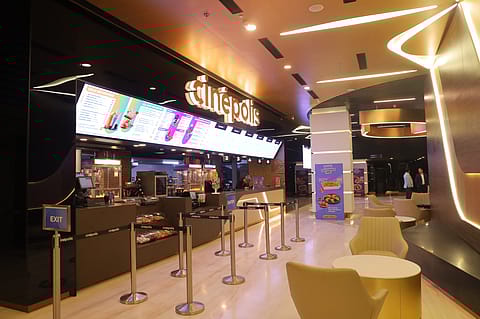
Cinépolis India is stepping up its expansion strategy with a sharper focus on premium formats and high-density micro-markets, as it opened a new multiplex in Dwarka, New Delhi, amid a key festive window.
Why is Cinépolis focusing on premium formats and micro-markets?
The five-screen, 761-seat property at City Centre II Dwarka marks the company’s eighth “Future Ready Cinema” launch in the past 12 months, underlining a shift from incremental screen additions to format-led growth. With two more properties planned before the end of 2026, the company is signalling sustained investment in next-generation exhibition infrastructure.
“Dwarka is exactly the kind of market that validates our expansion thesis—a high-density catchment with diverse audiences,” said Devang Sampat, managing director, Cinépolis India, adding that each new cinema is designed to deliver on technology, food and beverage, loyalty, and accessible pricing.
The timing of the launch—aligned with the Eid, Ugadi, and Gudi Padwa holidays—appears deliberate. Cinépolis is offering introductory ticket pricing starting at ₹300 for Dhurandhar 2, the only major release during the extended weekend, in a bid to maximise early footfall and build momentum for the new property.
The strategy reflects a broader recalibration underway in India’s multiplex industry. After a pandemic-led disruption and the subsequent rise of streaming platforms, theatre operators are increasingly relying on a combination of premium experiences and tactical pricing to draw audiences back.
Cinépolis’s “Future Ready Cinema” model sits at the centre of this approach. The format integrates laser projection, Dolby sound, and recliner seating across all auditoriums, while also emphasising food and beverage offerings and loyalty programmes as key drivers of repeat visits. The aim is to make the cinema outing more experiential, rather than purely transactional.
“Expansion is not just about adding screens,” said Sampat, highlighting the company’s focus on technology, in-cinema experience, and pricing accessibility as core pillars of growth.
Can festive pricing and experience drive sustained footfall?
The Dwarka launch also reflects a more granular market selection strategy. Instead of concentrating solely on central business districts or high-profile malls, operators are increasingly targeting densely populated residential clusters with strong consumption potential but relatively limited access to premium cinema infrastructure.
Such locations offer a dual advantage: a built-in audience base and lower competitive intensity. They also align with a broader consumption shift, where demand is spreading beyond traditional metro hotspots into suburban and peripheral urban markets.
Mall developers, too, continue to view multiplexes as anchor tenants that drive sustained footfall. “We are delighted to welcome Cinépolis to City Centre II Dwarka. A multiplex of this calibre is a meaningful addition and is expected to drive footfall, especially during the festive weekend,” said Harsh Vardhan Bansal, co-founder, Unity Group & Vegas Mall.
With the latest addition, Cinépolis India’s network has grown to 489 screens across 41 cities. But the emphasis is increasingly on the quality and consistency of formats rather than just scale. The company’s ongoing rollout of “Future Ready” properties suggests an attempt to standardise the cinema experience across locations, positioning it as a differentiated offering in an increasingly competitive entertainment landscape.
{{#most-powerful-women-snapshot-individual.slug}} {{/most-powerful-women-snapshot-individual.slug}} {{^most-powerful-women-snapshot-individual.slug}} {{/most-powerful-women-snapshot-individual.slug}} {{#showRanking}} {{current-rank}} {{/showRanking}} {{#photo.0.url}}
{{name}}
For the industry, the challenge remains balancing premiumisation with affordability. While audiences have shown a willingness to pay for high-quality experiences—particularly for event films and festive outings—price sensitivity continues to influence frequency of visits.
Cinépolis’s decision to combine upgraded infrastructure with entry-level pricing for a key release window indicates a hybrid strategy: build premium assets, but ensure accessibility to drive volume.
As theatrical exhibition continues to evolve, such format-led and market-specific strategies are likely to define the next phase of growth. The Dwarka multiplex, in that sense, is less about a single property launch and more about how operators are rethinking the business of going to the movies in India.
Follow Fortune India
NEXT STORY