Rolls-Royce’s Black Badge turns 10: The alter ego that reshaped modern luxury
/ 5 min read
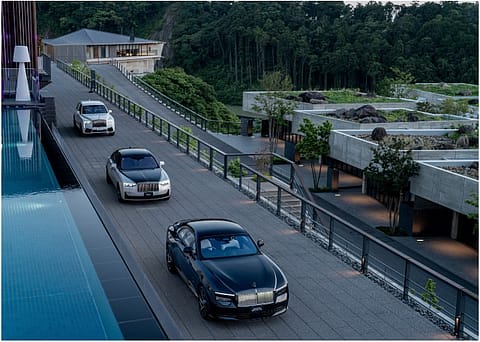
Rolls Royce Black Badge celebrates 10 years of its successful introduction | Credits: Rolls Royce Motor Cars
Rolls-Royce’s Black Badge turns 10: The alter ego that reshaped modern luxury
Celebrating a decade since its inception, Rolls-Royce's Black Badge has redefined luxury with its bold, dark aesthetic. Originating in 2016, it draws inspiration from the brand's rebellious history, including John Lennon's iconic Phantom V. Black Badge has become a symbol of modern luxury, appealing to a new generation of entrepreneurs seeking dynamic, expressive vehicles.
This summary is AI-generated, and Fortune India is not responsible for its content or any associated copyright issues.
From a rebellious aesthetic to a global cultural influence, Rolls-Royce’s darker expression marks a milestone moment.
Rolls Royce Black Badge celebrates 10 years of its successful introduction | Credits: Rolls Royce Motor Cars
Rolls-Royce Motor Cars marks a defining milestone this year: Ten years since the debut of Black Badge, the marque’s bold alter ego that redefined modern super-luxury. Introduced in 2016, Black Badge established a new aesthetic and dynamic template -- darker, more assertive and unapologetically expressive -- that has since echoed across the wider luxury sector. Yet while Black Badge feels distinctly contemporary, its spirit can be traced back almost a century.
From its founding, Rolls-Royce has balanced refinement with rebellion. Its creators, Henry Royce and Charles Rolls, were disruptors in their own ways. Royce overcame poverty and ill health to become one of history’s most revered engineers, while Rolls -- an aristocrat educated at Cambridge -- rejected a life of comfort to pursue the risks of early motor racing and aviation. Their shared defiance of convention laid the foundations for a brand that would come to represent both excellence and individuality.
During the digitisation of the company archives, historians documented a striking early precedent for the Black Badge aesthetic. In 1928, a 20 H.P. Brewster Brougham was delivered with its Spirit of Ecstasy and radiator grille finished in black rather than the era’s customary polished metal. At a time when chrome symbolised prestige and modernity, this darker treatment was daring and unconventional. Commissioned by J. E. Aldred, a financier of Rolls-Royce of America, the motor car reflected the confident, cosmopolitan tastes of a new generation. Aldred’s later commissioning of Montreal’s Aldred Building -- a landmark Art Deco tower -- underscored his affinity for bold, dramatic design. His blacked-out motor car anticipated the visual codes that would define Black Badge nearly a century later.
If that 1928 commission hinted at rebellion, one motor car in particular embodied it. In 1964, at the height of Beatlemania, John Lennon ordered a Rolls-Royce Phantom V finished almost entirely in black. Built by Mulliner Park Ward and supplied by R. S. Mead of Maidenhead, the car rejected the bright chrome accents typical of the period. Its bumpers and wheel discs were rendered in deep gloss black, complemented by darkened Triplex Deeplight glass.
Lennon explained his reasoning in a 1965 interview with Rolling Stone: “It’s for when you’re coming home late. If it’s daylight when you’re coming home, it’s still dark inside the car. You just shut all the windows, and you’re still in the club.” The remark captured more than a preference for privacy; it revealed an attitude -- subversive, theatrical and entirely personal. Today, this uncompromising Phantom V is widely regarded as the spiritual progenitor of Black Badge.
It would take more than half a century -- and a technological revolution -- for this darker expression to re-emerge as an official Rolls-Royce philosophy. In the early 2010s, a new generation of entrepreneurs approached the marque. Young, self-made and often rooted in digital industries, they sought exquisitely crafted products that matched their dynamic, disruptive lives. They admired Rolls-Royce’s V12 power and peerless craftsmanship but requested something more dramatic -- an interpretation that reflected their own bold narratives.
After careful internal deliberation, Rolls-Royce responded with Black Badge. The new sub-brand retained the marque’s uncompromising standards but introduced vivid colours, technical materials and a more urgent driving character. Icons such as the Spirit of Ecstasy, the Pantheon grille and the double-R Badge of Honour were cloaked in black chrome. A mathematical infinity symbol was adopted as Black Badge’s emblem, referencing both limitless power and the audacious spirit of Sir Malcolm Campbell’s record-breaking Blue Bird K3 hydroplane.
The visual drama extended to the paintwork itself. To create one of the industry’s darkest blacks, 45 kilograms of paint were atomised onto an electrostatically charged body before oven-drying. Two layers of clear coat followed, then hours of meticulous hand-polishing to achieve a piano-like gloss. The depth of this finish provided a striking canvas for the hand-painted coachline.
Beneath the surface, Black Badge motor cars were engineered for heightened engagement. Enhanced power and torque, recalibrated transmissions, sharpened throttle response and a more resonant exhaust note signalled a shift toward self-driven dynamism. Even the discreet ‘Low’ button was reconfigured to unlock additional reserves of performance. Inside, aerospace-inspired materials such as carbon fibre interlaced with aluminium threads introduced a contemporary, technical aesthetic, while Physical Vapour Deposition darkened interior brightwork to ensure enduring richness.
Black Badge debuted in 2016 with Black Badge Wraith and Black Badge Ghost at the Geneva Motor Show. That same year, a Black Badge Wraith tackled the rain-soaked hill at the Goodwood Festival of Speed, recording one of the fastest times ever achieved by a Rolls-Royce road car -- tangible proof that its intensity was more than skin deep.
Since then, the Black Badge family has expanded to include Black Badge Dawn, Black Badge Cullinan and, most recently, Black Badge Spectre, alongside Black Badge Ghost. Today’s portfolio -- Black Badge Spectre, Black Badge Ghost and Black Badge Cullinan --represents the most powerful and expressive interpretations of the marque’s craft.
{{#most-powerful-women-snapshot-individual.slug}} {{/most-powerful-women-snapshot-individual.slug}} {{^most-powerful-women-snapshot-individual.slug}} {{/most-powerful-women-snapshot-individual.slug}} {{#showRanking}} {{current-rank}} {{/showRanking}} {{#photo.0.url}}
{{name}}
Over the past decade, Black Badge has also inspired extraordinary Bespoke commissions that draw on influences far beyond traditional luxury: vintage video games, collectible sneakers, graffiti art and even the digital economy. Limited expressions such as Black Badge Adamas, Black Badge Neon Nights, Landspeed and Ékleipsis have reinforced its cultural relevance. Ownership experiences have evolved in parallel, from private runway driving events to immersive urban takeovers.
“From the outset, Black Badge was created to welcome a new generation of clients into Rolls-Royce: individuals who express their success unapologetically and with conviction. By serving them with the care and precision that defines the wider Rolls-Royce experience, we have made the marque relevant to many clients who may never have previously considered it,” Rolls-Royce Motor Cars CEO Chris Brownridge observed. This has supported the measured and sustained growth of Rolls-Royce Motor Cars over the ten years since Black Badge was introduced. Proof of its success is also evident beyond our own performance: Black Badge has established an aesthetic and experiential template that echoes throughout the luxury sector. I am excited to drive the further evolution of Black Badge in the years ahead.”
As Black Badge enters its second decade, demand continues to grow for ever more expressive interpretations. What began as a daring experiment has become a defining pillar of the brand -- a universe within Rolls-Royce where craftsmanship meets creative defiance. The alter ego that once challenged convention now shapes it, ensuring that the spirit of rebellion first glimpsed in 1928 -- and immortalised in Lennon’s midnight-black Phantom -- continues to evolve for a new era of luxury defined on its own terms.
NEXT STORY