India’s Biggest Unicorns: cult.fit is betting on acquisitions, disciplined expansion, and community-led programming for sustainable growth
/ 6 min read
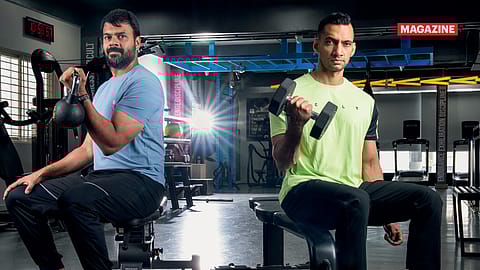
Naresh Krishnaswamy, CEO (left), and Rishabh Telang,
co-founder, cult.fit
India’s Biggest Unicorns: cult.fit is betting on acquisitions, disciplined expansion, and community-led programming for sustainable growth
Cult.fit, born from a single Bengaluru warehouse in 2016, has grown into a $1.43 billion fitness-tech unicorn by productising structured, coached group workouts in India. Backed by investors like Accel and Tata, it blends booking-based discipline, athlete-coaches, and community events with a multi-tier pricing strategy to drive retention and expand fitness penetration nationwide.
This summary is AI-generated, and Fortune India is not responsible for its content or any associated copyright issues.
As India’s fitness market gears up to double by 2030, cult.fit, ranked 24, is combining acquisitions, disciplined expansion, and community-led programming to convert awareness into a lasting habit — and sustainable growth.
Naresh Krishnaswamy, CEO (left), and Rishabh Telang,
co-founder, cult.fit
This story belongs to the Fortune India Magazine march-2026-indias-biggest-unicorns issue.
WHEN THE MOTLEY bunch showed up at a converted warehouse in Bengaluru for a workout, they saw it was nothing like a typical Indian gym. There were no mirrors lining the walls. No treadmill rows. No bro-science routines scribbled on sheets of paper. Instead, there was structure. There was a coach leading from the front. There was synchrony in their burpees and box jumps.
That session in May 2016 was cult.fit’s very first class. The banner on the warehouse’s façade had attracted curious locals to the industrial-style leased commercial unit repurposed into a group workout studio. Who would have thought that it would grow into one of India’s earliest fitness-tech unicorns? cult.fit, later a part of Curefit Healthcare Pvt. Ltd, did not stop at opening gyms. It attempted to productise fitness in a country where gym-going was largely informal, unstructured, and often short-lived.
Nearly a decade later, that bet gave it a $1.43 billion valuation as of March 2025, total equity funding of $667 million across 12 rounds, and revenue of ₹1,272 crore in FY25, up 24% year-on-year. While Curefit is the corporate entity, cult.fit (often referred to simply as “cult”) is the consumer-facing brand.
The journey, however, required far more than kettlebells and community. It has demanded capital, conviction, and an unflinching belief that behaviour change can be engineered at scale.
From CrossFit to cult
The idea was not born in a boardroom. It germinated in Rishabh Telang’s mind during his European work trips around 2014-15. Having quit a well-paying job, he was checking out CrossFit, martial arts, and functional movement studios. Telang saw structured, coached group formats — a rarity in India. His career so far in sales, marketing, and business analytics had left him with enough cash to pursue his ‘hobby’ of fitness. He founded the first cult gym with his brother Ritesh in 2016.
The business caught the eye of Myntra founder Mukesh Bansal and former Flipkart senior executive Ankit Nagori. In six months, they offered a term sheet to the brothers and invested $3 million to expand it. Later, they folded it into Curefit Healthcare Pvt. Ltd. This was a time when bodybuilding dominated the Indian fitness landscape. Aesthetics trumped athleticism. Professional programme design was largely locked behind expensive personal training packages.
More Stories from this Issue
Telang studied fitness science, observed behavioural patterns in local gyms, and reflected on his own transformation through periods of weight gain and weight loss. “The workouts had a life-transformative effect on me physically and mentally,” Telang, 5’8”, says. “I met coaches and athletes from different parts of the world who helped me get better every single day.”
His formula: Ask people to show up. Design everything else around that. What emerged was an ecosystem spanning structured programme design, standardised equipment formats, a proprietary technology backbone, coach recruitment pipelines, and an internal academy that focussed on pedagogy, empathy and personal fitness standards. Retention was the key. Pre-booked classes reinforced commitment bias. Coach familiarity fostered trust. Milestone progression programmes such as cult Ninja and cult Champions created visible goals. Community bonding through events like Yogathon and Unbound strengthened engagement. Peer recognition through squads and app-based reminders reinforced consistency.
Pricing reflected segmentation. The entry-level cultpass PRO memberships typically range from ₹10,000 to ₹12,000 annually. Mid-segment cult Elite formats are priced around ₹15,000–20,000 annually. Premium and luxury offerings such as Gold’s Gym and Fitness First can go up to ₹60,000 annually, depending on the city and package. Shorter-duration packs and EMI options are available to widen access.
Structure & coaching
{{#most-powerful-women-snapshot-individual.slug}} {{/most-powerful-women-snapshot-individual.slug}} {{^most-powerful-women-snapshot-individual.slug}} {{/most-powerful-women-snapshot-individual.slug}} {{#showRanking}} {{current-rank}} {{/showRanking}} {{#photo.0.url}}
{{name}}
Telang picked three points. First, a high-quality programme design. Second, accountability. Third, quality coaching by athletes for form correction. The warehouse, cult.fit’s birthplace, was stripped to its structural frame and rebuilt from the floor up. Shock-absorbent flooring was laid. Rigs, squat racks, and sled tracks were installed. The layout was designed for coached formats rather than open-access equipment rows.
As the chain expanded — today over 700 gyms across more than 60 cities — recruitment became the bigger operational challenge. Cult mapped “sporting India”, building relationships with sports NGOs and scouting athletic talent across multiple regions, including parts of Haryana and the North-east, such as Shillong. It tapped former state- and national-level athletes for coaching roles. “They saw the passion that athletes-turned-coaches brought to the floor,” Rishabh says. “Adoption grew because they found coaches who care.”
Gym attendance in India had long been built around flexibility. Cult insisted on booking-based access for group classes to maintain quality and capacity discipline. During the pandemic lockdowns, subscribers could access digital workouts without mandatory slot bookings. Live-streamed sessions were intentionally equipment-light, relying largely on bodyweight movements and minimal household substitutes than traditional gym gear.
Booking a workout became akin to calendaring a meeting. It reduced excuses. It improved consistency. It nudged behaviour. In retrospect, booking was less about logistics and more about psychology. When gyms shut down in 2020 due to lockdowns and restrictions on physical contact, the company launched cult Live, which is now cult Home. Nearly a million people used it during the lockdowns, including existing members and new digital-only users. For CEO Naresh Krishnaswamy, a passionate footballer who also participates in internal events such as Fit Games, the pandemic was an inflexion point.
Investors include Accel, Kalaari Capital, Chiratae Ventures, the Tata group, and Zomato. A Tracxn report in January shows cult has raised $667 million across 12 equity rounds. The largest round, in November 2021, brought in $180 million. Post-money valuation stands at $1.43 billion as of March 29, 2025. Revenue grew from ₹294.9 crore in FY21 to ₹1,272 crore in FY25. The three-year revenue CAGR stands at 59%. The net loss in FY25 was ₹481 crore, down from ₹889 crore in FY24.
Fitness services — gyms, group workouts, and personal training with subscription fees accounting for nearly three-fourths of the segment — bring in two-thirds of revenues. The rest is products. The fitness services business turned cash-flow positive in H1FY26.
Growth via acquisitions
Cult’s growth has been both organic and inorganic. Its latest acquisition was Gold’s Gym India in February 2022. It had earlier acquired Fitso in November 2021, Fitternity (February 2021), TREAD (June 2021), and OneFitPlus (December 2021), among others.
The company often retains the identity of the gym it acquires. Gold’s Gym India continues to operate within the premium ‘lux’ segment. The objective was not to dilute brand equity but to strengthen it. Pricing reflects segment positioning. Altering the brand would have risked eroding global recognition, franchise value, and its positioning.
Each acquisition gave cult new verticals — standalone gyms, sports bookings, franchising, and home fitness solutions, including equipment ranging from free weights to treadmills and other cardio machines. Each brand is designed for a clearly defined consumer segment and retaining it has helped cult expand the addressable market rather than fragment it.
Its partnership with actor Hrithik Roshan, collaborating on the HRX workout format available at cult centres, deepened cult’s positioning at the intersection of celebrity-led aspiration and structured fitness programming.
Today, cult operates across multiple formats: cult Neo for entry-level consumers, cult Elite for mid-segment guided workouts, and premium formats such as Gold’s Gym and Fitness First. cult Neo and cult Elite do not share the same physical space. Each caters to a distinct segment, with differing experience expectations and pricing sensitivities. The company also ranks first among 46 fitness startups by Tracxn score. Among funded peers, HealthifyMe has raised $145 million and Goqii $110 million.
There’s also cultsport, a mid-market athletic lifestyle brand that aims to make activewear and fitness essentials accessible without compromising durability, comfort or functional performance. “It is the natural extension of a brand built around creating an active lifestyle,” Krishnaswamy says.
According to a Deloitte–Health & Fitness Association report, India’s fitness market is poised to more than double by 2030. The industry is projected to grow from ₹16,200 crore ($1.9 billion) in 2024 to ₹37,700 crore ($4.5 billion) by 2030, delivering a 15% CAGR. Yet India’s gym penetration remains far below global averages. It currently has 12.3 million fitness facility members, expected to rise to 23.2 million by 2030. Even then, penetration will move from just 0.8% to roughly 1.7%. Of India’s 956 million people aged 18–62, nearly 820 million remain inactive. Only 15% of physically active individuals pay for structured fitness. The top 10 cities account for 56% of industry revenue but only 31% of facilities, signalling whitespace across Tier II and III markets.
The CEO notes that in cities where cult has gone deep, overall gym penetration rises as first-time users join. “We had conviction that more people would start their fitness journey with better accessibility to quality gyms.” With plans to expand to at least 100 cities in five years, the runway is long. “For us, success is linked to our ability to drive fitness penetration in India,” he says. cult wants to reach homes through products and sustain growth without disproportionately increasing marketing spend. Growth momentum in H1FY26 clocked around a 40% rise in operating revenue.
If cult has demonstrated anything over the past decade, it is discipline. Like any good training programme, progress has come rep by rep.
Follow Fortune India
Sign in to read full story
To access our exclusive magazine content, sign in to your Fortune India account.
Sign In NowNEXT STORY