India’s Biggest Unicorns: How upGrad is solving the skilling gap
/ 7 min read
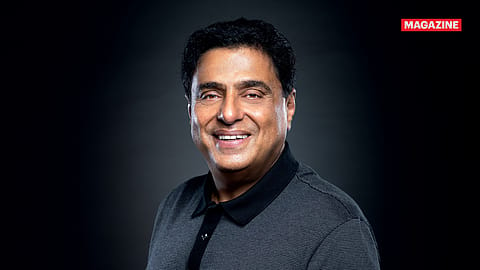
Ronnie Screwvala, founder & chairman, upGrad | Credits: Narendra Bisht
India’s Biggest Unicorns: How upGrad is solving the skilling gap
Ronnie Screwvala, known for his knack for identifying business opportunities, has successfully transformed upGrad into a leading edtech unicorn by focusing on higher education. Despite initial scepticism, upGrad has thrived by offering innovative online courses and skilling programs, addressing India's skill gap and preparing for an IPO, while expanding globally and advocating for the importance of online education.
This summary is AI-generated, and Fortune India is not responsible for its content or any associated copyright issues.
Online education is the only way India can skill its people and make them job-ready, says Ronnie Screwvala, founder, upGrad, which is No. 12 on the list.
Ronnie Screwvala, founder & chairman, upGrad | Credits: Narendra Bisht
This story belongs to the Fortune India Magazine march-2026-indias-biggest-unicorns issue.
RONNIE SCREWVALA has always had an eye for big businesses. Be it selling toothbrushes in the early years of his entrepreneurial journey, setting up a cable TV operation, or building a large media business, Screwvala is a pro at identifying niches and converting them into ventures of scale. However, each time he pinpointed a category/business he believed had potential, he found more naysayers than believers. And he has, time and again, proved them wrong.
Take the media business, for instance. “When I got into the media business, for 10 years I got a bashing from analysts questioning my focus. If you are a content company you should focus on making content, is what they told me. But we built 10 broadcasting channels, an animation studio, a movie studio, a special effects studio and we were also content producers. And we sold our business to Walt Disney Company at $1.4 billion. Today there are 30 media companies, and only a handful are over $40 million,” Screwvala says.
Proving naysayers wrong has become a way of life for Screwvala. He has never been a fan of the herd mentality and has always built businesses out of nothing. One of his more recent ventures is edtech platform upGrad. From the day he launched the platform in 2015, he was clear that he would focus only on higher education and not K-12. This was at a time when investors were falling over each other to pour money into platforms such as BYJU’S, which promised to take the online K-12 narrative to a new level through its application-based teaching style. Screwvala’s premise was that the curriculum of Indian universities was outdated and needed large-scale disruption. Meanwhile, online K-12 was augmented learning, which he felt could neither be disrupted nor was it possible to measure outcomes.
His bet on higher education proved to be a winner. In 2021, upGrad became a unicorn. Around five years later, the company — which posted revenue of ₹1,650 crore in FY25, according to Tracxn data — is getting ready for an IPO. Meanwhile, almost all of upGrad’s K-12 online peers are struggling, and some have even shut down.
While upGrad entered the market as a platform for professionals to upgrade their skills, it has over the years catapulted into a full-fledged edtech firm. Today, it services all aspects of higher education — online undergrad and postgraduate programmes, certificate courses, study abroad programmes (which includes counselling), as well as offline learning centres across India. It also has a B2B service that offers skilling programmes and placement services to corporates. And in late February, it acquired a 90% stake in internship and early-career hiring platform Internshala.
But Screwvala isn’t done. He is on a mission to solve the humungous skill deficiency staring at India Inc. He believes India can’t meet its Viksit Bharat target unless it adequately skills its workforce. And that can only happen via online platforms, he says.
At the same time, he is against frequent fund raises, especially in education. “You can’t build it with a one- to two-year view of ‘Let’s raise money’. You need long-term commitment,” he says. One of his pet peeves is being asked about when he will raise the next round of funding. “They could ask me, ‘[When] will the number of people studying online in India be double that of people studying offline?’ I’d rather have that question.”
More Stories from this Issue
Education isn’t a consolidation play either, he says. “You can’t buy four or five companies and think everything will happen.” Fundraising, he says, is not relevant for the education sector. “The problem that happened in the K-12 sector is they got money when they didn’t need it, they shouldn’t have needed it. If you raise money, you can’t take a long-term view.”
India’s edtech market was valued at $3.63 billion in 2025 and was projected to reach $33.31 billion by 2034, at a CAGR of 27.94% between 2026 and 2034, says data from market research and consulting firm IMARC Group.
Online is key
Building an organic business that would stand the test of time needs deep pockets. Screwvala, after the Walt Disney deal in 2012-13, had that and decided to take a long-term approach. “From the beginning it was that I am going to build something solid, and I think my innings in media outlasted 2,000 players. In education also, you need to outlast [others].”
The premise for setting up upGrad, Screwvala says, was to disrupt India’s higher education ecosystem. The idea was to add 25-30% of new-age courses to the existing curriculum of higher education institutions, to make students job-ready. “We tied up with universities not to take their offline courses online, but [to] co-create new courses,” he explains. One of the first courses upGrad designed was on data science with the International Institute of Information Technology Bangalore (IIIT-B). “They didn’t have a data science course, so we designed it together and launched it. We recently celebrated the 30,000th online graduate from IIIT-B.”
{{#most-powerful-women-snapshot-individual.slug}} {{/most-powerful-women-snapshot-individual.slug}} {{^most-powerful-women-snapshot-individual.slug}} {{/most-powerful-women-snapshot-individual.slug}} {{#showRanking}} {{current-rank}} {{/showRanking}} {{#photo.0.url}}
{{name}}
The platform also partnered with the likes of University of Chandigarh, D.Y. Patil University, and O.P. Jindal Global University to offer new-age undergrad as well as postgraduate courses. These courses are targeted at working professionals — for whom leaving jobs to study further is not an option, but at the same time they need to upgrade their skills to grow in their career.
The other part, and the most popular part of the business, is, of course, the short-term skill-based certificate programmes, the duration of which are anywhere between three months and eight months. It could be a six-month course on project leadership or an eight-month executive postgraduate course on Generative AI and Agentic AI from IIT Kharagpur, with a clear intent to help upgrade one’s existing skills.
Then there’s also upGrad’s brick-and-mortar format — upGrad Learning Centres — across the country (currently at 30, with plans to scale them to 200), which targets college graduates who haven’t landed a job yet. These students can undergo four- to five-month skilling courses at these centres and get themselves job-ready.
However, Screwvala firmly believes that the only way India can achieve its target of skilling people is through online education. “Most people think it is an adjunct and I am saying when people look at prices and costs, if you can study online, you are saving on boarding and lodging and you are saving on opportunity cost because you are able to carry on with your job. That to me is the key edifice of online. The unfortunate part is that nobody understands the importance of online,” Screwvala says, adding that even universities look at it as outside their core.
“At the core level, the government also knows without online we are not going to change our gross enrolment ratios nor can India be a Viksit Bharat because we haven’t got fundamental education. Online is the only way this can be solved and therefore there should be credible options,” he explains. Brick-and-mortar colleges and universities do play an important role, but it is only online that would enable education at scale, believes Screwvala. “We don’t have $200 billion to put in for 400 more universities with faculty. Some universities are getting grants of ₹2,000 crore, but they are serving 1,900 students. That’s a niche.”
upGrad also has a study-abroad service, where it helps students to pursue education at foreign universities. Even there it has an online element. “We have created a pathway programme where we have tied up with global universities, and now a student can do her first year online and go to the campus from the second year onwards. Suddenly we have made foreign university education affordable and accessible. If you are doing a two-year course, then it is half the cost, because your boarding and lodging cost in the first year is zero,” Screwvala explains.
Empowered, not entitled
Though upGrad’s mission is to skill Indians and make them job-ready, it doesn’t believe in giving them jobs per se. None of their programmes promise placements. Entitlement is a big problem when it comes to jobs, believes Screwvala.
“The moment you do skilling there comes the entitlement of where is my job. Yes, you have upgraded yourself, and in fact just paid an insurance payment to be less redundant in less period of time — that acceptance is not there.” Screwvala points to self-employment. He says that skilling has to be done in such a way that if people don’t manage to get employment, the skills they have acquired would enable them to be self-employed.
“If a person gets skilled in hospitality, he could join a restaurant or Taj Hotels, but he should also be able to start his own dhaba. We are adding 40 km of roads everyday so the opportunity for a highway eatery is immense.”
Besides India, upGrad has also spread its wings to Indonesia, Vietnam, and the Middle East, among others; and it is investing heavily to expand in the Middle East, and APAC nations such as Singapore, Japan, and Malaysia. It is also getting ready for an IPO in 2027, through which it intends to raise around $350-400 million. Screwvala is clear that the capital would only be used in strengthening the online education ecosystem in India and not to grow inorganically.
“If you look at the context today, what we have not been able to solve is the credibility of online education. It’s still looked [at] as a step down, but actually it’s not. We were trying to change the perception, and everything became negative because people lost money which they shouldn’t have put in the first place.”
Screwvala is well and truly on a mission to make online education an integral pillar as India strides towards Viksit Bharat by 2047.
Follow Fortune India
NEXT STORY