India’s Biggest Unicorns: Mobility vanguard Rapido plans to build the country’s largest gig ride economy
/ 6 min read
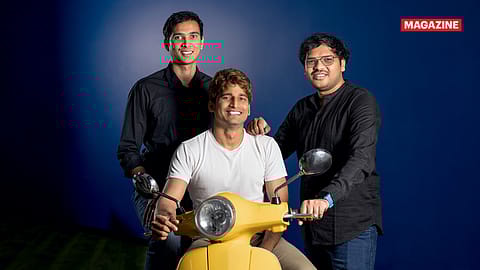
(From left) Aravind Sanka, Pawan Guntupalli and Rishikesh S.R.,
co-founders, Rapido | Credits: Narendra Bisht
India’s Biggest Unicorns: Mobility vanguard Rapido plans to build the country’s largest gig ride economy
Rapido, founded by Pavan Guntupalli, Aravind Sanka, and Rishikesh S.R., has emerged as a leading commute app in India by capitalising on the vast two-wheeler market. By offering affordable and efficient ride-sharing options, Rapido has become a major gig economy job creator, providing livelihoods to millions and redefining urban mobility.
This summary is AI-generated, and Fortune India is not responsible for its content or any associated copyright issues.
How Rapido, ranked 11, is betting on building India’s largest gig ride economy through a flat-pricing SaaS model.
(From left) Aravind Sanka, Pawan Guntupalli and Rishikesh S.R.,
co-founders, Rapido | Credits: Narendra Bisht
This story belongs to the Fortune India Magazine march-2026-indias-biggest-unicorns issue.
PIVOT IS AN art to begin with and a science in execution. That’s precisely what Pavan Guntupalli and his co-founders Aravind Sanka and Rishikesh S.R. managed to establish with Rapido, fast emerging as the most popular commute app across India’s metros and cities.
Valued at over $2.30 billion, the idea’s origins began when the three co-founders chose to switch over in 2015 from their thriving intra-city logistics platform, theKarrier, to ride sharing, amid the rise of Ola and Uber. The shift, though opportunistic, was also strategic. Betting on a vehicle that hundreds of millions of Indians owned but nobody had properly monetised at scale: the omnipresent two-wheeler.
While conventional wisdom was that Ola and Uber had cracked the urban commute code in India, the founders — all hailing from middle-class backgrounds — understood a reality that most businesses are aware of, but very rarely can build on. “One thing was evident that if I have to travel conveniently on a daily basis, I could not do so without burning a hole in my pocket,” Guntupalli tells Fortune India.
In short, though the duo had solved mobility issues for those salaried professionals who were comfortable paying a ‘surged’ price, for the majority of commuters it was still about navigating the broken system as before. “Over-cramped buses and metros; not to mention haggling with auto drivers,” explains Guntupalli. In short, the insight was: affordable was uncomfortable, but comfortable was unaffordable. Nothing existed in the middle.
And yet India owns the world’s largest two-wheeler fleet, estimated at 300 million with 18 million units sold last fiscal. The infrastructure existed. It just needed to be organised. That was the gap. That was Rapido.
What made the founders press on despite competing against companies with billion-dollar war chests was a simple probabilistic bet: “We realised it’s worth trying, because if it succeeds, it’s going to be relevant to millions...We have always looked towards the opportunity that exists, and not specifically competition,” says Guntupalli.
When the upside is that large, the calculus on risk changes entirely.
More Stories from this Issue
Today, as Guntupalli mentions, “More than Rapido being one of the biggest unicorns, we celebrate Rapido being one of the largest, if not the largest, livelihood creator in this country. We have created more than 90-95 lakh jobs and every single month, over 30 lakh individuals [earn] from Rapido’s platform.” That makes Rapido India’s largest gig economy job creator.
Rethinking the biz model
Two-wheelers remain its core offering, but Rapido is now making a play with autos and cabs as well. When the decision was made, the founders didn’t ask the question most competitive strategists would: how do we take market share from Ola and Uber? Instead, they asked a fundamentally different question that incumbents had either missed or ignored. “After close to 15 years of the ride-sharing industry existing in this country, out of 20-30 lakh autos, only 20-30%, at best, are participating. Why? What are the barriers?”
The answer was both obvious and damning: commissions. Ride platforms were positioning themselves as partners to drivers but extracting their pound of flesh with commissions as high as 20-30% for every fare. Drivers, especially those in smaller cities with lower fare volumes, were opting out. As a result, a supply side problem was seen as a demand problem, with incumbents too invested in their existing model to see it clearly.
Rapido’s response was to flip the model entirely. Rather than taking a cut for every ride, which they did initially, the company pivoted to a software-as-a-service offering by charging drivers a flat daily subscription (a one-time app login fee): roughly ₹20 on an average across 400 cities and let drivers keep 100% of what passengers pay. While the average is ₹20, login fees can vary between ₹9 and ₹15 as well.
{{#most-powerful-women-snapshot-individual.slug}} {{/most-powerful-women-snapshot-individual.slug}} {{^most-powerful-women-snapshot-individual.slug}} {{/most-powerful-women-snapshot-individual.slug}} {{#showRanking}} {{current-rank}} {{/showRanking}} {{#photo.0.url}}
{{name}}
The reframing is evident when Guntupalli says, “Our aim is to make an auto captain, or a cab captain realise that technology can actually help them. Instead of it being anti — stealing away their earnings — the perception they had, we wanted to let them know that technology brings efficiency.”
In short, Rapido is acting as the National Payments Corp. of India, which offers the Unified Payments Interface as an infrastructure layer that enables transactions between two parties and charges a nominal fee for access.
“When we launched this model, we saw close to a 50-60% jump from a lot of people who were first-time online,” says Guntupalli. In a stroke, Rapido wasn’t just acquiring drivers, but pulling people, who had never participated before, into the formal digital economy. “We are literally contributing to the digital literacy mission of this country. Educating these people to figure out how to even operate an app and how to leverage that to improve their earnings,” says Guntupalli.
Scale as the strategy
What’s strategically unusual is where that revenue comes from. While most consumer internet companies in India follow an 80-20 rule — 80% of revenue from Tier I cities — Rapido runs a deliberately different split. Only 60% of its revenue comes from top cities such as Delhi, Bengaluru, Hyderabad, Chennai, Kolkata, Mumbai, Jaipur, and Ahmedabad. Smaller cities such as Panipat, Siliguri, Guntur, Coimbatore and the like contribute the remainder.
That 40% isn’t a side effect of growth. It’s the thesis. It’s also a strategic moat that most competitors haven’t even tried, as building for Bharat is hard. Search infrastructure breaks down. App fluency drops. Navigation data thins out. “The user behaviour that works in Bengaluru doesn’t translate to Guntur or Siliguri. The app fluency in these places is also not as high, since people never use Google Maps to get around their city,” says Guntupalli. Rapido has spent years learning how to crack these markets.
The ambition, though, goes further still. In Delhi, roughly 60-70 lakh people travel daily on the metro. On Rapido, 8-9 lakh people travel each day. “One way to look at is, Rapido is contributing at least 15% of what a public infrastructure is contributing. But another way is that we are still only 15%.” The runway, framed that way, looks almost limitless.
What’s in the numbers?
With FY25 revenues of around ₹1,000 crore and losses of ₹250 crore, the obvious question is whether the unit economics is working, and whether this is just another new-age business that will hand retail investors the bill for losses that early investors have already priced in.
Guntupalli draws a sharp and important distinction between operational losses and investment spending. The former, he insists, is zero. “Rapido is currently operationally profitable, which means it literally burns absolutely zero money on any of the rides. A lot of our investments are towards expansion, and experimenting new categories to penetrate more and deeper into Bharat.”
The team is lean by design. Roughly 800 people running a platform of this scale, serving 400 cities, with 30 million monthly active earners. Most companies at this GMV would employ multiples of that headcount. “We are a data-first company. All our operations are heavily tech-enabled. That is one of the reasons we have always been able to keep our fixed costs low,” explains Guntupalli.
And when inflation threatens to squeeze margins, the answer is to find efficiency. “Earlier, when we used to launch in a city, we used to have a 10-15 member team. Now, we launch in a city with a single member,” reveals Guntupalli. The 400th city costs a fraction of what the 40th did.
The philosophy behind all these is deliberate, and worth taking seriously as a strategic stance: “We want to be a low-margin, high-volume business,” says Guntupalli.
The adjacency question
Rapido has started moving into services — travel, hotel bookings, and food delivery — and is exploring categories beyond mobility. It’s a move that invites the obvious comparison with every super-app that tried and struggled before it. Guntupalli doesn’t oversell it: “Some of these initiatives are launched more in an efficiency mode to ensure we have revenues coming in.” The real goal isn’t category expansion for its own sake: it’s finding revenue levers that allow the core mobility business to stay cheap for drivers and passengers alike. On the possibility of setting up lending as a natural next step given the platform’s deep relationship with millions of gig workers who lack access to formal credit, Guntupalli says, “Directionally, it is not just good for the captain, it’s good for stakeholders and the business also. If there are so many tick boxes, it’s only right that it is a matter of time.”
Perhaps what’s unique about Guntupalli’s worldview is how he defines what Rapido actually is. “In the North-east, after 9 o’clock, Rapido is the only transport available in the town or city. If the city moves, it will literally move on Rapido. Rapido over there is not a ride-sharing platform or a transport company. It is the major transportation infrastructure at that time in that city,” says Guntupalli.
That’s not the language of a startup chasing GMV targets. It’s the language of a startup aspiring to be a utility wherein network effects compound differently when a platform becomes the infrastructure. The outcome will be worth the effort: users won’t churn and drivers won’t drop off. While a utility business has its own challenges, that story is for another day. For now, this is, possibly, what separates Rapido’s story from the rest.
Follow Fortune India
Sign in to read full story
To access our exclusive magazine content, sign in to your Fortune India account.
Sign In NowNEXT STORY