India’s Biggest Unicorns: ShareChat is decoding Bharat’s social media code
/ 6 min read
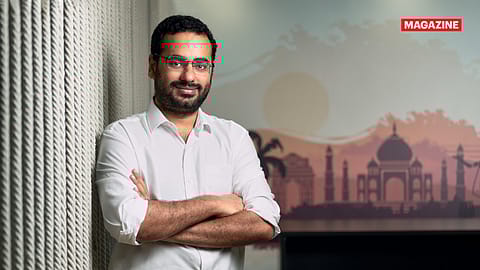
Ankush Sachdeva, co-founder & CEO, ShareChat and Moj | Credits: Nishant Ratnakar
India’s Biggest Unicorns: ShareChat is decoding Bharat’s social media code
ShareChat, one of India's largest social media platforms, has transformed its business model by reducing server costs and focusing on sustainable growth. With the introduction of microdrama content and strategic investments, the company has become cash flow positive and is experiencing significant revenue growth, positioning itself as a key player in the Indian social media landscape.
This summary is AI-generated, and Fortune India is not responsible for its content or any associated copyright issues.
In a market where scale often precedes sustainability, ShareChat—ranked No. 4—reversed the order. After cutting its server cost per user per year to one-third, it is now in a ‘build mode’ as it chases traffic and engagement to monetise better.
Ankush Sachdeva, co-founder & CEO, ShareChat and Moj | Credits: Nishant Ratnakar
This story belongs to the Fortune India Magazine march-2026-indias-biggest-unicorns issue.
EVERY WEEK, Ankush Sachdeva and Manohar Charan would sit down with their Top 50 leaders and project the company’s P&L on a screen. The numbers weren’t flattering. Losses were high. Media chatter was loud. But the mandate was simple: bring server cost per user below revenue per user. Only then would the business work in India.
That discipline has now reshaped one of India’s largest social media platforms.
In February last year, ShareChat turned cash flow positive. Today, it is growing again. Revenue is accelerating. A new content format, microdrama, is emerging as its fastest-growing vertical. And internally, the company calls this phase “build mode”.
“It’s been a long journey,” says Sachdeva, co-founder of ShareChat and its short-video platform Moj. “We figured out regional content in 2015. Then Jio happened. The audience expanded massively. In 2018, we pivoted from social feeds to algorithmic feeds, which drove large gains. In 2020, we launched Moj because we realised our recommendation systems were our strongest asset.” Following TikTok’s exit in June 2020 and benefitting from it, Moj now boasts over 160 million monthly active users.
But between 2022 and early 2025, the focus changed. Capital markets tightened. Burn rates came under scrutiny. The objective became clear: cut losses, build a sustainable model for Indian ARPU (average revenue per user) levels, and survive. “For those two to three years, we were not thinking what to build next,” Sachdeva says. “We were thinking how to make social media cheaper for India.”
Charan, the CFO, frames it more bluntly. “India has one of the lowest monetisable user bases in the world. If you want to run a scaled profitable business here, your cost structure has to be the most frugal.” At one point, ShareChat was spending three-digit million dollars annually on cloud and compute costs. Compute was the single largest line item. The team realised that in an algorithm-driven feed, every scroll has a cost. Each time a user opens the app, the system evaluates millions of posts to serve 10 relevant ones. That’s expensive.
The breakthrough wasn’t vendor renegotiation; it was surgical engineering. “We broke it down to fundamentals,” Charan says. “The day your server cost per user per year becomes less than revenue per user per year, you have a viable business model.”
More Stories from this Issue
The company reduced server cost per user per year to one-third of its earlier level over three years. They built deep observability across systems. Teams measured the RoI (return on investment) of every experiment. Machine learning models were recalibrated cohort by cohort.
Sachdeva explains the mechanics: “We would segment users by potential revenue. For a high ARPU cohort, we could afford more inference calls and real-time features. For lower ARPU users, we would batch recommendations differently. Even at the feature level, we asked: does this need to be real-time? Or can it be computed hourly or daily?”
That level of granularity, they argue, is unprecedented in global social media. “No one else had to go this deep,” says Charan. “In North America, ARPUs are high enough to subsidise inefficiencies. In India, you can’t afford that.”
In FY25, revenue remained largely flat — ₹757 crore versus ₹747 crore in the previous year, according to Tracxn. But losses shrank dramatically, from roughly ₹800 crore to about ₹200 crore at the adjusted Ebitda level. Its adjusted Ebitda loss fell 72% from the previous year to ₹219 crore. Total expenses declined 30%, with pre-tax losses narrowing to ₹1,105 crore from ₹1,898 crore in FY24.
{{#most-powerful-women-snapshot-individual.slug}} {{/most-powerful-women-snapshot-individual.slug}} {{^most-powerful-women-snapshot-individual.slug}} {{/most-powerful-women-snapshot-individual.slug}} {{#showRanking}} {{current-rank}} {{/showRanking}} {{#photo.0.url}}
{{name}}
Growth is back
For FY26, ShareChat is tracking north of 35% revenue growth. In the October–December quarter, revenue grew 45% year-on-year. The company claims to be cash flow positive for the past six months. “In fact, January alone generated more cash than the previous six months combined,” Charan says.
Equally significant is ad revenue per user, which has been expanding at 20-25% annually over the past three years. That change flips the business equation. In FY25, the company’s ad revenue fell 8% to ₹290 crore, while livestreaming income rose 7.7% to ₹434 crore.
Currently, the company has a market valuation of $5 billion.
“For two and a half years, we did zero paid-user acquisition,” Charan says. “More users meant more losses. Now each incremental user contributes to profit. So investing in user acquisition makes sense again.”
After a long pause, ShareChat has resumed marketing spends. Moj now ranks among the top social apps in India on app stores, driven by renewed demand-side investments. Internally, the company sees three pillars of investment in this build phase: demand (user growth), supply (content ecosystem), and technology.
The biggest bet among them is microdrama.
The microdrama wager
Scroll through Moj and you’ll find something new alongside short videos: episodic, vertically shot dramas, typically a few minutes per episode, designed for mobile viewing. ShareChat calls this format microdrama. It has also launched QuickTV as a dedicated property.
Time spent on Moj has grown about 50% over the past three quarters, driven significantly by microdrama consumption. “Microdrama is the single fastest-growing vertical inside the company,” says Sachdeva.
Why bet on this format?
Sachdeva sees parallels with 2015, when regional content was underserved. “We feel there is a dearth of relatable stories in regional languages,” he says. “Big-budget Bollywood makes a few films a year. But for a Tier II user, stories about everyday life — marriage stress, family dynamics — resonate more.”
Higher production, fancier shows haven’t delivered proportional RoI, the company admits. Rooted, relatable narratives are working better.
Charan describes ShareChat’s role not just as a distributor, but as an ecosystem builder.
“We’ve launched a studio accelerator programme with a ₹20-crore annual budget,” he says. Instead of simply commissioning content, ShareChat funds selected studios, gives them data insights from its roughly 60 million monthly microdrama consumers on Moj, and helps refine storytelling using platform analytics.
“We tell them what kind of twists work, which episodes see drop-offs, which genres resonate with female versus male audiences. We are enabling creators, not just financing them,” Charan adds. The goal is to build a new category of content studios tailored for short-form episodic storytelling — much like how The Viral Fever helped shape early web series in India.
Monetisation models are evolving, too. Ads remain core, but subscription, pay-per-view, and sachet-style pricing experiments are on the table. Competing with American giants on pure ad scale or compute muscle is futile, Sachdeva argues. Competing on format innovation is more realistic. “You have to decide where to take the giant head-on and where to build your own niche,” he adds.
AI & the next cost curve
Generative AI sits at the intersection of both opportunity and constraint. Recommender systems were expensive. Generative AI is even more so. “Building recommender systems was costly,” Sachdeva says. “But Generative AI is far more expensive. If you want to generate video at Bharat scale, current global models are still subsidised.”
ShareChat sees AI eventually lowering production costs for microdrama. “In five years, you could create fully AI-generated stories,” Sachdeva suggests. That would significantly reduce the cost of live-action production — studios, actors, sets. But the company’s experience with compute discipline makes it cautious. Generative AI must be profitable at Indian ARPU levels. Otherwise, it becomes another subsidised experiment.
That mindset — every feature tied to RoI — now permeates the organisation.
In a competitive landscape, Meta, YouTube, and other global platforms still dominate Indian digital advertising. Their ARPUs in developed markets subsidise large compute budgets and experimentation. ShareChat’s edge, the management believes, lies in serving regional India efficiently.
“Among major social media companies globally, we are probably serving the most efficiently managed content feed,” Charan claims. The metric he returns to is unit economics. If the server cost per user is structurally lower than revenue per user, and revenue per user keeps growing at 20% annually, the flywheel strengthens.
During the optimisation phase, the mantra was: hold traffic, cut cost. Now the mindset is to grow traffic, deepen engagement, and monetise better. Investments span global AI teams in London and Singapore, feed algorithms for both short video and microdrama, monetisation tech to maximise ad yield, paid-user acquisition, and a ₹20-crore studio accelerator.
The three-sided marketplace — demand, supply, technology — is being rebuilt with profitability guardrails intact. “We’ve come out of a very tough phase,” Sachdeva reflects. “It strengthened the company.”
ShareChat’s early years were about capturing regional India. The middle years were about survival and discipline. The current chapter is about building new formats on a cost structure engineered for India. In a market where scale often precedes sustainability, ShareChat reversed the order.
Now, as it doubles down on microdrama and experiments with AI-enabled storytelling, the question is no longer whether it can survive Indian ARPU realities. The question is whether that hard-earned frugality becomes its long-term moat.
Follow Fortune India
Sign in to read full story
To access our exclusive magazine content, sign in to your Fortune India account.
Sign In NowNEXT STORY