Regional gems: How Aditya Vision has crafted a success story in the consumer durables space
/ 6 min read
Regional gems: How Aditya Vision has crafted a success story in the consumer durables space
Aditya Vision, a Patna-headquartered consumer durables retailer, has grown from a single outlet in 1999 to a 192-store, ₹2,260-crore listed company by focusing on trust, premium products and deep regional understanding. Concentrated in the Hindi belt, it outperforms national chains like Reliance Digital and Croma in Bihar, leveraging customer-centric policies, no private labels and aggressive yet culturally aligned expansion plans.
This summary is AI-generated, and Fortune India is not responsible for its content or any associated copyright issues.
With a network of 192 stores, Patna-headquartered Aditya Vision is giving stiff competition to pan-India consumer durables retail chains, including Reliance Digital and Croma.
This story belongs to the Fortune India Magazine april-2026-the-emerging-100 issue.
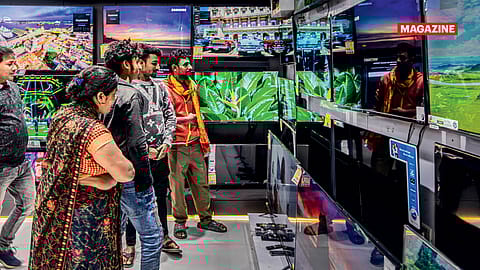
THE INDIRA GANDHI Planetarium in Patna, more popularly known as Taramandal, is a buzzing destination for tourists and educational institutions. Excited schoolchildren hopping in and out of buses for a planetarium visit is a common sight, as are the host of eateries outside buzzing with customers round-the-clock. But one store in the vicinity, which has nothing to do with tourists, but yet unmissable, is the 10,000-sq. ft Aditya Vision.
It’s a sultry Thursday afternoon and there’s an unusually long queue, thanks to the retail chain’s upcoming lucky draw, where people get a chance to win a home or a car! “I bought a TV panel last year from Aditya Vision and got lucky. I won a washing machine,” our cab driver shares excitedly.
In fact, with 20-odd stores, Aditya Vision is the most popular destination to shop for air conditioners, refrigerators or TV panels in Patna. “Neither Reliance nor Croma have been able to get a foothold in this market,” says the manager of an auto dealership.
And now for the surprise element. Headquartered in Patna, Aditya Vision is a 192-store-strong, ₹2,260-crore company listed on the BSE. It is profitable too — profit after tax (PAT) grew 36.9% year-on-year to ₹105 crore in FY25.
And it’s not just in Bihar. The retail chain has stores in adjoining Jharkhand, Uttar Pradesh, and Chhattisgarh as well. The plan is to enter Madhya Pradesh, too, and founder, MD and chairman Yashovardhan Sinha is busy chalking out his expansion strategy. He plans to have 350 stores (Reliance Digital has around 700, while Croma has 540) by 2027, but only in the Hindi belt. The rationale: cultural proximity.
“It’s not important for us to open more showrooms, but inculcate our culture within our employees,” says Sinha, who believes when language and cultures align, training employees to imbibe the organisation’s values becomes easier as well. “Whether it is Bihar, Jharkhand or U.P., you will find our staff speaking the same narrative of trust and value.”
At the retail chain’s flagship Taramandal store in Patna, a salesperson is busy hard-selling an AI-powered washing machine priced close to ₹1 lakh, to a young couple. After almost 30 minutes of granular detailing about how AI would simplify their day-to-day life, the goal is met. As one wonders if it is the general trend of Indians wanting to premiumise, or the recent GST cut-induced price reductions that did the magic, the salesperson tells the couple, “We are trained to offer long-term value to our customers. You should invest in a product which will make your life easier, even though it’s a bit expensive. We are always here to help you in case of a problem.”
More Stories from this Issue
The trust factor
Sinha is confident of consumers’ trust in Aditya Vision. He believes the company’s ‘obsessiveness’ for customer satisfaction has been the differentiator. “Our tagline is Sambandh Bharose Ka (a relationship of trust) and we walk the talk no matter what.”
No employee at Aditya Vision is allowed to turn down a customer, however unreasonable the demand might be, claims Sinha. “I am the only one who has the right to say no. We consider our customers our guests. If a customer has bought a TV, used it for two days, and asks for a change, our employees can’t turn them down. They either connect with the manufacturer and get the problem sorted or escalate the matter to higher authorities. Grievances seldom go unsolved.”
When Aditya Vision was launched in 1999, deep-discounting was the name of the game. Retailers would sell older models at deep discounts. If a consumer wanted a newly launched model, the retailer would place an order with the manufacturer, and give it to them after weeks. “I took a contrarian approach. I told my customers that I may not offer discounts, but I will ensure that I give them the best value, and our relationship lasts forever.”
{{#most-powerful-women-snapshot-individual.slug}} {{/most-powerful-women-snapshot-individual.slug}} {{^most-powerful-women-snapshot-individual.slug}} {{/most-powerful-women-snapshot-individual.slug}} {{#showRanking}} {{current-rank}} {{/showRanking}} {{#photo.0.url}}
{{name}}
The strategy paid off. Sinha opened 4,000-5,000 sq. ft stores and made sure the latest models were available. People started buying higher-capacity refrigerators, five-star air conditioners and big TVs — mainly premium products. Aditya Seva, the company’s add-on service, also helped.
“It’s a toll-free call centre. Even if you are not our customer, our team will take down your details and facilitate the service for you. We don’t offer after-sales services, but we [pursue] the OEM to get it done. Till the customer is satisfied, we don’t give up.”
The talk of the town, however, is the Bhagyashali Coupon scheme, which culminates in a lucky draw every year. Any consumer who purchases goods worth ₹10,000 or more gets the coupon. Sinha claims to have given away ₹18 crore worth of gifts in 2025. “The winner of the lucky draw last year was a daily wage labourer in Lucknow, who got an apartment,” he gleams.
The retail chain’s customer-centric focus also includes a policy of zero private brands. Sinha agrees private brands do churn high margins, but he wouldn’t be doing justice either to his consumers, or the brands. “Luring consumers with cheaper products isn’t fair. Also, OEMs are spending so much money on innovation and on our stores. Giving customers a fair choice is important.”
Kamal Nandi, business head and executive vice president, Godrej Appliances, says having a presence at an Aditya Vision store is an important part of the retail strategy of most consumer durable brands, especially in the Hindi belt. “Their understanding of local demand patterns and ability to build consumer trust have helped us drive growth across categories.”
Credits: Nishant Ratnakar
Growth story
When Sinha quit his cushy job at Punjab National Bank to start Aditya Vision in 1999, expanding outside Patna was a far cry. Power supply was a huge problem in Bihar. “There used to be load-shedding for 20 hours a day, and there was no point setting up stores if one had to operate on generators. It was an expensive proposition.” It was not until 2015 that Bihar had surplus power and Sinha was able to expand in Muzaffarpur, Bhagalpur, Purnia, Motihari, and Aurangabad.
The company went public in 2016. “We raised a meagre ₹5.8 crore, but we thought that if ₹5.8 crore comes from the equity market, we can easily raise another ₹18-20 crore from private investors.” A bulk of the company’s expansion took place during the Covid years. That was the time when a lot of businesses shut down due to lack of capital. The retail chain opened around 37 stores during the Covid years of 2020-2022!
“We got talent cheap as everyone was losing jobs. We also got real estate at competitive prices. We grew by 50%, and have never looked back. Our CAGR is more than 30%,” says Sinha. In 2024, the company raised ₹280 crore through a preferential order from California-based Capital Group. “We were debt-free as far as capex was concerned, even in terms of working capital,” he adds.
What the future holds
Sinha’s plan is to penetrate deeply into the Hindi-speaking states, especially Haryana and Rajasthan. “We will very soon come closer to the NCR, but we will not enter that market. It is a crowded market and will eat into our profits. The margins would be lower too. We are answerable to our investors. FIIs and DIIs together hold 35-36% of our market cap,” explains Sinha.
He is also willing to expand into non-Hindi-speaking states, but only after fully tapping the potential of the Hindi belt. Within the Hindi belt, Sinha has begun making inroads into rural markets as well. The retail chain has been organising loan fairs in rural areas in collaboration with NBFCs.
According to Sinha, rural India offers significant growth opportunities. “They are even open to buying mobile phones worth ₹1 lakh. We are putting up stalls, displaying different products and even billing them on the spot.”
Godrej’s Nandi says partnerships with regional retail chains such as Aditya Vision has enabled them to reach new households. “We have been able to strengthen our market penetration, especially in premium products, and deliver a more localised retail experience for consumers.”
When Sinha started his business 27 years ago in Patna, Bihar was considered an impoverished state with no investment opportunities. But Sinha persisted. “At that time Bihar’s population was 12 crore. My belief was that even if we give a haircut of 50%, say 6 crore consumers can’t buy consumer durables, there were still 6 crore with disposable incomes. It was a big enough market, in fact as big as the population of the U.K.” Hence, enabling the average ‘Bihari’ to upgrade his/her lifestyle through consumer durables seemed a viable proposition.
The bet worked. Aditya Vision grew, and expanded into adjacent geographies. Sinha’s ambition now is to accelerate the expansion in the next couple of years.
Follow Fortune India
NEXT STORY