Selective audiences are reshaping box office’s blockbuster revival
/ 10 min read
Films like Dhurandhar are leading to packed theatres once again, but a new and more discerning audience is reshaping the business of cinema.
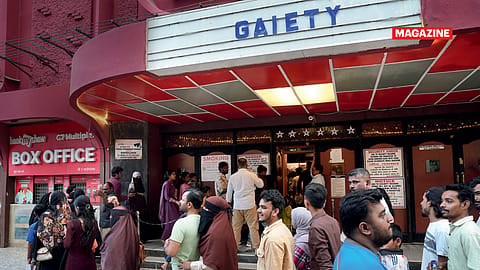
The G7 multiplex in Bandra, Mumbai.
This story belongs to the Fortune India Magazine may-2026-biocon-next issue.
Weeks before Dhurandhar: The Revenge was released on March 19, theatres across the country were sold out. Social media was abuzz with memes and shorts of people packing night clothes and snacks to sustain themselves through the four-hour film. The franchise has crossed a mind-boggling box-office revenue of close to ₹3,000 crore worldwide, with Dhurandhar: The Revenge grossing over ₹1,000 crore globally in its first week.
Dhurandhar is probably the only blockbuster to have drawn crowds the way Sholay (released in 1975) did. Sholay ran for five years in what was then Bombay’s Minerva Theatre.
The success of Dhurandhar also indicates that moviegoers are flocking back to the big screen. Ever since streaming platforms invaded homes and smartphones a decade ago, cinemas have seen footfalls decline. Both multiplexes and single-screen theatres struggled. The Covid-19 pandemic in 2020, which prompted the government to impose lockdowns and restrict public gatherings, brought the theatre business to a halt. Many single screens and smaller multiplexes perished. For the larger ones, such as PVR, INOX and Cinépolis, it was a hand-to-mouth existence.
Getting consumers back to theatres remained a challenge even after the pandemic. Multiplexes tried everything, from showing reruns of yesteryear blockbusters to improving the F&B experience and offering premium services. But they didn’t manage to get anywhere near their pre-pandemic earnings. This was also the time (in 2023) when the two big multiplex companies, PVR and INOX, decided to merge — the rationale was to improve operational efficiency so that they could recover faster from pandemic-related losses. The merger made them a 1,700-screen entity, and they hoped they would have better bargaining power with real estate partners and film producers. However, growth remained patchy as fewer movies turned into hits, inflation squeezed consumer spending, and consumers in general stuck to streaming platforms.
Besides PVR and INOX, Bollywood star Ajay Devgn also joined hands with Vishwa Samudra Group last year to unveil Devgn Cinex, the new identity of Devgn’s NY Cinemas. Devgn CineX operates 57 screens across 19 locations. “India remains under-screened compared to markets like the U.S. and China, with fewer screens per million people — this indicates a substantial headroom for growth in theatrical infrastructure, particularly in markets where audiences are ready for upgraded experiences,” says Kumar Mangat Pathak, co-founder, Devgn CineX, and chairman, Panorama Studios.
Incidentally, 2025 turned out to be the year of blockbusters. Box office collections crossed ₹13,000 crore for the first time in history. Blockbusters such as Dhurandhar, Chhaava, and the revival of romance through Saiyaara propelled cinema halls into record territory, restoring confidence across the value chain.
What was the magic? High-quality content, says Sanjeev Kumar Bijli, executive director, PVR INOX Ltd. “Dhurandhar is a prime example that compelling cinematic storytelling continues to draw audiences to the big screen regardless of the broader global climate. The strong opening weekend response recorded healthy footfalls across our cinemas with overall occupancies exceeding 85%,” says Bijli.
More Stories from this Issue
Manoj Desai, executive director, G7 Multiplex and Maratha Mandir in Mumbai, says, “Business has picked up, and 2025 has been exceptional for theatres. After the disruption during Covid, footfalls have returned strongly, and audiences are once again choosing the big-screen experience.”
The Ormax Box Office Report 2025 says gross collections reached ₹13,395 crore, surpassing the previous high of ₹12,226 crore recorded in 2023. According to Ormax, 37 films earned more than ₹100 crore each, against just 22 in 2024.
The recent string of hits has left the multiplex companies cheering for more. In Q3FY26, PVR INOX posted a 166% jump in net profits over the same quarter of the previous year.
Kamal Gianchandani, chief, business planning and strategy at PVR INOX, says, “The numbers that we are seeing are those which we used to dream of in 2019. We’ve come a long distance.”
{{#most-powerful-women-snapshot-individual.slug}} {{/most-powerful-women-snapshot-individual.slug}} {{^most-powerful-women-snapshot-individual.slug}} {{/most-powerful-women-snapshot-individual.slug}} {{#showRanking}} {{current-rank}} {{/showRanking}} {{#photo.0.url}}
{{name}}
Devang Sampat, MD, Cinépolis India, says it sold over 800,000 tickets in the first week of Dhurandhar. The second part is only converting a franchise audience at a speed and density that requires a different kind of exhibition infrastructure. He also provides a sobering reality check. “In 2019, India recorded 103 crore admissions. In 2025, despite record box office collections, footfalls stood at around 83 crore. That is roughly 20% lower,” he says.
The writing on the wall is clear: the spate of hits in 2025-2026 has indeed revived the fortunes of film exhibitors, but is this success here to stay? The rebound is not a simple return to pre-Covid normalcy. It reflects a structural shift in audience behaviour, content economics, and the evolving interplay between theatrical and digital platforms. The key question is whether the momentum is sustainable or is driven by a handful of tentpole successes.
Selective viewership
INDIA HAS just 10,000-odd screens to serve a population of 1.4 billion, compared with 93,000 in China, which has roughly the same population, and around 40,000 in the U.S., which has a population of 349 million. According to the FICCI-EY Media and Entertainment Report 2025, screen count has increased by just 2% in the past year. Movie buffs need a convincing reason to spend ₹1,000-4,000 to watch a film in the theatre. Gone are the days when people thronged to the theatres to watch the first-day-first-show of an Amitabh Bachchan blockbuster. Today, they would rather watch it on a streaming platform in the comfort of their home, at a fraction of the cost. They could either binge-watch the entire film or watch it in parts as convenient.
The FICCI-EY report confirms this trend: just 6% of the population enters a cinema hall in a year, as one segment has cheaper alternatives such as OTT and TV. The shortening of digital windows to four weeks in many cases has also led to a cost-conscious audience segment willing to wait for films that do not receive high ratings or positive social media reactions. Dhurandhar did rake in the highest-ever earnings for theatres, but a sizable segment of consumers waited for the film’s OTT release.
Movies such as Darlings, Tumbbad and Gehraiyaan received a better response on streaming platforms after a lacklustre run in theatres. “Footfalls haven’t shrunk — they’ve actually hit some of their strongest levels in recent years. What has changed is audience behaviour. Audiences are now far more selective, with a disproportionate share of footfalls concentrated around just five to eight films annually,” says Sunil Chainani, business head, movies, Applause Entertainment.
The “middling movie” — once capable of delivering steady, if unspectacular, box office returns — has effectively disappeared from the theatrical ecosystem. In its place is a sharply polarised market. At one end are large-scale, event-driven spectacles. At the other end are tightly defined, genre-specific films targeting niche audiences (such as Article 370 or Laapataa Ladies). The space in between is shrinking.
Vikram Malhotra, founder & CEO of Abundantia Entertainment, sees this as a natural evolution rather than a structural weakness. “Theatrical viewing is still becoming more of an event for families. You will have large, community-driven spectacles on one end and tightly positioned, genre-focussed films on the other. The middle may continue to thin out, but that’s not a weakness; it’s a structural shift.”
He also points to a more discerning audience. “The audience is mature; they know there is a better story waiting for their time and money available on another option.”
What the industry calls a change in audience behaviour is actually the death knell for many a theatre operator, especially single-screen owners. With footfalls going down and the audience clearly being choosy about what to watch in theatres, it is a challenge for theatre owners to sustain.
Akshat Gupta, managing partner, Eros and Metro Cinemas, offers a stark assessment: “I don’t think single screens have a profitable business model anymore.” Along with Atul Rawat (also managing partner), he advocates adaptive reuse. “The best help that a single screen can get from the government is to allow them to shut down and convert while maintaining the heritage of the building, so the city still gets a famous building, but they get it as something else,” he says. Both Eros and Metro Cinemas are iconic landmarks of Mumbai. The theatre company has recently leased two floors of Eros in Churchgate to Reliance Industries’ retail venture, Swadesh.
Premium wins
CINEMA-GOING is no longer a spontaneous activity but a planned, value-driven decision. India’s box office growth is increasingly being driven by higher ticket prices rather than higher attendance. The average ticket price (ATP) has risen from ₹106 in 2019 to ₹161 in 2025. The average movie-going experience (ticket price plus F&B) in a multiplex has doubled from ₹1,500 per person a couple of years ago to ₹3,000. Multiplexes are responding by pivoting towards premiumisation. Premium screens, recliner seating, and elevated F&B offerings are no longer differentiators — they are becoming the baseline for driving higher per-capita spends.
PVR INOX aims to increase its luxury inventory to 20% of its total screens. Its luxury screens include formats such as Director’s Cut, Insignia, and Luxe. With features such as ultra-comfortable seating, elaborate global luxury food experiences, and sensory-rich movie experiences, a luxury PVR INOX experience could cost anywhere between ₹1,150 and ₹1,700. The multiplex company is also taking its luxury experiences to smaller cities such as Pune, Ahmedabad, and Udaipur.
Cinépolis’ Sampat says, “Post-pandemic, audiences are more deliberate about cinema visits. When they come, they want an outing, not just a film. At Cinépolis, we have built our strategy around this insight. We call it ‘future-ready cinema’, and it rests on four pillars: accessibility, experience, F&B, and loyalty. Premium formats have moved from niche to mainstream. IMAX, 4DX, Macro XE, and luxury seating command higher ticket prices than standard screens and achieve strong occupancy. Technology upgrades like laser projection have improved the base experience.”
“Our FOOVIES platform brings food and movies together as inseparable parts of the experience. Menu innovation, regional flavours, and beverage variants have contributed to F&B now representing 30% of our revenue,” Sampat further adds, saying these are not defensive moves, but structural improvements that have changed how Cinépolis thinks about unit economics.
A Cinépolis IMAX or 4DX seat costs between ₹300 and ₹700, and delivers higher occupancy rates and per-seat revenue. “These formats are profitable. But the business must scale beyond a premium-only model. India has roughly 7.5 screens per million people. Reaching even 15-20 screens per million requires massive standard format expansion, not just IMAX,” says Sampat.
The cost factor
THERE’S A limit to what film exhibitors can do to attract audiences. The clincher is the content quality, not the samosa. Maratha Mandir’s Desai, who says he serves the world’s best samosa (priced at a humble ₹60 for two) and a cold drink can, emphasises preserving the core cinematic experience. “The best way to maintain the theatre is to have a proper sound system. People should enjoy watching the movie on a big screen and not on a small screen,” Desai says.
He is betting on affordability. “If you keep the layer of the rates familiar, then people could eat; we have kept very, very low rates.” While his single-screen peers have begun to doubt the format’s longevity, Desai remains persistent.
Mukesh Kumar, CEO, Infiniti Mall, says real estate is expensive. A multiplex is typically spread over 45,000-50,000 sq. ft of real estate, and to be profitable, it would need sales per sq. ft of at least ₹650 on the carpet area. As anchor tenants in most malls, multiplexes pay 15-20% lower rentals, but at the end of the day, a multiplex’s fate largely relies on the quality of content and hits.
“Margins have reduced with OTT gaining ground, but the experience provided by multiplexes remains unmatched. If the content is good, moviegoers will prefer theatres. Expenses can only be controlled to a certain extent; top line has to go up,” Kumar says, pointing to improved F&B offerings and pricing strategies as key levers.
Nirzar Jain, president (leasing) at Nexus Select Malls, Mumbai, underscores the strategic role of cinemas: “Cinemas continue to be among the critical anchor partners across our portfolio, typically occupying 7–10% of mall space; their real value lies in driving consistent footfalls and catalysing consumption across F&B and retail.”
A large part of a multiplex’s costs is fixed (real estate), and it has to manage it wisely when the content isn’t powerful enough to draw audiences. PVR’s Gianchandani says it requires a lot of discipline. “We are also a business of high operating leverage. The fixed cost component of our business is fairly high; therefore, at high occupancy, we make outsized profits. At low occupancies, our margins come under severe pressure, and therefore, we attack the fixed cost structure,” he feels.
“Whether it is rental, CAM (common area maintenance), people cost, power cost, repair and maintenance of our properties, technology — in every area, we have optimised our cost, but there has been absolutely zero impact on the services that we offer to the consumers,” Gianchandani claims.
The relationship between theatrical and streaming has also matured. During the Covid year, there were myriad debates on the death of theatres and the emergence of the direct-to-digital era. But movie makers are again swearing by the big screen. Entertainment industry veteran Sameer Nair believes that theatrical releases are the only way a film can achieve scale. “Dhurandhar would have never made the revenue it has had if it had only been released on a streaming platform,” he had said in an earlier interview to Fortune India.
Jyoti Deshpande, president, media and content business at Reliance Industries, agrees. “A lot of quickly produced content was churned out, which was detrimental to both sides. OTT leaders now prefer films that have had a theatrical release because they have some gravitas, there’s some marketing momentum, and they do much better on our platform.”
Shailesh Kapoor, founder and CEO of Ormax Media, says, “Theatrical films on OTT are a big draw; language democratisation is something that OTT has enabled.”
Transformation, not return
THE THEATRICAL industry is not reverting to its pre-Covid state — it is finding a new equilibrium.
The success of Dhurandhar: The Revenge demonstrates the power of the big-screen experience. But it also underscores the risks of over-reliance on a narrow set of high-performing films.
A single blockbuster can lift sentiment, drive quarterly performance, and reaffirm the appeal of cinemas. But long-term stability will depend on something far less predictable and far more critical — a steady, diversified pipeline of compelling content that brings audiences back not just for events, but out of habit.
Follow Fortune India
Sign in to read full story
To access our exclusive magazine content, sign in to your Fortune India account.
Sign In NowNEXT STORY