The FAQs are AI-generated, and Fortune India is not responsible for its content or any associated copyright issues.
Explained: Why Indian Energy Exchange shares fell after CERC proposed market coupling rules
/ 3 min read
IEX shares fell 7.6% to hit an intraday low of ₹125.35 on the BSE, while its market capitalisation dropped to ₹11,341 crore.
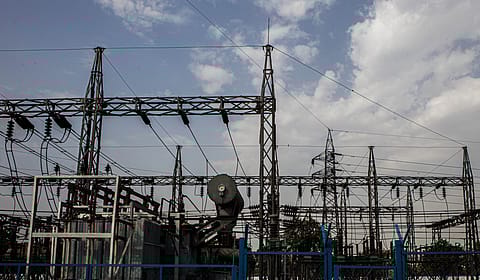
Indian Energy Exchange (IEX) shares drop nearly 8% on Monday | Credits: Sanjay Rawat
Shares of Indian Energy Exchange (IEX) declined by as much as 8% on Monday amid reports that the Central Electricity Regulatory Commission (CERC) has proposed a “market coupling” framework to streamline electricity price discovery across power exchanges in India.
Weighed down by the development, IEX shares fell 7.6% to hit an intraday low of ₹125.35 on the BSE amid strong volumes, with nearly 9 lakh shares changing hands compared to a two-week average of 4.17 lakh shares. At the time of reporting, the stock was trading at ₹126.20, down 6.97%, with a market capitalisation of about ₹11,341 crore.
The shares of IEX had touched a 52-week high of ₹215.40 on June 9, 2025, and a 52-week low of ₹114.50 on March 30, 2026. It is up about 5% in the past month, but down by over 5% year-to-date, nearly 9% over six months, and more than 33% over the past year.
Meanwhile, the exchange has also sought clarification from the regulator regarding the proposed framework.
What fuelled the sell-off in IEX shares?
According to Balaji Rao Mudili, Research Analyst at Bonanza, the CERC draft proposes that Grid-India will act as the market coupling operator, aggregating bids from all power exchanges and discovering a single uniform market clearing price.
Currently, exchanges such as IEX independently discover prices based on demand-supply bids. Under the proposed system, exchanges will continue to collect bids, but pricing authority will shift away from them.
“The exchanges however will continue to collect bids but will no longer set prices. IEX holds roughly 84% market share in the power exchange segment, so its discovered price was effectively the national benchmark which was also the major competitive advantage which it had,” he explained.
The change directly impacts IEX’s core positioning as the company currently holds around 84% market share in the power exchange segment, making its price discovery the de facto national benchmark—one of its key competitive advantages.
Besides, IEX would transition from a price-discovery exchange to a bid-collection platform, weakening its structural moat. This could also allow smaller players such as PXIL and HPX to gain volumes without building liquidity depth, potentially slowing IEX’s market share growth.
“Following the new norms, smaller players like PXIL and HPX can attract volumes without having to build their own liquidity, which for IEX means slower volume growth as it is no more the price decider. IEX makes about 78% of its revenue from per unit transaction fees so any market share loss impacts the top line directly,” the analyst said.
He further said that there are two modes of trading on power exchanges—the real time market (RTM) and the day ahead market (DAM). Market coupling would first be implemented in the Day-Ahead Market (DAM) segment, which is IEX’s largest revenue contributor. This raises concerns over near-term earnings visibility. Around 78% of IEX’s revenue comes from transaction fees, making its earnings highly sensitive to traded volumes and market share.
RANK
COMPANY NAME
REVENUE
(INR CR)
(INR CR)
{{#current-rank}} {{current-rank}} {{/current-rank}} {{^current-rank}} {{rank}} {{/current-rank}} {{name}} {{#revenue}} {{revenue}} {{/revenue}} {{^revenue}} {{noi}} {{/revenue}}
“IEX trades at a P/E of around 24, a premium built on its dominance. If that dominance fades, multiples could compress. India’s power market is expanding and even with a smaller slice of the pie, IEX could grow if the pie itself expands fast enough. But the monopoly like franchise narrative is effectively over and the market is still in the middle of repricing what IEX is worth without that moat,” he said.
(DISCLAIMER: The views and opinions expressed by investment experts on fortuneindia.com are either their own or of their organisations, but not necessarily that of fortuneindia.com and its editorial team. Readers are advised to consult certified experts before taking investment decisions.)
Frequently Asked Questions
NEXT STORY