The FAQs are AI-generated, and Fortune India is not responsible for its content or any associated copyright issues.
Fortune India Startup Summit: Best time to start up, say VCs, backing long-term value amid AI-led disruption
/ 3 min read
Speaking at the Fortune India Startup Summit 2026, VCs said the correction in global tech valuations and the moderation in funding compared to the 2021 peak are cyclical and often create the best opportunities for innovation.
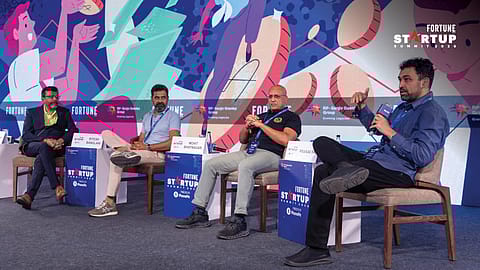
L-R: V. Keshavdev, Executive Editor, Fortune India; Ritesh Banglani, Partner, Stellaris Venture Partners; Mohit Bhatnagar, Managing Director, Peak XV Partners; Pranav Pai, Founding Partner and Chief Investment Officer, 3one4 Capital, speaking at Fortune India Startup Summit 2026 in Bengaluru. | Credits: Sanjay Rawat
Amid a volatile global environment and rapid AI-led disruption, venture capitalists believe the focus in India’s startup ecosystem is shifting from valuations to long-term value creation.
Speaking at the Fortune India Startup Summit 2026, industry experts said the correction in global tech valuations and the moderation in funding compared to the 2021 peak are cyclical and often create the best opportunities for innovation.
“You have to measure success and failure over five to ten years, not five or six quarters,” said Mohit Bhatnagar of Peak XV Partners. “Every decade will see multiple ‘perfect storms’, but each downturn also creates opportunities for disruption. This is actually the best time to start up.”
He pointed to emerging sectors such as space, precision manufacturing, and semiconductors as new frontiers for Indian entrepreneurs, driven by both technological shifts and global realignments.
Pranav Pai of 3one4 Capital said the nature of innovation itself is undergoing a fundamental shift. “What does valuation even mean today?” he said. “AI companies are going after a $35 trillion global payroll opportunity, and that is changing how we think about margins, scale, and value creation.”
He added that the real focus is no longer on past funding cycles but on the future trajectory of businesses. “It’s less about 2021 and more about what 2035 looks like,” he said.
Ritesh Banglani of Stellaris Venture Partners said both new-age startups and incumbents will participate in value creation.
“It’s simplistic to assume one or two companies will capture all the upside,” he said. “We will still need applications and services, and a lot of that value will accrue to companies that are already building aggressively in this space.”
The discussion also highlighted how AI is reshaping startup building itself. Investors noted that AI-native companies are achieving more with significantly smaller teams, fundamentally altering cost structures and scaling dynamics.
“AI is an enabler across businesses, much like the internet or mobile once was,” Pai said, adding that early indicators of AI-native companies include lean teams and faster execution.
However, the AI shift is also introducing new complexities. Startups are increasingly building on top of foundational AI platforms, which may also compete for the same customers—raising questions about long-term value capture and dependencies.
{{#most-powerful-women-snapshot-individual.slug}} {{/most-powerful-women-snapshot-individual.slug}} {{^most-powerful-women-snapshot-individual.slug}} {{/most-powerful-women-snapshot-individual.slug}} {{#showRanking}} {{current-rank}} {{/showRanking}} {{#photo.0.url}}
{{name}}
Despite these uncertainties, investor appetite remains strong. Banglani said venture capital strategies are evolving to account for higher uncertainty, with a greater willingness to back more ideas while reserving capital to double down on winners.
“In times of great flux, you have to assume a higher rate of failure,” he said. “But the companies that succeed can create outsized value.”
The panel also pointed to a structural shift in India’s startup ecosystem. From having just one billion-dollar public tech company a decade ago, India now has several, though their share of the overall market remains relatively small compared to global peers—indicating significant headroom for growth.
Early-stage investing, they said, remains largely insulated from public market volatility. “At our stage, valuation is a derived metric,” Banglani noted. “What matters is whether a founder can build an enduring, large company over time.”
They also highlighted improving fundamentals within the ecosystem, including faster paths to profitability and scale. Companies are reaching revenue milestones and breakeven levels much quicker than in the past, reflecting stronger execution and a maturing founder base.
Ultimately, the message for founders was clear: focus on ambition and resilience rather than short-term valuation metrics.
“The real question is whether you can build a globally relevant company,” Bhatnagar said. “India has proven it can create billion-dollar businesses. The next step is to build $50 billion or even $100 billion companies.”
Follow Fortune India
Frequently Asked Questions
NEXT STORY