Vedanta Aluminium, Hindalco, NALCO tumble up to 5%; what's dragging aluminium stocks today?
/ 3 min read
Aluminium stocks fell after global aluminium prices dropped on hopes of normalised trade flows through the Strait of Hormuz following U.S.-Iran peace agreement.
THIS STORY FEATURES
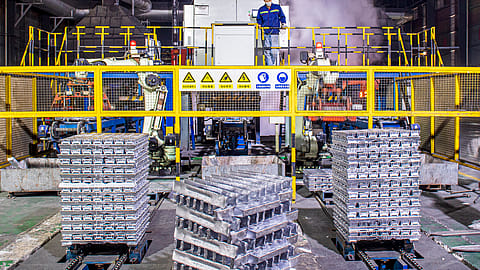
Aluminium prices on the London Metal Exchange (LME) declined 4.4% to settle at $3,379.50 per tonne on Monday | Credits: Getty Images
Shares of aluminium producing companies witnessed selling pressure on Tuesday, with National Aluminium Company (NALCO), Hindalco Industries and Vedanta Aluminium Metal falling up to 6%, dragging the Nifty Metal index lower by nearly 2%.
The weakness in aluminium stocks follows a sharp decline in global aluminium prices after a breakthrough interim peace agreement between the United States and Iran raised hopes of the Strait of Hormuz reopening to normal trade flows.
Shares of NALCO dropped as much as 5.7% to ₹360.55 on the BSE, while Hindalco Industries fell 4.3% to ₹969.85. The newly listed Vedanta Aluminium Metal was locked in its 5% lower circuit at ₹475.65.
Vedanta Aluminium Metal, one of the four demerged entities of Vedanta, commenced trading on the stock exchanges on Monday following the conglomerate's demerger exercise.
The weakness was broad-based across the Nifty Metal index, which declined 1.7%. Apart from aluminium producers, steel and mining stocks were also under pressure. JSW Steel and Jindal Steel & Power fell around 1.5% each, Tata Steel slipped 1.3%, while Hindustan Copper, Hindustan Zinc and NMDC lost nearly 1%.
LME aluminium prices fall 4.4%
Aluminium prices on the London Metal Exchange (LME) declined 4.4% to settle at $3,379.50 per tonne on Monday, their lowest level since March 27. The proposed agreement is expected to pave the way for the resumption of metal shipments through the strategically important Strait of Hormuz, a key transit route for raw materials and finished metals.
The Middle East conflict had earlier triggered a sharp rally in aluminium prices after missile attacks disrupted operations at major regional smelters, while restrictions on movement through the Strait of Hormuz disrupted the flow of raw materials and finished metal.
With prospects of supply chains normalising, traders rushed to unwind part of the geopolitical premium embedded in aluminium prices, leading to a selloff in both the metal and related stocks.
Analyst remains bullish
However, analysts believe the recent correction does not necessarily mark the end of aluminium's structural bull cycle.
According to a recent report by Axis Securities, the global aluminium industry has entered a phase of "energy-constrained scarcity", where supply growth is increasingly restricted by power availability and environmental regulations rather than traditional market cycles.
China, which accounts for nearly 60% of global aluminium production, has already reached its 45-million-tonne production cap, limiting the industry's ability to rapidly expand supply. At the same time, demand continues to rise, driven by electric vehicles, renewable energy infrastructure and the increasing use of lightweight materials across industries.
{{#most-powerful-women-snapshot-individual.slug}} {{/most-powerful-women-snapshot-individual.slug}} {{^most-powerful-women-snapshot-individual.slug}} {{/most-powerful-women-snapshot-individual.slug}} {{#showRanking}} {{current-rank}} {{/showRanking}} {{#photo.0.url}}
{{name}}
The brokerage estimates that disruptions in the Middle East, coupled with production challenges in regions such as Iceland and Mozambique, have removed around 3.3 million tonnes of output in 2026, pushing the market into a supply deficit.
While aluminium prices have corrected from their June peak of around $3,850 per tonne, Axis Securities expects the metal to remain elevated in the $3,000-$3,800 per tonne range over the next two years. Rising energy costs, carbon compliance expenses and limited new supply additions are expected to continue supporting prices over the long term.
Axis Securities has retained its 'Buy' rating on both Hindalco and NALCO, arguing that the recent decline in aluminium prices is largely driven by near-term macroeconomic and geopolitical developments rather than any deterioration in the industry's long-term fundamentals.
(DISCLAIMER: The views and opinions expressed by investment experts on fortuneindia.com are either their own or of their organisations, but not necessarily that of fortuneindia.com and its editorial team. Readers are advised to consult certified experts before taking investment decisions.)

Follow Fortune India
NEXT STORY