Will DGCA curbs and guidance cut dampen IndiGo’s Sensex entry?
/ 3 min read
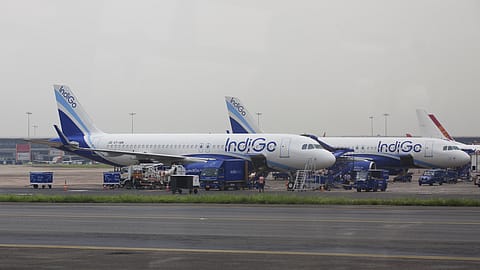
IndiGo to replace Tata Motors PV in Sensex | Credits: Fortune India
Will DGCA curbs and guidance cut dampen IndiGo’s Sensex entry?
IndiGo is set to join the BSE Sensex, replacing Tata Motors PV, amid regulatory challenges and flight disruptions. Despite recent market volatility and a significant drop in market cap, analysts remain optimistic about IndiGo's long-term prospects, citing its dominant market position and temporary nature of current operational issues.
This summary is AI-generated, and Fortune India is not responsible for its content or any associated copyright issues.
Despite near-term challenges, analysts remain bullish on IndiGo, with most maintaining a ‘Buy’ rating even after trimming earnings forecasts.
THIS STORY FEATURES
IndiGo to replace Tata Motors PV in Sensex | Credits: Fortune India
InterGlobe Aviation, the parent company of domestic carrier IndiGo, is set to join the BSE Sensex on December 22, a move expected to provide some downside support to the stock and attract passive fund inflows. However, analysts remain cautious about a strong recovery, as the airline continues to face regulatory headwinds following widespread flight cancellations triggered by crew shortages and stricter adherence to flight duty time limitation (FDTL) rules.
This comes after the company and analysts cut guidance for capacity and passenger unit revenues for the third quarter of the current financial year. IndiGo revised its outlook following last week’s flight disruptions and subsequent action by the Directorate General of Civil Aviation (DGCA), including a 10% curtailment of its winter schedule.





IndiGo to replace Tata Motors PV in Sensex
As part of the upcoming index reshuffle, IndiGo will replace Tata Motors Passenger Vehicles Ltd (TMPV) in the 30-share benchmark index. Tata Motors was recently demerged into two separate entities—Tata Motors Passenger Vehicles and Tata Motors Commercial Vehicles. While the restructuring affected the Nifty 50 composition, the Sensex remains unchanged except for this replacement.
In a notification last month, BSE announced several changes across its key indices from December 22. On the Sensex, IndiGo will replace Tata Motors Passenger Vehicles, while Max Healthcare Institute will replace IndusInd Bank on the BSE Sensex 50. IndusInd Bank will move to the BSE Sensex Next 50 in place of Max Healthcare.
IDFC First Bank will replace Adani Green Energy on the BSE 100, while Adani Green Energy will move to the BSE Sensex Next 50. Separately, four stocks—Canara Bank, AU Small Finance Bank, Punjab National Bank (PNB), and Union Bank of India—will be added to the BSE Bankex index from December 26 onwards.
Long-term story remains intact
IndiGo shares have faced sharp selling pressure over the past two weeks, falling more than 18% since November 27, when flight disruptions began. The sell-off, triggered by flight cancellations, new pilot norms, DGCA curbs, and near-term profitability concerns, has wiped out over ₹40,000 crore in market capitalisation for the country’s largest carrier, which commands more than 60% of India’s aviation market.
The stock has shown some recovery in recent sessions, gaining nearly 1% and closing at ₹4,860.85 per share on the BSE on Friday, with a market capitalisation of ₹1.88 lakh crore.
Despite near-term challenges, analysts remain bullish on IndiGo, with most maintaining a ‘Buy’ rating even after trimming earnings forecasts. Optimism is attributed to the temporary nature of operational disruptions, capacity constraints faced by competitors like Tata and SpiceJet, and IndiGo’s dominant position in the domestic aviation market.
Following the flight disruptions and refunds processed by IndiGo, the stock has received support from both domestic and global brokerages. Morgan Stanley assigned an ‘Overweight’ rating with a price target of ₹6,359, while Jefferies maintained its ‘Buy’ rating with a target of ₹6,035. Citi Research also reaffirmed its ‘Buy’ stance, keeping the target price unchanged at ₹6,500.
Elara Securities, in a recent report, retained a Buy rating but trimmed the target price to ₹6,020 from ₹7,241. The brokerage also cut earnings estimates (excluding forex losses) by 12% for FY26E, 14% for FY27E, and 13% for FY28E, while reducing available seat kilometers (ASKM) capacity assumptions by 4% for FY26E, 10% for FY27E, and 7% for FY28E.
However, Elara expects IndiGo to keep costs under control in FY27, supported by stable Airbus deliveries, easing Pratt & Whitney AOG issues, new airport additions in Delhi and Mumbai, and softer crude oil prices. The brokerage views the current pilot shortage as a temporary issue likely to ease over the next two to four quarters.
{{#most-powerful-women-snapshot-individual.slug}} {{/most-powerful-women-snapshot-individual.slug}} {{^most-powerful-women-snapshot-individual.slug}} {{/most-powerful-women-snapshot-individual.slug}} {{#showRanking}} {{current-rank}} {{/showRanking}} {{#photo.0.url}}
{{name}}
Lower industry capacity could also support airfares. Historically, every 1% reduction in capacity has translated into roughly a 1% increase in fares. During the grounding of Jet Airways and the GoAir crisis, domestic capacity fell by 15% and 7%, respectively, while IndiGo’s average airfares rose by approximately 16% YoY and 7% YoY in the subsequent periods.
(DISCLAIMER: The views and opinions expressed by investment experts on fortuneindia.com are either their own or of their organisations, but not necessarily that of fortuneindia.com and its editorial team. Readers are advised to consult certified experts before taking investment decisions.)
Follow Fortune India
NEXT STORY