Will Sensex, Nifty extend losing streak to a seventh week? Five factors to watch
/ 4 min read
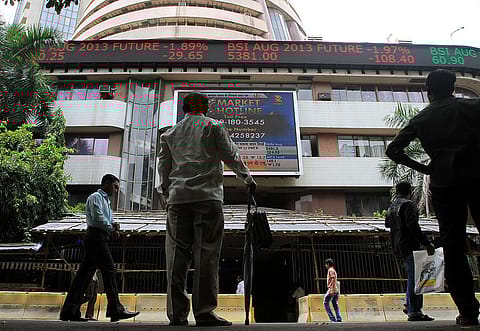
Both the Sensex and Nifty extended their losing streak to a sixth consecutive week, as the ongoing Middle East crisis continued to weigh on investor sentiment. | Credits: Getty Images
Will Sensex, Nifty extend losing streak to a seventh week? Five factors to watch
Indian equities enter a crucial week after Sensex and Nifty logged a sixth straight weekly loss amid Middle East tensions and record FPI outflows. Market direction will hinge on RBI’s April 8 policy, Q4 earnings led by TCS, fragile foreign flows, surging crude near $100, and evolving geopolitics, keeping volatility and event-driven moves elevated.
This summary is AI-generated, and Fortune India is not responsible for its content or any associated copyright issues.
The equity market this week will be driven by key triggers including the RBI’s policy decision, the start of March quarter earnings, trends in FII flows, movements in crude oil prices, and the evolving geopolitical situation.
Both the Sensex and Nifty extended their losing streak to a sixth consecutive week, as the ongoing Middle East crisis continued to weigh on investor sentiment. | Credits: Getty Images
Indian equities are heading into a crucial week, caught between global uncertainty and key domestic triggers. The market’s direction will likely hinge on five factors -- the RBI policy outcome, March quarter earnings, FII flows, crude oil prices, and the evolving geopolitical situation.
Last week, despite being shortened by holidays, saw plenty of action. Both the Sensex and Nifty extended their losing streak to a sixth consecutive week, as the ongoing Middle East crisis continued to weigh on investor sentiment. The BSE Sensex slipped 0.4% to close at 73,319.55, while the Nifty 50 declined 0.5% for the week to end at 22,713.10.
Broader markets also remained under pressure, with the Nifty Midcap 100 and Nifty Smallcap 100 falling 0.8% and 1.5%, respectively, marking their sixth consecutive week of losses.
Though it was a truncated three-session week, volatility remained high. Markets opened sharply lower on Monday, with both Sensex and Nifty dropping over 2%. A strong rebound in the following session erased these losses, but momentum faded at higher levels. On the final trading day, indices again plunged over 2% in early trade before staging a V-shaped recovery in the latter half, ending the session flat and the week with marginal losses.
Here are five factors that will set tone for the market this week:
RBI policy: Walking a tightrope
The upcoming meeting of the Reserve Bank of India’s Monetary Policy Committee will be key trigger for the domestic market. While a rate pause appears widely expected, the policy commentary will be critical. The RBI is scheduled to announce the first policy decision for the financial year 2026-27 on April 8, 2026.
Market participants will closely track the central bank’s guidance on liquidity, inflation trajectory, and future rate path, especially as currency stability remains a concern.
On the data front, investors will closely track the final readings of HSBC Services PMI and HSBC Composite PMI for deeper insights into the momentum of economic activity. Additionally, foreign exchange reserves data will be monitored to gauge the strength and stability of the external sector.
Earnings season: IT sector in focus
The March quarter earnings season kicks off this week, setting the tone for corporate performance expectations. The spotlight will be on Tata Consultancy Services (TCS), which is scheduled to announce its Q4 results on April 9.
India’s IT sector, often seen as a proxy for global demand trends, will be closely watched for commentary on client spending, deal pipelines, and margin outlook amid an uncertain macro environment. The earnings trajectory will be crucial in determining whether current valuations hold.
Among others, Anand Rathi Wealth and GM Breweries will also unveil their Q4 results on April 9.
{{#most-powerful-women-snapshot-individual.slug}} {{/most-powerful-women-snapshot-individual.slug}} {{^most-powerful-women-snapshot-individual.slug}} {{/most-powerful-women-snapshot-individual.slug}} {{#showRanking}} {{current-rank}} {{/showRanking}} {{#photo.0.url}}
{{name}}
FPI flows: Sentiment remains fragile
Foreign portfolio investors (FPIs) continue to be a key overhang. March saw record outflows, driven by rising U.S. bond yields, a strengthening dollar, and heightened geopolitical risks.
"March witnessed massive selling by FPIs to the tune of ₹1,22,182 crore. This is the biggest ever monthly selling by FPIs. Continuation of the war, crude again spiking to above $100 level, the steady decline in the rupee and appreciation of the dollar triggered this record selling by FPIs,” said VK Vijayakumar, Chief Investment Strategist, Geojit Investments.
FPIs recorded equity outflows of around ₹1.76 lakh crore ($19.3 billion) in FY26, marking one of the highest annual withdrawals since FY21, when they had pulled out ₹2.74 lakh crore ($37 billion) during the Covid-19-led crisis.
In contrast, domestic institutional investors (DIIs) infused over ₹8.3 lakh crore ($94 billion) into the equity cash market, offsetting persistent FPI selling.
Vijayakumar further said that sustained selling by the FPIs have made Indian market valuations fair and in some segments attractive. “But FPI inflows can happen only when there is de-escalation on the war front leading to decline in crude.”
Crude oil: The biggest swing factor
Movements in crude oil prices remain the most critical external variable for Indian markets. Brent crude oil prices have surged by approximately 34% over the past month, driven primarily by escalating conflict in the Middle East and a blockade of the Strait of Hormuz.
As an import-dependent economy, India is particularly vulnerable to spikes in oil prices, which can widen the current account deficit, stoke inflation, and pressure the currency.
Any sustained move above the $100 per barrel mark could exacerbate macroeconomic concerns, while a pullback may offer much-needed relief to both markets and policymakers.
Geopolitical tensions: The wildcard
The trajectory of the Middle East conflict continues to loom large over global markets. Any escalation could trigger risk-off sentiment, pushing investors towards safe-haven assets and away from emerging markets like India.
Conversely, signs of de-escalation or a ceasefire could spark a sharp relief rally, especially given the current oversold conditions.
Market outlook: Volatility to persist
Markets are currently navigating a fragile landscape marked by elevated volatility, weak momentum, and selective participation. While intermittent recoveries are possible, they are likely to face selling pressure unless supported by a meaningful shift in global cues.
“Global developments continued to dictate market direction, particularly the evolving US-Iran conflict, which kept crude oil prices volatile and elevated. This, in turn, raised concerns over inflation and fiscal stability for import-dependent economies like India,” said Ajit Mishra – SVP, Research, Religare Broking.
Near-term direction will remain event-driven, influenced by currency movement, central bank signals, and evolving geopolitical developments, particularly in the Middle East and global growth outlook, said Ponmudi R, CEO of Enrich Money.
Follow Fortune India
NEXT STORY