The FAQs are AI-generated, and Fortune India is not responsible for its content or any associated copyright issues.
Banking needs judgement beyond models, says RBI Deputy Governor Swaminathan J
/ 2 min read
Delivering the 12th G. Ramachandran Memorial Lecture at the Madras School of Economics, Swaminathan said a career in banking offers “three educations” — the classroom, the banking counter, and supervision — each providing a distinct perspective on the financial system.
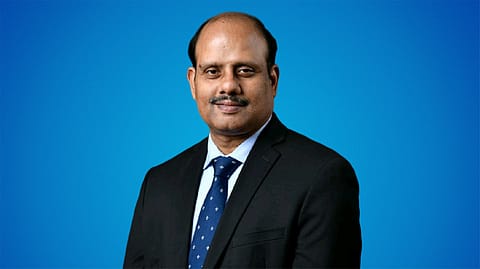
Swaminathan J, Deputy Governor, RBI.
Swaminathan J, Deputy Governor of the Reserve Bank of India (RBI) has said that banking cannot be understood solely through numbers, models or regulations, but requires judgement, experience and a strong sense of public purpose.
Delivering the 12th G. Ramachandran Memorial Lecture at the Madras School of Economics, Swaminathan said a career in banking offers “three educations” — the classroom, the banking counter, and supervision — each providing a distinct perspective on the financial system.
The event was attended by C. Rangarajan, chairman of the institution, N. R. Bhanumurthy, director of the institute, industry representatives, academicians and students.
Paying tribute to G. Ramachandran, Swaminathan highlighted his role in shaping India’s economic and financial architecture in the early decades after Independence. Ramachandran served as Finance Secretary to the Government of India and was associated with key policy measures such as bank nationalisation and poverty alleviation, before later joining the Asian Development Bank.
Theory and practice must align
Swaminathan said while economic theory provides a framework to understand incentives, risks and outcomes, its real value emerges when applied in practice. Concepts such as moral hazard, adverse selection, information asymmetry and systemic risk are not merely academic, but are encountered routinely in banking operations.
“A good education in economics teaches us to ask the right questions — about incentives, costs, benefits and unintended consequences,” he noted.
Highlighting the “education of the counter,” he said banking is fundamentally about judgement, especially in credit decisions that involve uncertainty about the future.
Recommended Stories
“Credit is a judgement about whether a borrower will repay and whether projected cash flows will materialise,” he said, adding that financial ratios and models, while essential, cannot fully capture the quality of management or evolving risks.
He also stressed the importance of looking beyond balance sheets to understand real business conditions, governance practices and borrower behaviour.
Supervision and public trust
From a supervisory perspective, Swaminathan underscored that regulators must focus on safety, soundness and the broader public interest, rather than just institutional performance. “The value of supervision often lies in crises that do not happen,” he said, noting that its role is to quietly preserve confidence in the financial system.
He added that compliance alone is insufficient, and effective supervision must assess
RANK
COMPANY NAME
REVENUE
(INR CR)
(INR CR)
{{#current-rank}} {{current-rank}} {{/current-rank}} {{^current-rank}} {{rank}} {{/current-rank}} {{name}} {{#revenue}} {{revenue}} {{/revenue}} {{^revenue}} {{noi}} {{/revenue}}
Addressing students, the RBI Deputy Governor outlined three key lessons: build strong conceptual foundations, seek real-world exposure, and recognise the broader societal impact of financial decisions.
He also pointed to emerging challenges in a rapidly evolving financial ecosystem marked by digitisation, data-driven lending and the growing role of non-bank intermediaries.
Swaminathan said while technological advancements can improve access and efficiency, they also raise concerns around fairness, accountability and risk recognition. “These questions cannot be answered by technology alone. They require judgement, institutional discipline and a sense of public purpose,” he said.
Concluding the lecture, he said the future of finance will depend not just on technical expertise but on the ability to combine knowledge with judgement and align ambition with public interest.