Nascent signs that India has started thinking long-term on deep tech are visible now: Srinivas Kollipara
/ 8 min read
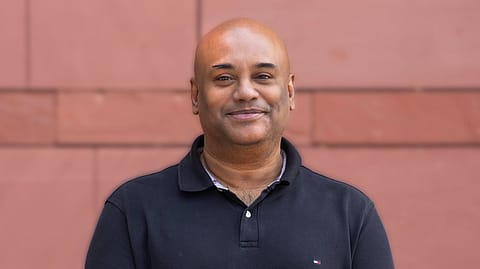
Srinivas Kollipara | Credits: Sanjay Rawat
Nascent signs that India has started thinking long-term on deep tech are visible now: Srinivas Kollipara
Srinivas Kollipara, founder of T-Hub, has embarked on a new venture with Biome, a full-stack venture studio focused on transforming bold ideas into impactful enterprises. In an interview with Fortune India, he discusses Biome's founder-first approach and India's promising long-term vision for deep tech, highlighting the evolving startup ecosystem and the unique model of Venture Studios.
This summary is AI-generated, and Fortune India is not responsible for its content or any associated copyright issues.
Srinivas shares in details about Biome’s founder-first approach and his take on the evolving startup ecosystem in India.
THIS STORY FEATURES
Srinivas Kollipara | Credits: Sanjay Rawat
Start up incubator T-Hub’s founder, Srinivas Kollipara has set forth on a new journey with full stack venture studio – Biome, with an aim of transforming bold ideas into impactful enterprises.
In an exclusive interaction with Fortune India, Srinivas shares in details about Biome’s founder-first approach and his take on the evolving startup ecosystem in India. In the freewheeling interaction, Srinivas says India’s approach to deep tech is genuinely impressive.
Q: You've transitioned from T-Hub to Biome. Was it a natural progression? What's new and different from what you achieved at T-Hub?
T-Hub was a different place, different time. The ecosystem was new. It was pre-Startup India, pre-Flipkart. There were no exits, or very difficult exits. What I realised, having been an entrepreneur myself, is that entrepreneurship is hard. Really hard and really lonely. We had a bunch of really smart people trying to solve large problems, struggling and failing — not because they lacked potential, but because they didn't have access. There was no ecosystem. If they wanted customers, investors, mentors, there was no one there. So my first instinct was: how do we join the dots and help them scale? That was the birth of T-Hub.
T-Hub started as an incubator and grew from there. It's about breadth and connecting things, less about working with individual startups. But I'm a builder at heart.
I wanted to work with startups again. Depth, not breadth, was the focus. That's when I came across the Venture Studio model, about six to seven years ago. I studied it. I came to believe that this model is one of the levers that can genuinely transform an economy, and it's particularly relevant to India right now.
Q: What differentiates a Venture Studio from the traditional startup ecosystem — incubators, accelerators, funds?
Startups are hard and most of them fail. We have incubators, accelerators, and funds — Angel, VC, and so on that are supposed to help them get past those bridges. But two fundamental issues exist with all of those.
First, they play the volume game. It's all about cohorts and size, knowing that some will fail. Second, they're mostly hands-off. Ultimately, it's up to the founder. And underpinning all of this is a fundamental philosophy: they're searching for Superman. They're looking for the Mark Zuckerbergs of the world — people who can build a company on their own. You back the jockey and help a little, but it rests on them.
{{#most-powerful-women-snapshot-individual.slug}} {{/most-powerful-women-snapshot-individual.slug}} {{^most-powerful-women-snapshot-individual.slug}} {{/most-powerful-women-snapshot-individual.slug}} {{#showRanking}} {{current-rank}} {{/showRanking}} {{#photo.0.url}}
{{name}}
The Venture Studio is neither of those things. We make focused bets and work hands-on with every founder to build the company. We're co-founders, not just capital or advisors. And where others are searching for Superman, I'd say we're building Ironman. We back ourselves as executors alongside the founder.
Two, we actually do the work. In the early stages, it's mostly our team building the company. There'll be one or two founders and twelve of our team doing the heavy lifting — then we spin it out into a real startup.
Q: What does the portfolio look like right now in terms of number of founders and investment value?
We're only a year and a half old. At our scale, we'll never do more than three or four companies a year, because we have to be hands-on. We also consciously went slow in the beginning, figuring out the right set of investors, building our thesis properly, and understanding how we add deep value to each company.
Right now, we have two companies. Very different from each other. One is a real estate lending company-Zoop.money. The other is a deeptech material science company-OsteoForge Medtech
The real estate lending company is building a lending solution that digitises the bank's back end and integrates into the builder's CRM on the front end to give loans to individuals.
Q: What is your typical equity ownership structure?
We essentially operate across two models. And I should mention that Venture Studios broadly fall into four types: founder, co-founder, late-founder, and re-founder.
Founder-led studios generate all ideas internally. There's no external founder. Co-founder studios work with someone who has an idea and co-found it together. Late-founder studios come in after a founder has already built out a bit of the company, closer to an incubator model. Re-founder is rare. It involves acquiring a failed company or technology and spinning it into something new.
We are primarily co-founder and late-founder. We tried the pure founder model and sensed that our internally-generated ideas weren't getting to scale.
In the co-founder model, where someone comes to us with an idea, we typically take 20–25% equity. In the late-founder model, depending on how far along they are, that comes down to around 10–15%, combined for cash plus co-founder equity. The cash component is typically around two crores per company, plus our team's time and involvement over the next five years — and we have a very senior team. That's the model.
Q: Which emerging areas are you looking at? Defence tech, deep tech — where do you see opportunity?
It's a very interesting question. It's a very interesting question. I'm also an advisor to a new defence fund called Indus Bridge Ventures, where significant LP interest signals strong opportunities in the defence sector.
But the bigger growth area I see across the board is deep tech — technology-heavy, hard science, non-web stuff. And interestingly, that plays directly to the strength of the Venture Studio model. Deep tech founders are researchers, scientists, technologists. In the past, they'd have had to become the CEO of their own company and handle everything. That's hard for two reasons: one, their brain doesn't work that way, and two, it's not what they're good at. Let them focus on what they do brilliantly, and we take care of the rest.
As a Venture Studio, we do two broad types of things for our companies. One is the obvious — scaling, business model development, customer acquisition, fundraising. The other, which people often overlook, is taking off founders' shoulders the things they're not good at and that drain their energy: legal, finance, accounting, talent acquisition, fundraising.
On the AI question — it's clear that AI is transforming industries across the board. But for software-heavy companies, that moat is disappearing fast. Five years from now, software won't be the moat.
Q: Where does India stand on deep tech compared to the US or China, and how do we get there?
We have structural issues with deep tech. Traditionally, we haven't had the kind of risk capital that deep tech requires — patient, long-horizon capital willing to sit on hardware. That's changing. The government is trying to build that through multiple fund layers. Execution is where the rubber meets the road, but at least the right moves are being made.
The other part of it is mindset — and I say this with some historical perspective. India was a closed economy 35 to 40 years ago. Our education system was built around learning and repeating, not applying. Research meant publishing a paper. That was the goal — not commercialisation.
What's changed is a few things. First, geopolitics. It's no longer as easy or attractive to build a career in science and research in the US, so people are coming back. Our ecosystem is filling up with returning talent, just like the startup ecosystem did a few years ago. Ambitions are getting bigger. Second, capital is now available — we have large VC funds in India beginning to invest into deep tech, space tech, medtech. They weren't doing that before.
And it's worth remembering — the entire digital startup story in India really only started after Jio's intervention in 2016. Data became cheap and accessible, and only then did we start building the stacks on top of it. That's less than ten years ago. Something that was magical suddenly becomes ordinary, and people want the next thing. That's human nature. We went from being amazed that you could type something and get an intelligent response, to demanding AGI. The same progression is happening in deep tech.
Q: What's the profile of the other companies in your pipeline?
The second company we're working with is a deep tech play. The founders have created a patented new biomaterial. When you break a bone, implants are typically made of polymers or titanium. The problem with titanium is that you have to remove it after 15 to 18 years — some devices even sooner. People often forget or ignore it, and if left too long, the bone starts fusing with the metal, creating complications. This material is what they call bio-resorbable: it gets absorbed into the body, so you never need to remove it. More importantly, it actively stimulates bone growth, so healing is faster. It's patented and in the final stages of clinical trials.
Beyond those two, we have three more companies in final pipeline stages. To put it in perspective — to arrive at the two we're working with, we evaluated 376 companies. About 60 went through deeper assessment. Around 15 reached final stages where we spent two to three months on business strategy before deciding. Our philosophy is that everyone we touch should leave with value, whether we work with them or not.
Q: Within your portfolio and the companies you've worked with across your career, which profiles have excited you the most?
For me, it's never really been about the domain. It's about that moment when you hear an idea and think, wow! And in that “wow” moment, there's almost always a second thought — why has nobody else done this? Because usually, it actually makes sense. Nobody just thought of it that way.
Q: Globally, which country or ecosystem is doing this well — thinking big, not just incrementally?
It's not a popular answer, but China is rethinking things from the ground up, with a long-term horizon. They looked at EVs and traced the entire chain — rare earth materials, electricity infrastructure, everything. That foundation is now giving them the edge in AI too. Power and water alone — they built out surplus capacity for EVs, and now AI needs enormous amounts of electricity. I'm not sure India has enough for it. China thought through all of it: labour, training, infrastructure, cutting-edge research. They sent their people to foreign universities to bring that knowledge back. They have a genuinely holistic, long-term approach. We're seeing the end result today, but this has been in motion for well over a decade. That kind of long-term thinking has been missing in most countries — it's always about addressing what's urgent right now.
Q: Are there signs that India is also starting to think long-term on deep tech?
There are nascent signs. Space tech is a good example. The way we're approaching it is genuinely impressive. A founder of a major space startup told me that thee expected red tape when they started a couple of years back. What they got was a red carpet. Anything they needed - policy changes, incentives - it was made available. So, there is deep thinking happening in that space. Are we at the level of SpaceX or other global leaders? Not quite yet, but we're doing a good job. These things take time.
Follow Fortune India
NEXT STORY