‘Fake news to manipulate markets’: Iran rejects US talks claim as Trump doubles down; oil tumbles, equities surge
/ 3 min read
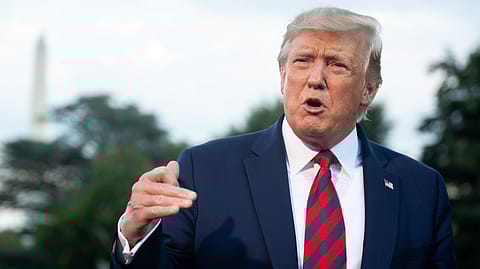
US President Donald Trump | Credits: Getty
‘Fake news to manipulate markets’: Iran rejects US talks claim as Trump doubles down; oil tumbles, equities surge
Iran has dismissed U.S. claims of ongoing negotiations, labeling them as 'fake news' intended to manipulate financial markets. Despite Tehran's denial, President Trump insists on 'productive talks' and pauses planned strikes, leading to a sharp decline in oil prices and a surge in global equities, reflecting hopes of de-escalation.
This summary is AI-generated, and Fortune India is not responsible for its content or any associated copyright issues.
The reaction follows U.S. President Donald Trump’s claim that Washington and Tehran had held “very good and productive conversations” over the past two days regarding a resolution of hostilities.
US President Donald Trump | Credits: Getty
Global markets are facing heightened uncertainty amid a sharp divergence in narratives between Washington and Tehran on Monday, as Iran’s top leadership rejected US claims of ongoing negotiations even as equities rallied and oil prices slumped on hopes of de-escalation.
Iran’s parliament Speaker Mohammad Bagher Ghalibaf said there have been no negotiations with the United States, calling reports of talks “fake news” aimed at influencing financial and oil markets.
“Fake news is used to manipulate the financial and oil markets and escape the quagmire in which the US and Israel are trapped,” he said.
Trump claims ‘productive talks’, doubles down despite denial
The reaction follows U.S. President Donald Trump’s claim that Washington and Tehran had held “very good and productive conversations” over the past two days regarding a resolution of hostilities.
He said he has ordered a five-day pause on planned strikes targeting Iranian energy infrastructure, citing progress in discussions.
That claim was swiftly refuted by Iranian media outlets which quoted officials saying no peace talks with U.S. have been held.
Despite that, earlier in the day, speaking to reporters before boarding Air Force One, Trump reiterated that there were “major points of agreement”, maintaining that talks were progressing even as Tehran publicly denied any negotiations.
According to Axios, President Trump said his envoys Steve Witkoff and Jared Kushner have spoken with a senior Iranian official, with potential "deal" terms emerging. The report also added that President Trump claimed Iran has committed not to pursue nuclear weapons or to enrich uranium, and to hand over its existing stockpiles; agreed to be "low key on missiles"; and also agreed to reopen the strait of Hormuz.
Oil plunges as war premium unwinds
Crude oil prices saw a sharp decline following Trump’s announcement, with Brent crude slipping below the $100 per barrel mark after trading above $110 earlier.
Brent Crude was trading at $98.97 per barrel as on 9:58 pm IST.
The fall reflects a rapid unwinding of the geopolitical risk premium tied to fears of supply disruption through the Strait of Hormuz. While prices did not hit formal exchange limits, the drop marked one of the sharpest intraday declines in recent sessions.
{{#most-powerful-women-snapshot-individual.slug}} {{/most-powerful-women-snapshot-individual.slug}} {{^most-powerful-women-snapshot-individual.slug}} {{/most-powerful-women-snapshot-individual.slug}} {{#showRanking}} {{current-rank}} {{/showRanking}} {{#photo.0.url}}
{{name}}
Global equities rally sharply
Global equity markets surged in response to the perceived de-escalation.
U.S. stock futures jumped following Trump's announcement, with S&P 500 futures rising nearly 3%, Nasdaq futures gaining over 2.5%, and Dow futures up nearly 3%.
In India, GIFT Nifty surged nearly 3–4%, pointing to a sharp gap-up opening in the next session.
Indian markets had seen a bloodbath earlier
The rebound signal comes after a steep sell-off in domestic equities earlier in the day.
The Sensex plunged 1,836 points to close at 72,696, while the Nifty fell 2.6% to 22,512, with all sectoral indices ending in the red.
The sell-off wiped out nearly ₹14 lakh crore in investor wealth, driven by rising crude prices, a record low rupee, and sustained foreign investor outflows.
Market breadth remained weak, with midcap and smallcap stocks also witnessing sharp declines, while metals and banking stocks led the losses.
Conflicting narratives keep uncertainty high
Adding another layer, an earlier Axios report said countries including Turkey, Egypt and Pakistan are mediating backchannel communications between the U.S. and Iran.
While this suggests diplomatic engagement is underway, there is no confirmation of direct talks, aligning with Iran’s official stance while partially validating Washington’s claims of ongoing communication.
Follow Fortune India
NEXT STORY