
BMW is gunning for the top spot. Mercedes just won’t let go without a fight
ADVERTISEMENT
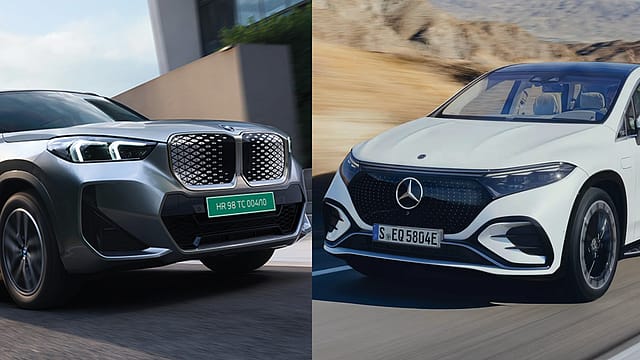
It seemed like a cake walk of sorts. Until it didn’t.
Last year, BMW closed the gap to India’s largest luxury carmaker, Mercedes-Benz, growing by nearly 15%, while Mercedes-Benz seemed stuck in a quagmire, with sales falling by 3%. The numbers looked strikingly close for BMW to usurp Mercedes-Benz at the top, and expectations were that BMW could be on track to overtake it this year.
With BMW planning some 26 launches (new and product refresh) compared to Mercedes' 12 for the year, it seemed well on target.
Then, Mercedes decided to take on the fight head-on.
On July 7, the Pune-based German automaker announced its highest-ever sales for the first half of the year, retailing 9,768 vehicles between January and June 2026. That growth, largely driven by a surge in entry-level sedan and top-end luxury car sales, has helped the automaker tide it over the tumultuous macroeconomic conditions and take the fight to BMW, which has been in a league of its own. Mercedes also continues to retain the top spot in India’s luxury automobile sector.
The German luxury carmaker also recorded its best-ever April-June quarter, selling 4,637 vehicles, up 10% from 4,238 a year earlier. "The growth has been fundamentally driven by new launches," Santosh Iyer, MD & CEO of Mercedes-Benz India, said.
In contrast, despite stronger growth on the back of a lower baseline, BMW must contend with being painstakingly close to Mercedes for the top step, with its sales still falling short by nearly 700 cars in the first half of the year. BMW sold 9,075 cars, up 17% year-on-year in the first half of the year, and 4,507 cars in the April-June quarter.
“BMW Group India has delivered its highest-ever sales performance in the first half of 2026. We have delivered 9,075 cars, but beyond this impressive number, what we are really focused on is to continue our steady double-digit growth in an otherwise challenging environment,” Hardeep Brar, CEO of BMW Group India, said.
The BMW Group India is in the midst of a two-pronged attack to win the Indian market, where it had long had to contend with being the runner-up. BMW is also throwing serious money and attention to the MINI brand, the British automobile company that BMW acquired a little over 30 years ago, and last month launched the Mini Countryman C, an SUV, at a rather attractive price of ₹47 lakh, marking it as the first locally assembled SUV in its lineup.
Still, the strong showing by Mercedes has meant that BMW now needs to up the ante in the remaining six months, if it intends a shot at the top step in India’s fast growing largest luxury car market. Already, BMW will launch as many as 14 vehicles before the end of the year.
Mercedes, though, was also helped by a phenomenal growth in the top end of the luxury market. Sales of vehicles priced above ₹1.4 crore grew by over 20% during the first six months of 2026, with these models accounting for 28% of the company's overall sales in India—its highest-ever contribution.
The portfolio includes models such as the Mercedes-Maybach range, S-Class, AMG performance vehicles, EQS SUV, and the new V-Class. Typically, for Mercedes, 25% of its sales came from the top end, while the core luxury segment accounted for a little more than 60%. At the entry level, that share was 13%.
Mercedes-AMG, in particular, recorded a sharp 50% growth in H1, reflecting rising demand for high-performance luxury cars among affluent Indian buyers. Battery electric vehicles also made significant inroads into the premium segment, contributing 25% of top-end luxury sales during the period.
So, what happens now?
Currently pegged at $1.5 billion, India’s luxury car market is expected to grow to $1.92 billion by 2031, notes market research firm Mordor Intelligence. Rising household wealth is a key factor driving demand for luxury goods. As of 2025, India had nearly 870,000 millionaire households (with a net worth of around ₹8.7 crore), according to the Mercedes-Benz Hurun India Wealth Report 2025 — almost double the number in 2021.
That means, for both Mercedes and BMW, the opportunity remains enormous. And being a market leader always adds heft, whoever holds the reins. “It’s a trade-off,” Harshvardhan Sharma, group head, automotive tech & innovation group at Nomura, had told Fortune India about the divergent strategy by Mercedes and BMW. “Focussing on core and top-end luxury improves margins, brand exclusivity, and dealer economics.” That said, entry models play a critical role as brand feeders. Any leader might want to retain a well-differentiated entry presence while laddering customers into higher segments over time.”
Today, only about 50,000 luxury vehicles are sold in the country, of the total 4.5 million cars sold annually. That’s also why BMW has chalked out a strategy to turn its attention to the entry level, even as Mercedes claims to move away from triggering a price war in the entry-level luxury segment.
“You can’t have people at the top growing,” Brar had told Fortune India earlier. “Once they (the buyers) enter, they slowly and gradually upgrade to the bigger cars. And for that, you need your entry-level to be very strong, so people know what luxury is about. The expansion will always happen at the bottom.”
Meanwhile, the race to the top step will also depend heavily on automakers' electric offerings. The luxury segment has been experiencing rapid growth, with sales nearly doubling last month. Additionally, triggered by the West Asia conflict and the improved cost competitiveness of electric vehicles (EVs), overall electric vehicle sales are expected to more than double by the next fiscal, according to ratings agency Crisil.
BMW remains the number one luxury electric vehicle (EV) brand in India with sales of 2,359 vehicles in the first half of the year, cornering 69% market share in the luxury EVs segment, and as much as 26% penetration of sales in H1, making every fourth car BMW Group India sells an EV. Mercedes-Benz, meanwhile, has seen penetration double to 14% of total sales mix in Q2 2026, driven by the success of the New CLA BEV and demand for the top-end EQS SUV.
So, what happens now? “I think we don’t just rest on the innovations that we do,” Iyer had told Fortune India earlier. “The relentless pursuit of being relevant to the market, keeping the customer at the center of what we do, bringing those innovations to the market, and making them relevant — I think that’s the secret sauce.”
The fight to the top may not be an easy one, just yet, for BMW.