
Cleaner vehicle sales rise to 32% in India as EV, hybrid, CNG adoption accelerates: Maruti Suzuki MD Hisashi Takeuchi
ADVERTISEMENT
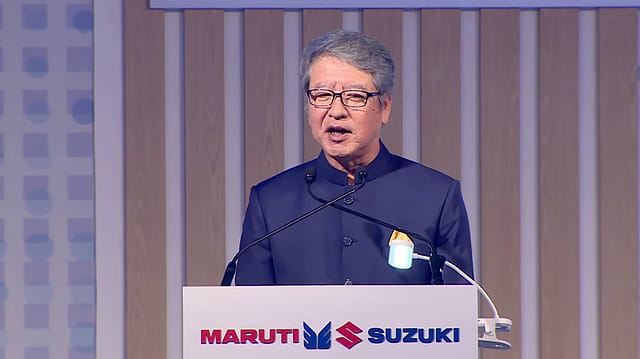
The share of cleaner vehicle technologies in India’s automobile sales has risen to 32% this year from about 27% a year earlier, signalling a broadening shift towards electric vehicles, hybrids and CNG, Maruti Suzuki MD & CEO Hisashi Takeuchi said on Thursday.
Speaking at the 66th SIAM Annual Convention, Takeuchi said the April-July period showed that roughly every third car sold in India now uses one of these technologies. “This shows how coordinated policies from the government and efforts from all stakeholders are making India a global leader in sustainable mobility,” he said.
Multiple technologies to drive cleaner mobility
Takeuchi said India would need a multi-technology approach to cleaner mobility, given differences in consumer requirements, infrastructure and affordability.
“For Maruti Suzuki, sustainable mobility has 5 important dimensions: Reducing carbon emissions, Improving air quality, Keeping mobility affordable, Strengthening energy security, and Pursuing solutions that are scalable,” he said.
He pointed to battery electric vehicles, hybrids, CNG and biofuels such as compressed biogas (CBG) and ethanol as technologies that can contribute to the transition. Hydrogen, he added, could emerge as another viable option.
The shift towards cleaner vehicles is taking place alongside renewed focus on affordability. Takeuchi said the recent GST reforms had demonstrated the impact of pricing on demand, with small cars in the 18% GST bracket recording about 30% growth in the first four months of the financial year, against nearly 20% growth for vehicles in the 40% bracket. Entry-level cars recorded almost 100% growth, he said.
CBG seen as potential energy-security lever
Takeuchi also highlighted CBG as an option with relevance beyond the automotive sector, given India’s availability of cattle dung, biomass and agricultural waste.
“CBG is Carbon Negative; it curbs stubble burning, thereby improving air quality; it is fully Atmanirbhar, and it generates income and employment opportunities in rural India,” he said.
Suzuki has three cow-dung-based biogas plants operational in India, while seven more such plants and four agriculture-based plants are in the pipeline, he said.
Manufacturing, recycling part of mobility transition
Takeuchi said the sustainability challenge extends beyond the technology fitted inside a vehicle to manufacturing, energy sourcing, materials, transportation and recycling.
At the manufacturing level, Maruti Suzuki is increasing the use of renewable energy, including solar power and biogas, while expanding rail transportation for vehicles and working on material circularity and recycling.
“India today has the advantages of scale, engineering capability, a strong supplier ecosystem and a large domestic market,” Takeuchi said.
He added that deeper localisation, technology development and globally competitive quality could help India emerge as one of the world’s important automobile manufacturing and export hubs.