
Explained: How Vehicle-to-Vehicle communication could transform road safety in India from 2028
ADVERTISEMENT
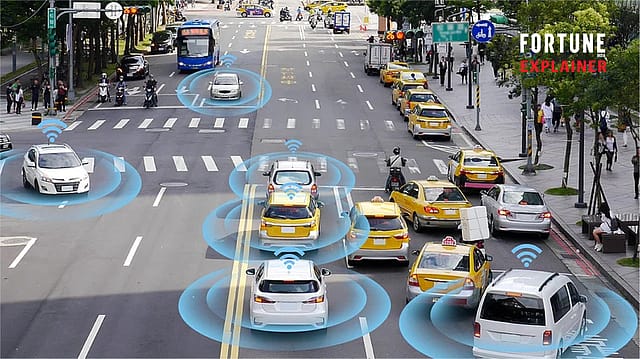
The Centre has proposed making Vehicle-to-Vehicle (V2V) communication systems mandatory in all new vehicles from October 2028. Here's what the technology is, how it works and why it could mark a major shift in road safety and connected mobility.
What is Vehicle-to-Vehicle (V2V) communication?
Imagine a car warning another about a sudden brake application or an ambulance approaching long before either comes into the driver's line of sight. That's the idea behind Vehicle-to-Vehicle (V2V) communication, a technology that enables nearby vehicles to exchange real-time information such as speed, position, direction and acceleration through wireless communication.
The Ministry of Road Transport and Highways (MoRTH) has proposed making V2V communication systems mandatory in all new L, M and N category vehicles manufactured from October 1, 2028, as part of a phased rollout aimed at improving road safety and laying the foundation for connected mobility.
How is it different from ADAS?
Unlike Advanced Driver Assistance Systems (ADAS), which rely primarily on onboard cameras, radar and other sensors to detect hazards, V2V allows vehicles to "talk" to each other even beyond the driver's field of vision. This means a vehicle can receive alerts about potential dangers hidden around a bend, obscured by heavy traffic or masked by poor visibility, enabling quicker responses in safety-critical situations.
Rather than replacing ADAS, V2V is designed to complement it by sharing information that onboard sensors alone may not capture.
How will the system work?
Under the proposed framework, manufacturers will equip vehicles with factory-fitted On-Board Units based on Cellular Vehicle-to-Everything (C-V2X) technology operating in the 5.875 GHz-5.925 GHz spectrum. These units will continuously exchange safety-related information with nearby vehicles, allowing systems to generate warnings for situations such as emergency braking, forward-collision risks, wrong-way driving and approaching emergency vehicles.
The technical requirements are laid out in the Automotive Industry Standard (AIS)-230, which also prescribes cybersecurity, communication security, positioning accuracy and radio-performance standards.
Why does it matter?
It is important to note that, India records one of the highest numbers of road fatalities globally, with human error accounting for a large share of accidents. By allowing vehicles to share information in real time, V2V has the potential to improve situational awareness and warn drivers of risks before they become visible.
The proposal also marks an important step towards connected and intelligent transport systems, creating the groundwork for future technologies such as vehicle-to-infrastructure communication, smarter traffic management and increasingly software-defined vehicles. If notified after public consultation, the mandate could become one of India's most significant road-safety technology reforms in recent years.