
India auto industry bets on EVs, alternative fuels, AI to drive global mobility leadership
ADVERTISEMENT
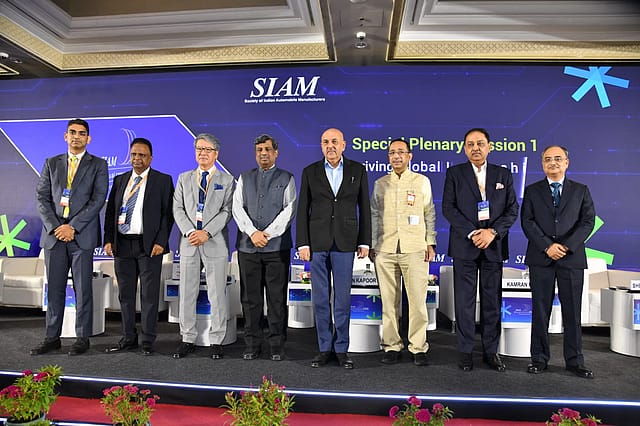
India’s automobile industry is stepping up its push to become a global hub for sustainable mobility, with electric vehicles, alternative fuels, artificial intelligence (AI), advanced manufacturing and exports emerging as key areas of focus.
The industry’s roadmap was discussed at a special plenary session of the Society of Indian Automobile Manufacturers’ (SIAM) 66th Annual Convention, where policymakers and auto industry leaders outlined the need to accelerate the transition to cleaner mobility while keeping vehicles affordable and building indigenous technology capabilities.
Tarun Kapoor, Advisor to the Prime Minister, said India’s mobility transition needs to move faster towards cleaner fuels, with electric vehicles, biofuels and green hydrogen expected to play a key role.
“India’s mobility transition must accelerate towards cleaner fuels, with electric, biofuels and green hydrogen shaping the way forward,” Kapoor said.
He also underlined the need to expand charging infrastructure, accelerate the electrification of heavy vehicles, strengthen India’s export ecosystem and position the country as a global hub for advanced mobility technologies and manufacturing.
The government’s focus on accelerating the transition was also reflected in the comments of V Umashankar, Secretary, Ministry of Road Transport & Highways, who described the automobile sector as a strong growth story driven by collaboration among stakeholders.
Umashankar also pointed to the government’s PARIVARTAN scheme for commercial vehicles in Delhi-NCR, saying it was gaining momentum and would transform the segment in the region.
Kamran Rizvi, Secretary, Ministry of Heavy Industries, said India’s electric mobility journey had evolved significantly from the FAME scheme to production-linked incentive (PLI) programmes, with policy support helping the industry achieve scale.
“Over the next 10–15 years, the scales will be tipped towards electric mobility,” Rizvi said.
At the same time, he stressed the need for India to narrow the technology gap with global markets and accelerate the development of indigenous technologies.
Affordability remains central to mobility transition
While electrification is expected to gain momentum, industry leaders stressed that the shift to cleaner mobility must not come at the cost of affordability.
Hisashi Takeuchi, Managing Director and CEO of Maruti Suzuki India, said affordability had played a key role in expanding car ownership in India. He added that GST reforms had made mobility more accessible, particularly for first-time buyers.
Takeuchi also highlighted India’s expanding alternative-fuel ecosystem, pointing to the availability of CNG and biofuels at scale as an important part of the country’s efforts to reduce dependence on fossil fuels.
The emphasis on multiple fuel and technology pathways comes as the industry seeks to balance three priorities — sustainability, affordability and energy security — rather than relying on electrification alone.
AI emerges as key technology driver
AI is also emerging as an important pillar of the automobile industry’s technology strategy, with its applications spanning product development, manufacturing, customer experience and automated driving.
Ola Källenius, CEO of Mercedes-Benz and President of the European Automobile Manufacturers’ Association (ACEA), said India has the company’s largest R&D centre outside Germany and is an important production base for both internal combustion engine (ICE) and electric vehicles.
Speaking virtually, Källenius highlighted applications of AI ranging from voice assistants to automated driving and said India and Europe could work together to shape the digital future.
“Together, India and Europe can shape the digital future,” he said.
McKinsey & Company Senior Partner Nitesh Gupta also made a presentation on leveraging AI to drive global leadership in sustainable mobility.
R Velusamy, Chairman of the SIAM Passenger Vehicle CEOs Council and President – Automotive Business at Mahindra & Mahindra, highlighted the opportunity for India to use AI to accelerate innovation and improve sustainability across the domestic automotive ecosystem.
Technology, exports to shape next phase
The session was also attended by Shenu Agarwal, Vice President, SIAM and Managing Director & CEO, Ashok Leyland.
The discussions underscored a wider shift in India’s automotive strategy, with the transition to cleaner mobility increasingly linked to technology development, manufacturing scale and exports.
For the industry, the ambition extends beyond increasing EV adoption. Building indigenous technologies, expanding alternative-fuel options, deploying AI and strengthening India's export capabilities are emerging as parallel priorities as automakers seek a larger role in the global mobility ecosystem.