
JSW MG Motor bets on multi-powertrain strategy with new NEV platform, targets EV and PHEV launches by FY27
ADVERTISEMENT
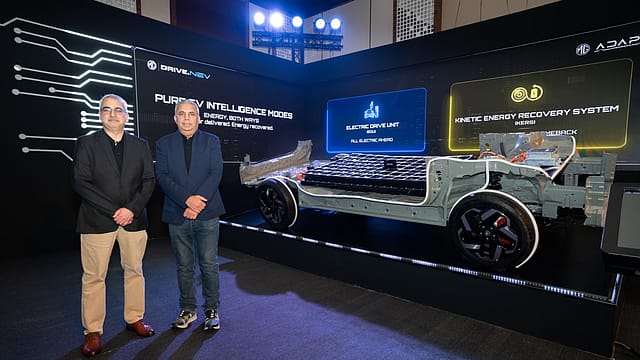
JSW MG Motor India on Thursday unveiled a new modular vehicle architecture that supports four electrified powertrain technologies, doubling down on its multi-energy strategy as demand for new energy vehicles (NEVs) gathers pace amid rising fuel prices triggered by the West Asia conflict.
The company stated that its new Advance Drive Architecture Platform Technology (ADAPT) will underpin future Electric Vehicles (EVs), Hybrid Electric Vehicles (HEVs), Plug-in Hybrid Electric Vehicles (PHEVs) and range-extender electric vehicles (REEVs), with an electric vehicle set to debut first, followed by a plug-in hybrid model later this year.
The move comes as automakers increasingly adopt flexible vehicle architectures to cater to evolving consumer preferences and changing market dynamics.
JSW MG Motor India Managing Director Anurag Mehrotra said the company expects new energy vehicles to contribute 70-80 per cent of its overall sales this year, driven by improving customer acceptance and a sharp rise in demand following higher fuel prices. He added that the company has sold nearly 40,000 vehicles so far this year, registering around 12-13 per cent year-on-year growth, with its Halol manufacturing facility currently operating at full capacity across three shifts.
West Asia conflict accelerates shift towards NEVs
Mehrotra said the conflict in West Asia has accelerated consumer interest in new energy vehicles after fuel prices started rising.
"After March, once the West Asia crisis hit, we are actually seeing better traction on NEVs, and that is clearly visible by the penetration going up."
He noted that passenger vehicle EV penetration has risen from 3.8 per cent in January to over 8 per cent in June, indicating a significant shift in buying preferences.
"Consumers are coming to the stores and they are wanting to make the choices which are more leaning towards NEVs, and that is true for all of us."
Asked whether the company was benefiting from the trend, Mehrotra replied, "Absolutely. It is reflected in our numbers and our growth. We are running full production capacity in three shifts."
ADAPT platform to anchor future product pipeline
MG ADAPT has been developed as a modular architecture capable of supporting EVs, HEVs, PHEVs and REEVs on a common platform. According to the company, the architecture has been designed to improve product development efficiency while enhancing driving range, charging capability, vehicle performance, safety and refinement.
Explaining the rationale behind the platform, Mehrotra said a common architecture would enable the company to optimise investments while improving localisation.
"Instead of having multiple platforms to cater to multiple consumers, having a single platform makes it that much more capex-efficient."
He added that the common platform would also allow localisation levels to increase significantly as higher production volumes would justify greater domestic sourcing of components.
Capacity expansion gathers pace
To meet rising demand, JSW MG Motor India is expanding production capacity at its Halol plant. Mehrotra said the first phase of expansion will be completed by March next year, increasing annual production capacity from 1.2 lakh units to 1.6 lakh units, following which work will begin on the second phase to raise capacity to 3 lakh units annually.
The company has already increased its workforce at the facility by around 40 per cent to support the third production shift and has earmarked ₹1,400 crore in capital expenditure this year as part of its previously announced ₹4,000-crore investment programme for product development, localisation and capacity expansion.
At the heart of the ADAPT platform is an integrated technology ecosystem comprising a dedicated hybrid engine, dedicated battery system, India's first 10-in-1 intelligent electric drive unit and an intelligent energy management system that automatically switches between four drive modes to optimise efficiency and performance. The platform will form the technological backbone for JSW MG Motor India's next generation of new energy vehicles.