
Maruti Suzuki raises FY31 capex to ₹77,500 crore as growth plans accelerate: MD & CEO Hisashi Takeuchi
ADVERTISEMENT
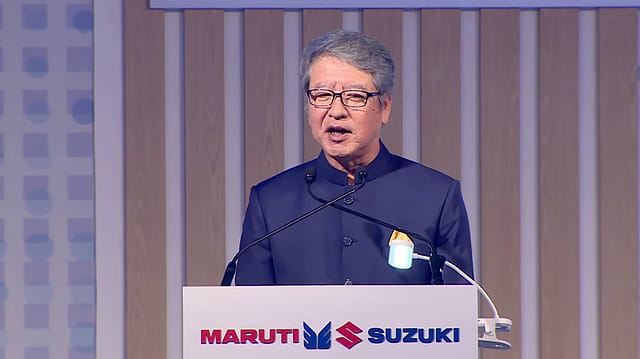
Maruti Suzuki India Limited (MSIL) has raised its capital expenditure plan to ₹77,500 crore for the five years through FY31, stepping up investments in manufacturing capacity, new models and research and development as the country’s largest carmaker prepares for its next phase of growth.
MSIL Managing Director and CEO Hisashi Takeuchi told shareholders at the company’s 45th annual general meeting on Monday that Maruti will increase FY27 capex by 40% to ₹14,000 crore from around ₹10,000 crore in FY26.
“For FY27, we have planned a 40% jump in capital expenditure in a single year from around ₹10,000 crore last year to ₹14,000 crore this year. From FY27 to FY31, we have planned a capex of ₹77,500 crore,” Takeuchi said.
₹77,500 crore investment to fund capacity, new models
The latest investment plan is higher than the ₹70,000 crore commitment outlined last year by Toshihiro Suzuki, Representative Director and President of Suzuki Motor Corporation, Maruti Suzuki’s parent, for strengthening its Indian operations over the next five to six years.
Takeuchi said the expanded programme would cover “capacity expansion, new model development, R&D activities, plant maintenance, marketing and sales infrastructure, carbon neutral measures, logistics and so on.”
Maruti has already reached an annual installed production capacity of 29 lakh units following the commissioning of its fourth plant at Hansalpur, Gujarat, and second plant at Kharkhoda, Haryana, this year. Hansalpur accounts for 10 lakh units of capacity, Manesar 9 lakh, and Kharkhoda and Gurugram 5 lakh units each.
The company is targeting 40 lakh units of annual capacity. “Our roadmap from 29 lakh units to 40 lakh units includes two additional plants at Kharkhoda and three plants at our upcoming facility in Gujarat, located at Sanand, each with a capacity of 2.5 lakh units,” Takeuchi said.
Seven SUVs, flexible plants to reshape product strategy
Maruti plans to introduce seven SUVs over the next five years as it seeks to increase its presence in the segment. The company currently sells five SUV models—Fronx, Brezza, Jimny, Grand Vitara and Victoris.
At the same time, its small-car franchise remains a key part of the strategy. Maruti commanded an 83% share of India’s small-car market during April-July FY27, with volumes rising 63% year-on-year, driven by models including Alto K10, S-Presso, Celerio and WagonR.
“There is a huge potential for small cars in future as household incomes continue to grow and we remain focussed in this segment through appropriate product interventions,” Takeuchi said.
The new manufacturing facilities are also being designed for greater powertrain flexibility. “In our new plants, we can make electric vehicles (EVs), strong hybrids, CNG and internal combustion engine vehicles on the same line,” Takeuchi said.
By FY31, Maruti expects EVs to account for 15% of domestic passenger vehicle volumes, hybrids 25%, CNG 35% and gasoline blended with biofuels 25%.
EV, E20 and green manufacturing investments
Maruti introduced its first EV, the e Vitara, in FY26. The company has exported more than 43,000 units and sold around 8,500 units domestically so far. Takeuchi said the company will continue localising EV components, including batteries, as India’s EV ecosystem develops.
“We started from mid-upper segment EV considering the situation of charging infrastructure in India and also the availability of home charging capability,” he said. “But as the infrastructure of EV charging will be ready in India, we will add a smaller EV in our portfolio.”
Takeuchi also assured shareholders that Maruti cars produced from 2008 onwards are E20 compatible, saying the company had improved ethanol compatibility from that production year.
Maruti is simultaneously increasing investment in cleaner manufacturing. Its in-house solar capacity is planned to rise from 79.1 MW in FY26 to 211.3 MW by FY31, which Takeuchi said would meet nearly 35% of its total electricity requirements. The balance will largely come from green electricity, mainly solar and wind power, while biomass plants are planned at Manesar, Kharkhoda and Sanand.
Despite the higher investment outlay, Takeuchi said Maruti would maintain a high dividend payout. “While our capital expenditure is increasing, we are consistently maintaining a high dividend payout ratio of around 30%,” he said.
For FY26, the company’s board recommended its highest-ever dividend of ₹140 per share, while consolidated revenue reached a record ₹1,83,266 crore and profit stood at ₹14,445 crore.