
Tesla's bigger bet: Can the Model Y's Rs 50 lakh variant disrupt India's premium EV market?
ADVERTISEMENT
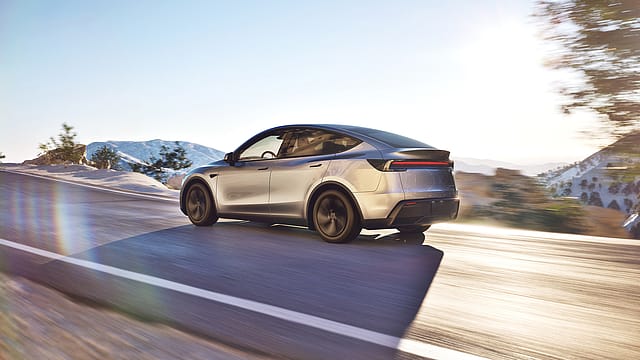
Tesla Inc.'s decision to expand its India portfolio with the launch of the new Model Y Premium Rear-Wheel Drive (RWD) comes at a time when competition in the country's premium electric vehicle market is intensifying. While battery-driven models account for a small share of overall Passenger Vehicle (PV) sales, the premium Electric Vehicle (EV) segment has emerged as one of the fastest-growing pockets of the industry, attracting both global luxury brands and new-age players.
The move also comes against the backdrop of Tesla's global scale. The Elon Musk-led company delivered more than 1.63 million vehicles worldwide in 2025, with the Model 3 and Model Y continuing to account for the bulk of its global volumes.
As per industry analysts, the arrival of the new Model Y is significant not because it will dramatically alter India's overall EV penetration, but because it places Tesla more directly in the path of established premium EV rivals such as BMW, Mercedes-Benz, Volvo, BYD and Kia.
Priced at ₹50.89 lakh (ex-showroom), the new Model Y Premium RWD becomes Tesla's most affordable offering in India so far. The question now, according to industry analysts, is whether Tesla can expand the premium EV market or simply divert buyers from competing brands.
The launch comes nearly a month after Tesla introduced the three-row, six-seater Model YL at ₹61.99 lakh and about a year after the company entered India with the Model Y priced at ₹59.89 lakh. The company has clarified that the latest launch is not a price cut but the introduction of a new variant aimed at broadening its portfolio. The Long Range variant offered earlier has been phased out.
A market still in its infancy
India's passenger EV market remains heavily concentrated. Tata Motors continues to dominate the segment with an estimated market share of around 40%, followed by JSW MG Motor at nearly 29%. Mahindra has rapidly emerged as the third-largest player, riding on strong demand for its new-generation electric Sport Utility Vehicles (SUVs), while Hyundai and BYD complete the top five.
Industry estimates suggest passenger EV sales crossed 1.75 lakh units in 2025, while EV penetration remains around 4% of the overall passenger vehicle market. However, the momentum is particularly visible in the luxury segment.
Industry estimates indicate luxury EV penetration has moved into double digits, driven by rising demand for electric offerings from BMW, Mercedes-Benz, BYD, Volvo and Kia.
While the luxury EV market remains small in absolute volumes, it is expanding at a significantly faster pace than the broader passenger vehicle industry. At the luxury end, Tesla will increasingly find itself competing with the BMW iX1 and i4, Mercedes-Benz CLA and Volvo EX40."
A market still in its infancy
India's passenger EV market remains heavily concentrated. Tata Motors continues to dominate the segment with an estimated market share of around 40%, followed by JSW MG Motor at nearly 29%. Mahindra has rapidly emerged as the third-largest player, riding on strong demand for its new-generation electric Sport Utility Vehicles (SUVs), while Hyundai and BYD complete the top five.
Industry estimates suggest passenger EV sales crossed 1.75 lakh units in 2025, while EV penetration remains around 4% of the overall passenger vehicle market. However, the momentum is particularly visible in the luxury segment.
Industry estimates indicate luxury EV penetration has moved into double digits, driven by rising demand for electric offerings from BMW, Mercedes-Benz, BYD, Volvo and Kia. While the luxury EV market remains small in absolute volumes, it is expanding at a significantly faster pace than the broader passenger vehicle industry.
In the mass-premium segment, buyers can choose from models such as the BYD Seal, BYD Sealion 7, Hyundai Ioniq 5 and Kia EV6. At the luxury end, Tesla will increasingly find itself competing with the BMW iX1 and i4, Mercedes-Benz CLA and Volvo EX40.
More than a product battle
Tesla's Indian arm has claimed that it has been expanding its charging footprint, retail presence and service network across major cities, signalling a commitment to the market beyond product launches.
Puneet Gupta, Director, S&P Global Mobility, believes Tesla's latest move could have implications beyond the company's own sales performance.
"With a lower entry price point, Tesla is making itself more accessible to Indian consumers. The move may not immediately transform volumes, but it certainly improves consideration levels. Beyond sales, Tesla's presence and pricing strategy can act as a catalyst for innovation, competition and premium EV penetration in India," Gupta says.
Yet, industry experts caution that success in India's premium vehicle market is not determined by technology alone.
"The Model Y can disrupt the luxury market at that price point. However, one needs to remember two things. First, at that price point people buy a prestige badge and not necessarily an electric vehicle. Second, because the badge is prestige, the vehicle has to have that amount of presence," says Avik Chattopadhyay, Founder, Expereal.
According to Chattopadhyay, while the premium EVs are helping broaden consumer awareness, the real volume opportunity lies further down the market. "EV penetration is still low as there is really no offer below ₹10 lakh where the market for adoption really exists," says Chattopadhyay.
Whether Tesla ultimately disrupts the premium EV hierarchy or simply intensifies competition within the luxury segment will become clearer as deliveries begin and consumer response unfolds.