
The Hyundai Creta has had a phenomenal run for a decade. Can the magic continue?
ADVERTISEMENT
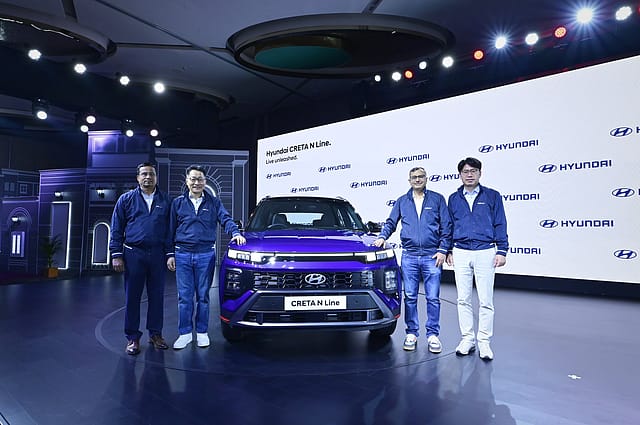
It’s been an astonishing year for the Hyundai Creta.
With sales of over 200,000 units a year, the Creta has become the first vehicle in the country's fast-growing midsize SUV segment to reach those figures. That works out to sales of almost 550 vehicles a day for a car that retails at an average price of about Rs 16 lakh. The numbers are significant, especially since these sales figures have historically been the forte of smaller vehicles, which cost significantly less.
For instance, the Tata Punch, which retails between Rs 5.5 lakh and Rs 10 lakh, had sold about 200,000 vehicles in 2024. The Maruti Suzuki Dzire, which sells about 200,000 units a year, is priced below Rs 9.5 lakh. Creta, however, retails between Rs 10.5 lakh and Rs 20 lakh, with on-road prices for the vehicle going up to Rs 25 lakh for the top variant.
“Creta is also the highest-selling SUV of our country on a cumulative basis from 2020-2025,” Tarun Garg, the newly appointed Indian CEO of Hyundai Motors India, said in a statement. “The brand’s momentum also reflects in the rise of first-time buyers - from 13% in 2020 to an impressive 32% in 2025.”
Today, as much as 44 percent of Cretas sold in the country are diesel, and 32 percent of buyers are first-time buyers. The car is sold in 70 variants across multiple powertrains, including diesel, petrol, and electric. In fact, amid a crisis at Hyundai—losing the second spot in India’s automotive market—the Creta remains a silver lining.
“Hyundai India’s ‘Creta magic’ isn’t about one great product,” Vinay Piparsania, founder and principal of MillenStrat Advisory & Research and a former executive director at Ford India, says. “It’s about consistently understanding the Indian consumer better than most. Creta combines aspiration with practicality, emotional design with everyday usability, and premium positioning with value.”
A big market
India’s mid-size SUV segment has seen increasing competition in recent years, with the likes of Kia, Maruti Suzuki, Toyota, Renault, Tata, and Skoda among others vying for sales in the fast-growing segment. Despite that, Creta has remained the largest in the mid-size SUV segment, with a 34 percent market share. Last month, in what’s seen as a testimony to the fastest-growing nature of the midsize SUV segment, Tata Motors launched the Tata Sierra, which mopped up over 70,000 bookings in a single day.
The Tata Sierra is available in seven variants, priced from Rs 11.49 lakh to Rs 21.29 lakh. “Hyundai built an ecosystem around the Creta with powertrain choice, frequent refresh cycles, tech-led features, strong after-sales confidence, and powerful brand storytelling,” adds Piparsania. “As the market shifts to connected, safer, higher-tech mobility, Hyundai must now reinforce Creta as the benchmark for modern Indian SUVs- smarter, more efficient, and more experiential. If Hyundai keeps anticipating the next need before consumers articulate it, Creta will remain less of a model and more of a franchise brand.”
India’s mid-size SUV segment is one of the most lucrative, with margins significantly higher than in the compact SUV segment. The Mid-size SUV category accounts for about one-fourth of all SUV sales in the country, with the Creta and Kia Seltos accounting for about half of the segment's sales. 2026 promises further action in the segment with the launch of Kia’s new Seltos, Renault’s new Duster, and Maruti Suzuki’s Victoris.
Can it continue the momentum?
For Creta, which has been around for 10 years, the next few years will undoubtedly be crucial, as competition intensifies. Hyundai has sold over 1.3 million Cretas in India since it launched a decade ago.
In its first year in 2015, the Creta sold about 40,888 units, which more than doubled to over 90,000 units by 2016. In 2024, Hyundai sold about 186,919 Cretas, which has since grown to over 200,000 in 2025. Much of its success is also due to frequent reinvention: the model is now in its second generation, with multiple product refreshes, and offers features such as ADAS, ventilated seats, a sunroof, and wireless charging, among others. “Aspirations of Creta customers have also evolved over the years, with sunroof-equipped variants contributing more than 70% of CRETA’s sales in 2025,” adds Garg.
Although Hyundai does not offer a hybrid version of the Creta, the company is reportedly working on a Hybrid variant for the next-generation Creta. “In many ways, the biggest risk for Hyundai is believing its own success story,” says Piparsania. “Creta cannot be allowed to drift into complacency. India doesn’t reward arrogance—whether in pricing, over-complication, or cosmetic theatrics. Hyundai must resist the urge to over-tinker, over-segment, or over-style the Creta. The SUV must continue to stand for substance, refinement, credibility—and leadership without hubris.”
With its market share coming under pressure from homegrown automakers, Hyundai has already announced a strategic investment plan of Rs 45,000 crores through FY2030. The company is now gearing up to launch 26 new products, including seven new nameplates, with entries into the MPV and off-road SUV segments, alongside India's first locally manufactured dedicated electric SUV by 2027 and the launch of the luxury brand Genesis in India in the same year.
The slew of investments, Hyundai reckons, will help it achieve a 15 percent market share, with as much as 80 percent of its portfolio contribution from utility vehicles and more than 50 % powered by eco-friendly technologies like CNG, EVs, and hybrids. In addition, favourable government policies, including the recent decision to reduce vehicle taxes, are expected to keep sales ticking in the world’s third-largest automotive market. India is the world’s third-largest passenger vehicle market, but car penetration remains at around 30 per 1000 people.
“HMIL stands out for its strategic investments aimed at scaling revenue and product diversification,” brokerage firm ICICI Direct said in a report. “It’s roadmap to achieve 1.5x revenue growth, combined with disciplined margin management and expanding market share, supports a compelling growth outlook.”
And, in all likelihood, with its success behind it, Hyundai is sure to turn to the Creta as it gets ready to take on the fight for the second position in the Indian car market.