
Audi’s new Q3 is more than a new SUV; it is the first test of the brand’s India comeback
ADVERTISEMENT
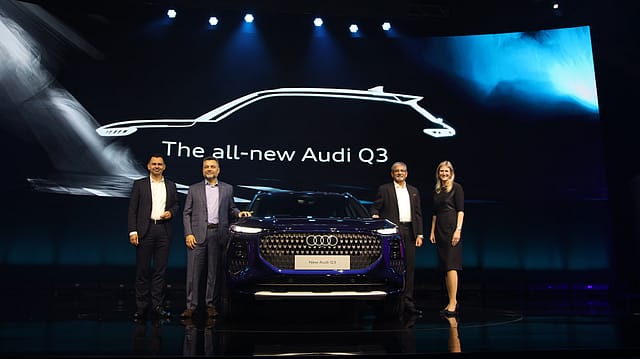
A little over a decade ago, Audi was India’s largest luxury carmaker, crossing the 10,000-unit annual sales mark in 2013. Since then, its position has steadily weakened. The company sold 7,931 cars in 2023, 5,816 in 2024 and just 4,510 in 2025—a decline of about 43% in two years. Its 2025 volumes were also roughly 55% below the 10,002 units it sold in 2013. The decline has come even as India’s luxury-car market has expanded, leaving Audi behind rivals such as Mercedes-Benz and BMW and forcing the German carmaker to rethink how it wins customers in India.
That makes the third-generation Q3 more than another product introduction. It is arguably the first major test of the company’s attempt to regain lost ground.
Part of Audi’s challenge has also been its product cycle. Balbir Singh Dhillon, head of Audi India, acknowledged that some of the company’s products had reached the end of their life cycles, while supply constraints created further gaps in the portfolio. “Some of our products have been towards the end of their life cycle. Eventually, there is no more supply of those cars,” Dhillon tells Fortune India.
He says the strategy rests on three things—products, a deeper presence across India and customer experience. “The idea is to double our market share from where we are today in three to five years,” Dhillon said.
Audi also plans to deepen its retail footprint. From the current 28 new-car showrooms, the company plans to reach 40 by the end of next year and more than 50 by 2030, with tier-II and tier-III cities forming an important part of the expansion.
But the Q3 may be the most important product in that strategy, because Audi sees it as a car that can bring a new kind of buyer into the brand.
Audi sees the Q3 as a gateway for first-time luxury buyers
Audi’s own customer analysis shows why the Q3 matters. Dhillon said 85% of Q3 customers told the company that they had driven the car themselves, with many of them being first-time luxury buyers. “When they spend that kind of money, for the first time, they would want to drive the car, not sit in the back.”
The Q3 is also showing signs of being more than a one-time purchase for some customers. Around 14% of Q3 buyers went on to buy another Q3, either for another family member or as an additional car. “The purpose of this car is to solve for diversity in the family when it comes to comfort, convenience and safety,” Dhillon said.
The shift is also visible in Audi’s variant mix. Dhillon said the top trim now accounts for around 55% of buyers, while the entry-level version is about 10%, suggesting customers are increasingly paying for more equipment rather than simply seeking the cheapest entry point. “The customer no longer wants just the price point to enter the car… we need to have more equipment loaded on our cars,” he said.
Audi expects the Q3 to account for around 25–30% of its volumes in a normal year when the full portfolio is available.
The recovery, however, is taking place against a challenging cost environment for luxury carmakers. Dhillon identified the depreciation of the rupee as a bigger immediate concern than demand, given the industry’s dependence on imported vehicles and components. That makes local assembly important for both pricing and the economics of Audi’s India business.
From metros to tier-II and tier-III cities
Audi’s strategy is also tied to how the company plans to expand beyond India’s traditional luxury-car markets. Dhillon said the post-pandemic period has changed where affluent customers live and how they think about mobility, creating opportunities for luxury brands beyond the biggest cities. According the Dhillon, the luxury car space is projected to hit around 58,000 units, which is nearly three times more than the market size in 2020.
Audi currently has 28 new-car outlets and 41 workshops. Dhillon said the company has followed a workshop-first approach in smaller markets because service creates a more regular customer touchpoint. “We have always followed a workshop-first approach,” he said.
The customer base itself has also widened over the years, moving from traditional business owners to professionals, startup founders and younger first-time luxury buyers. “What has changed over time is owning a product to experiencing. So it’s now ownership experience, not just ownership,” he added.
Audi’s next bet: localised EVs
The new Q3 is being launched with a petrol powertrain, but Audi’s longer-term India strategy will also include electric vehicles. “We are working on BEVs as well,” Dhillon said. “BEV is something new for us, and we are looking at local assembly there as well. That is important because that gives us the right price.” A locally assembled electric vehicle could help the company address the pricing challenge that has limited the appeal of imported EVs in the market.
The timeline for the locally assembled BEV has not yet been disclosed, with Dhillon indicating that approvals are still required.
For now, however, the Q3 is the immediate test.